Whole-Body Immune Responses Visualized in Real Time as Immuno-PET Advances Cancer Monitoring
A preclinical imaging approach demonstrates how systemic immune activation during cancer virotherapy can be tracked dynamically across the body rather than through static tumor assessment.
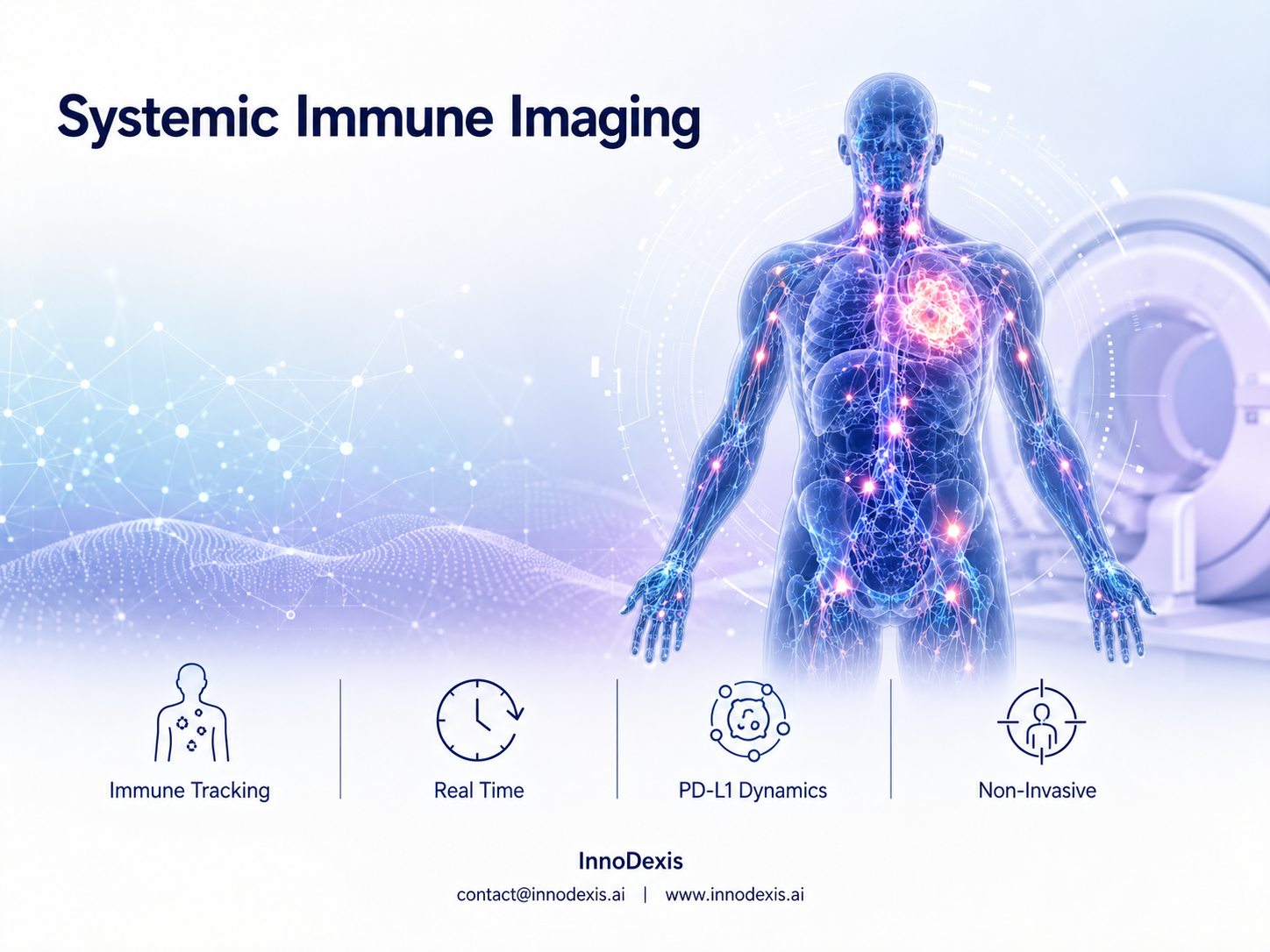
InnoDexis has published its latest Innovation Intelligence Report covering immuno-oncology imaging innovation, analyzing recent preclinical research from Institute of Cancer Research focused on immuno-PET imaging and systemic immune monitoring. The report reveals that researchers successfully visualized whole-body immune responses to cancer virotherapy in real time, including immune activation beyond the primary tumor site. The findings indicate a transition from static biopsy-driven assessment toward longitudinal immune tracking, with implications for how cancer therapies may be timed, combined, and personalized in future oncology systems.
Key Findings
Researchers at Institute of Cancer Research demonstrated an immuno-PET imaging approach capable of visualizing systemic immune responses during cancer virotherapy. The technique enabled researchers to monitor immune activity across the body in real time rather than relying solely on localized tumor analysis.
Whole-body immune activation was detected beyond the primary tumor site following treatment. This finding suggests that localized therapeutic interventions may trigger broader systemic immune cascades that are not fully observable through conventional imaging or biopsy-driven assessment methods.
The study identified dynamic changes in PD-L1 expression over time. PD-L1 levels increased within three days following treatment and declined by day seven, indicating that immune responses may evolve rapidly during therapy and require time-sensitive monitoring approaches.
Non-invasive immuno-PET imaging enabled repeated longitudinal monitoring without the need for invasive procedures. This capability supports continuous observation of immune dynamics and may improve understanding of how treatment responses change during therapeutic cycles.
The imaging system successfully tracked responses to the oncolytic virus therapy RP1. This demonstrates the potential for integrating immune imaging with virotherapy-based treatment models, particularly in combination immunotherapy environments where timing and sequencing are increasingly important.
Strategic Insight and Trend Analysis
The findings indicate a broader shift in oncology from static treatment assessment toward dynamic immune-system monitoring. Traditional cancer evaluation methods often rely on biopsies or isolated imaging snapshots that provide limited visibility into how immune responses evolve throughout treatment. The immuno-PET approach instead focuses on tracking immune activity longitudinally and systemically.
This transition reflects growing recognition that cancer therapies increasingly depend on coordinated immune behavior rather than isolated tumor reduction alone. The ability to monitor immune activation across the body introduces the possibility of optimizing treatment timing, sequencing, and combination strategies based on real-time biological responses.
The observed fluctuation in PD-L1 expression within days of treatment further reinforces the importance of temporal monitoring. Rather than treating immune markers as static indicators, the data suggests that immune states may change rapidly during therapy and could influence when interventions are most effective.
The successful monitoring of responses to RP1 oncolytic virus therapy also points toward a convergence between imaging systems and immunotherapy platforms. As combination therapies become more common, tools capable of visualizing systemic immune cascades may become increasingly important in treatment design and clinical decision-making.
Although the work remains preclinical, the findings suggest that future oncology systems may place greater emphasis on continuously tracking immune coordination rather than periodically measuring tumor size alone. This represents a structural shift in how treatment response may ultimately be evaluated and managed.
Global and Industry Implications
For corporates and R&D teams, the findings highlight growing demand for integrated oncology platforms that combine imaging, immunotherapy, and longitudinal monitoring capabilities. Companies developing cancer therapies may increasingly require tools that provide real-time visibility into systemic immune behavior.
For investors and capital allocators, the emergence of immune-tracking technologies indicates potential opportunities in platforms that support adaptive treatment optimization. Solutions enabling dynamic monitoring may become strategically important as combination immunotherapies expand.
For policymakers and national innovation bodies, advances in non-invasive immune imaging may influence future clinical evaluation frameworks and oncology infrastructure priorities. Supporting translational validation and imaging accessibility could become increasingly relevant as personalized treatment systems evolve.
InnoDexis Statement
“Real-time visualization of systemic immune responses signals a transition from static oncology assessment toward adaptive treatment monitoring, where understanding immune coordination may become as important as measuring tumor reduction,” noted InnoDexis in its latest intelligence report.
Conclusion
The preclinical immuno-PET research conducted at Institute of Cancer Research demonstrates how systemic immune activity during cancer therapy may be monitored dynamically across the body. By enabling longitudinal observation of immune responses, the approach introduces new possibilities for optimizing treatment timing, sequencing, and personalization. Human validation will represent the next critical phase in determining clinical applicability and scalability. The complete Immuno-Oncology Imaging Intelligence Report is available to InnoDexis subscribers and enterprise clients.
About InnoDexis
InnoDexis is a global Innovation Intelligence platform that tracks, analyzes, and interprets breakthrough innovations, prototypes, and emerging technologies across industries and countries. Its intelligence helps corporates, investors, and policymakers understand the true structure and direction of global innovation. Learn more at innodexis.ai.