Wearable Two-Sticker Device Delivers Cystic Fibrosis Diagnosis Without Laboratory Infrastructure as Smartphone-Based Testing Emerges
CF SWIFT, developed by researchers at Lurie Children's Hospital and Northwestern University, demonstrated high correlation to standard sweat chloride testing across 55 participants while eliminating the need for specialised laboratory equipment.
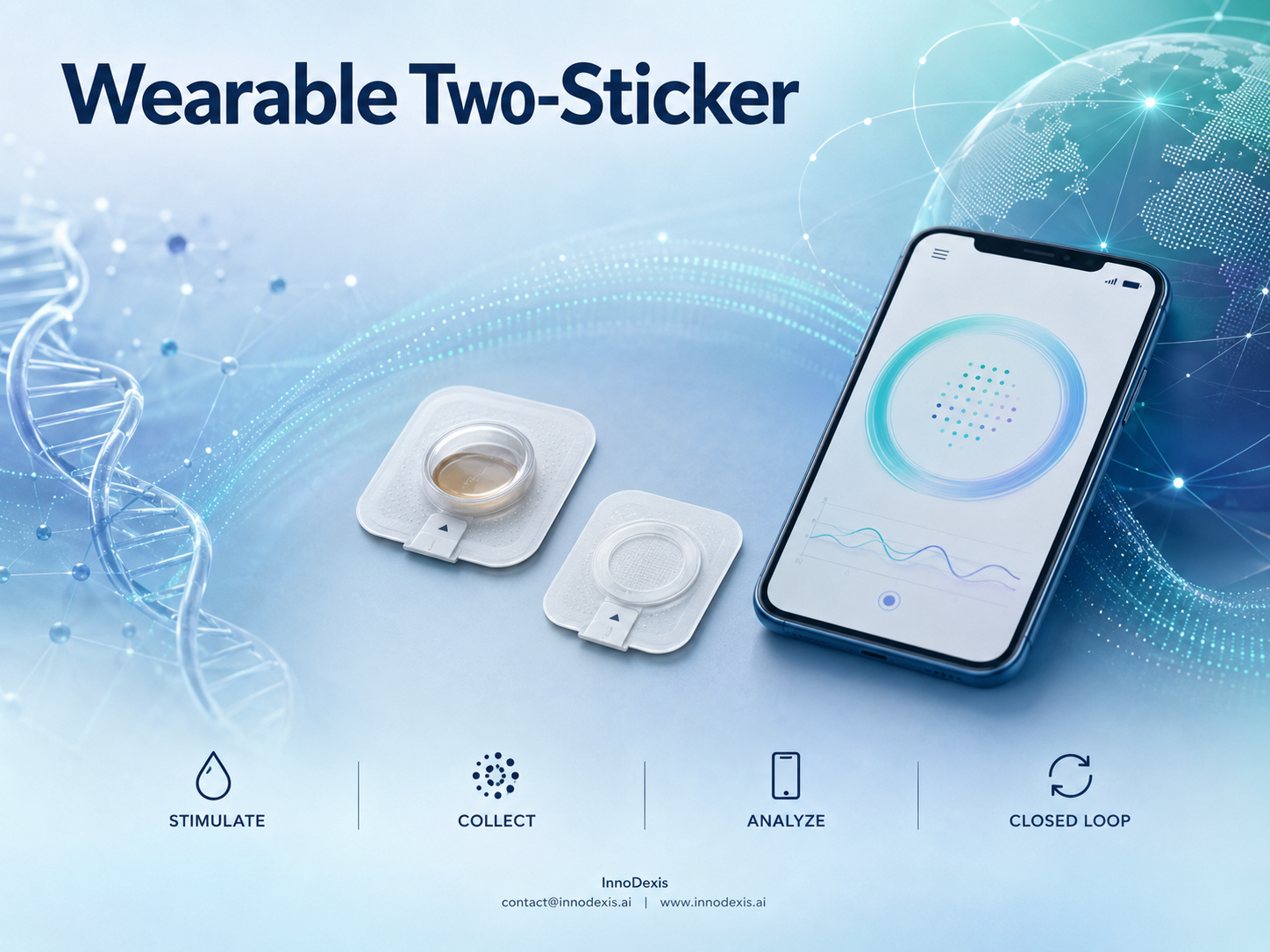
InnoDexis has published its latest Innovation Intelligence Report covering wearable diagnostic technology for rare disease detection, analyzing a high-significance innovation developed at Lurie Children's Hospital and Northwestern University. The report reveals that researchers have developed CF SWIFT — a two-sticker wearable system that stimulates and collects sweat for chloride analysis without specialised equipment, with results read through a smartphone application using colorimetric image analysis. The innovation directly addresses the diagnostic access gap that leaves an estimated half of people with cystic fibrosis worldwide undiagnosed.
Key Findings
CF SWIFT demonstrated high correlation to standard sweat chloride testing across a 55-participant study. This performance benchmark against the established diagnostic standard is the foundational clinical signal in the dataset, establishing that the wearable system produces results comparable to laboratory-based sweat testing without requiring the infrastructure that laboratory testing depends upon.
The system operates through a two-sticker architecture — one sticker stimulates sweat production and a second collects the sweat sample for chloride analysis. This separation of functions into a flexible, skin-mounted format eliminates the procedural and equipment dependencies of conventional sweat chloride testing, replacing them with a self-contained wearable format that requires no specialised clinical setting for administration.
A smartphone application reads diagnostic results through colorimetric image analysis of the collected sweat sample, removing the need for laboratory instrumentation entirely. This shifts the diagnostic constraint from laboratory availability to smartphone availability — a meaningful distinction in regions where mobile device penetration significantly exceeds access to specialised medical infrastructure.
The small and flexible design of CF SWIFT is explicitly noted as gentle enough for use on infants. This design specification is clinically significant: cystic fibrosis diagnosis at the earliest possible age is directly associated with improved health outcomes, and the ability to administer the test to infants without laboratory access expands the window and geography of early diagnosis substantially.
Half of people with cystic fibrosis worldwide remain undiagnosed, according to the dataset. This figure defines the scale of the access problem that CF SWIFT is designed to address. Diagnostic access — not treatment availability — is identified in the dataset as the binding constraint in managing cystic fibrosis globally, a framing that has direct implications for how health systems, funders, and policymakers should prioritise diagnostic infrastructure investment.
Strategic Insight and Trend Analysis
The CF SWIFT innovation represents a structural shift in the model of rare disease diagnosis — from a laboratory-anchored, infrastructure-dependent process to a point-of-care model deployable wherever a smartphone is available. This transition is significant not because wearable diagnostics are new as a concept, but because the dataset documents a device that has validated performance against the clinical standard, operates on infants, and removes every infrastructure dependency simultaneously.
The strategic reframing embedded in this dataset is precise: the primary barrier to cystic fibrosis diagnosis in underserved regions is not the absence of treatment or clinical knowledge — it is the absence of testing access. CF SWIFT addresses that specific constraint directly. This matters because it repositions the diagnostic gap as a solvable engineering and distribution problem rather than an intractable healthcare infrastructure challenge.
The broader implication extends beyond cystic fibrosis. The dataset explicitly raises the question of how many other rare diseases share the same bottleneck — where diagnosis, not treatment, is the binding constraint — and whether the same wearable colorimetric model could be applied across that disease class. This is a directional signal for the wearable diagnostics field as a whole: the design principles demonstrated in CF SWIFT — skin-mounted stimulation, passive collection, smartphone readout — constitute a replicable architecture that is not inherently disease-specific.
The shift from laboratory to smartphone as the enabling infrastructure for diagnostic access is also a signal about where innovation investment in global health diagnostics is heading. Platforms that leverage existing consumer device penetration rather than requiring new clinical infrastructure investment carry a fundamentally different deployment economics and adoption curve.
Global and Industry Implications
For corporates and R&D teams in medical devices and digital health, CF SWIFT demonstrates a validated design architecture for smartphone-integrated wearable diagnostics that combines sweat stimulation, sample collection, and colorimetric analysis in a single patient-facing system. Organisations developing point-of-care diagnostics for other rare or chronic diseases should examine whether the two-sticker stimulation-collection model and smartphone readout pathway are transferable to their target disease areas.
For investors and capital allocators, the innovation signals continued commercial opportunity at the intersection of wearable technology, rare disease diagnostics, and digital health infrastructure. The 55-participant validation study represents an early-stage clinical signal — the translational pathway to regulatory clearance and commercial deployment will require further study — but the performance correlation to the standard of care and the infant-safe design profile strengthen the investability of the underlying platform concept.
For policymakers and national innovation bodies, the dataset highlights diagnostic access — not therapeutic access — as the primary policy lever for improving cystic fibrosis outcomes in underserved regions. Procurement and reimbursement frameworks that prioritise point-of-care diagnostic tools with smartphone readout capability could substantially reduce the undiagnosed population at comparatively low infrastructure cost.
InnoDexis Statement
"CF SWIFT reframes cystic fibrosis diagnosis as a distribution and access challenge rather than a clinical infrastructure requirement — a structural shift that, if validated at scale, carries implications for rare disease diagnostic strategy well beyond a single condition," noted InnoDexis in its latest intelligence report.
Conclusion
As the global burden of undiagnosed rare diseases becomes increasingly recognised as a tractable problem rather than an inevitable one, wearable diagnostic platforms that leverage smartphone infrastructure represent a meaningful advance in the tools available to address it. CF SWIFT's validation against the standard sweat chloride test, combined with its infant-safe design and smartphone readout capability, positions it as a model worth monitoring as it progresses toward broader clinical validation. InnoDexis will continue tracking developments in wearable diagnostics, point-of-care rare disease testing, and smartphone-integrated health platforms. The complete Wearable Diagnostics Innovation Intelligence Report is available to InnoDexis subscribers and enterprise clients.
About InnoDexis
InnoDexis is a global Innovation Intelligence platform that tracks, analyzes, and interprets breakthrough innovations, prototypes, and emerging technologies across industries and countries. Its intelligence helps corporates, investors, and policymakers understand the true structure and direction of global innovation. Learn more at innodexis.ai.