United States Leads Optical Chirality Innovation as Chip-Scale Dynamic Control Emerges
A single Harvard SEAS breakthrough demonstrates the first reconfigurable, chip-scale platform for real-time optical chirality control, signaling a new direction for photonics and sensing technologies.
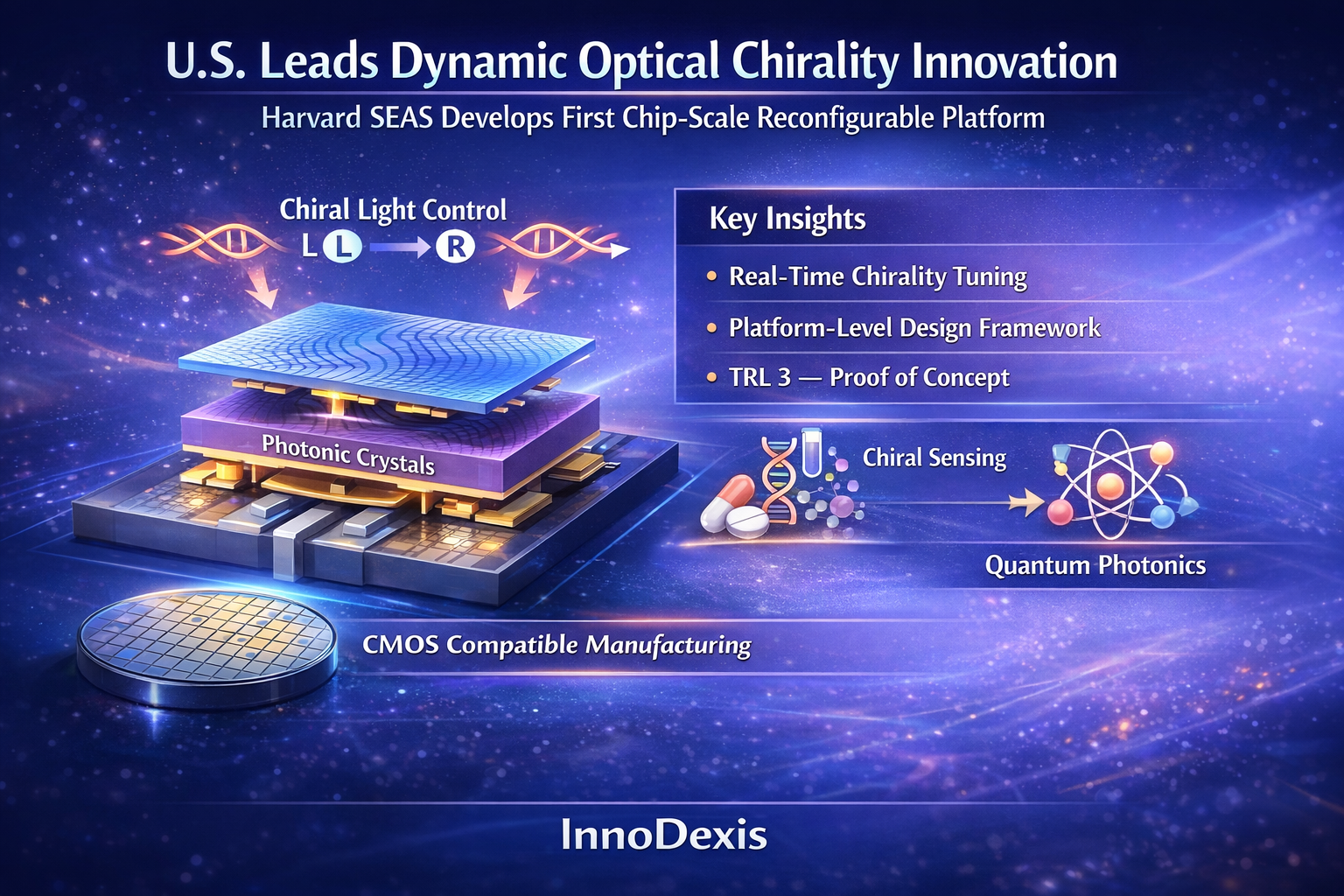
InnoDexis has published its latest Innovation Intelligence Report covering optical chirality and photonic systems, analyzing 1 innovation across 1 country during March 2026. The report reveals that chip-scale, dynamic control of optical chirality has now been demonstrated for the first time through a MEMS-actuated twisted bilayer photonic crystal platform developed at Harvard SEAS. This proof-of-concept innovation establishes a new architectural approach to manipulating the ‘handedness’ of light in real time, integrating twistronics, photonic crystals, and MEMS into a single manufacturable system with implications across sensing, communications, and quantum photonics.
KEY FINDINGS
The first chip-scale platform for dynamic optical chirality control has been demonstrated. Unlike existing static optical systems, the Harvard SEAS device enables real-time, continuous tuning of chirality without replacing components. This represents a fundamental shift from fixed-function optics to reconfigurable photonic systems.
The innovation converges three previously independent technology domains—twistronics, photonic crystal engineering, and MEMS actuation—into a unified device architecture. This cross-domain integration enables chirality control through geometric configuration and mechanical tuning rather than relying on specialized materials.
Performance approaches theoretical limits for chiral light discrimination. The device demonstrates near-maximum selectivity between left- and right-handed light modes at the proof-of-concept stage, indicating that performance gains are not incremental but structurally significant.
Manufacturing compatibility is explicitly confirmed. The system is built using silicon nitride and standard photonics fabrication processes, indicating that no new infrastructure is required for scaling, a critical factor for commercialization pathways.
The innovation is currently positioned at TRL 3, with a working prototype validated in laboratory conditions. However, progression to higher TRLs will require validation in complex environments such as biochemical sensing systems and integrated photonic circuits.
A general design framework—not just a single device—has been introduced. This positions the innovation as a platform-level contribution with broader applicability across future photonic device families.
STRATEGIC INSIGHT AND TREND ANALYSIS
The dataset indicates the emergence of a new sub-field best understood as photonic twistronics—the translation of twist-induced symmetry control from electronic materials into photonic systems. This shift is structurally significant because it changes how optical properties are engineered: from material-dependent effects to geometry-driven, mechanically tunable configurations.
At a systems level, the innovation reflects a broader trend toward convergence-driven device architectures. Twistronics provides the physics mechanism, photonic crystals provide light confinement, and MEMS enables real-time tunability. The resulting system is not an incremental improvement within a single domain but a recombination of capabilities that creates a new functional category—reconfigurable chirality platforms.
This convergence also shifts photonics closer to software-defined paradigms seen in electronics, where functionality can be dynamically adjusted rather than fixed at fabrication. The ability to continuously tune both twist angle and interlayer spacing introduces a multi-dimensional control space that did not previously exist in optical systems.
Importantly, the innovation demonstrates that high-performance optical control can be achieved using CMOS-compatible materials, aligning advanced photonic functionality with existing industrial manufacturing ecosystems. This reduces the typical lag between laboratory discovery and industrial deployment.
Collectively, the findings point to a transition from static photonic components to adaptive, platform-based photonic systems with cross-industry applicability.
GLOBAL AND INDUSTRY IMPLICATIONS
For corporates and R&D teams, particularly in pharmaceuticals and photonics, the findings indicate a shift toward tunable, chip-scale sensing and modulation platforms. Early engagement—especially at TRL 3–4—will be critical to influence application-specific validation and secure advantageous licensing positions.
For investors and capital allocators, the innovation presents a platform IP opportunity with multi-market exposure, spanning pharmaceutical sensing, photonic integrated circuits, and quantum photonics. The combination of manufacturing compatibility and a clearly defined addressable market increases the likelihood of spinout formation within a short-to-medium timeframe.
For policymakers and national innovation bodies, the report highlights the strategic importance of supporting convergence-driven research at the intersection of physics, engineering, and life sciences. Optical chirality, particularly in pharmaceutical contexts, has direct implications for safety and regulatory oversight, reinforcing the need for funding mechanisms that accelerate validation and deployment.
INNODEXIS STATEMENT
“Dynamic control of optical chirality at chip scale signals a structural transition from static photonic components to reconfigurable platform technologies with cross-sector implications,” noted InnoDexis in its latest intelligence report.
CONCLUSION
The March 2026 breakthrough marks an early but structurally important milestone in optical photonics. While the technology remains at proof-of-concept stage, its convergence-driven architecture, manufacturing compatibility, and platform-level design framework position it for rapid progression toward applied systems. The next phase to monitor will be validation in real-world environments, particularly in pharmaceutical sensing and photonic integrated circuits. As this field evolves, InnoDexis will continue to track developments in photonic twistronics and adaptive optical systems. The complete Optical Chirality & Photonic Systems Innovation Intelligence Report is available to InnoDexis subscribers and enterprise clients.
ABOUT INNODEXIS
InnoDexis is a global Innovation Intelligence platform that tracks, analyzes, and interprets breakthrough innovations, prototypes, and emerging technologies across industries and countries. Its intelligence helps corporates, investors, and policymakers understand the true structure and direction of global innovation. Learn more at innodexis.ai.