United States and Canada Advance Quantum Materials Research as Magnetic Topological Systems Gain Strategic Relevance for Future AI Computing
A new research roadmap from the University of Ottawa and MIT suggests magnetic topological materials could become a foundational pathway toward lower-energy, high-efficiency computing architectures.
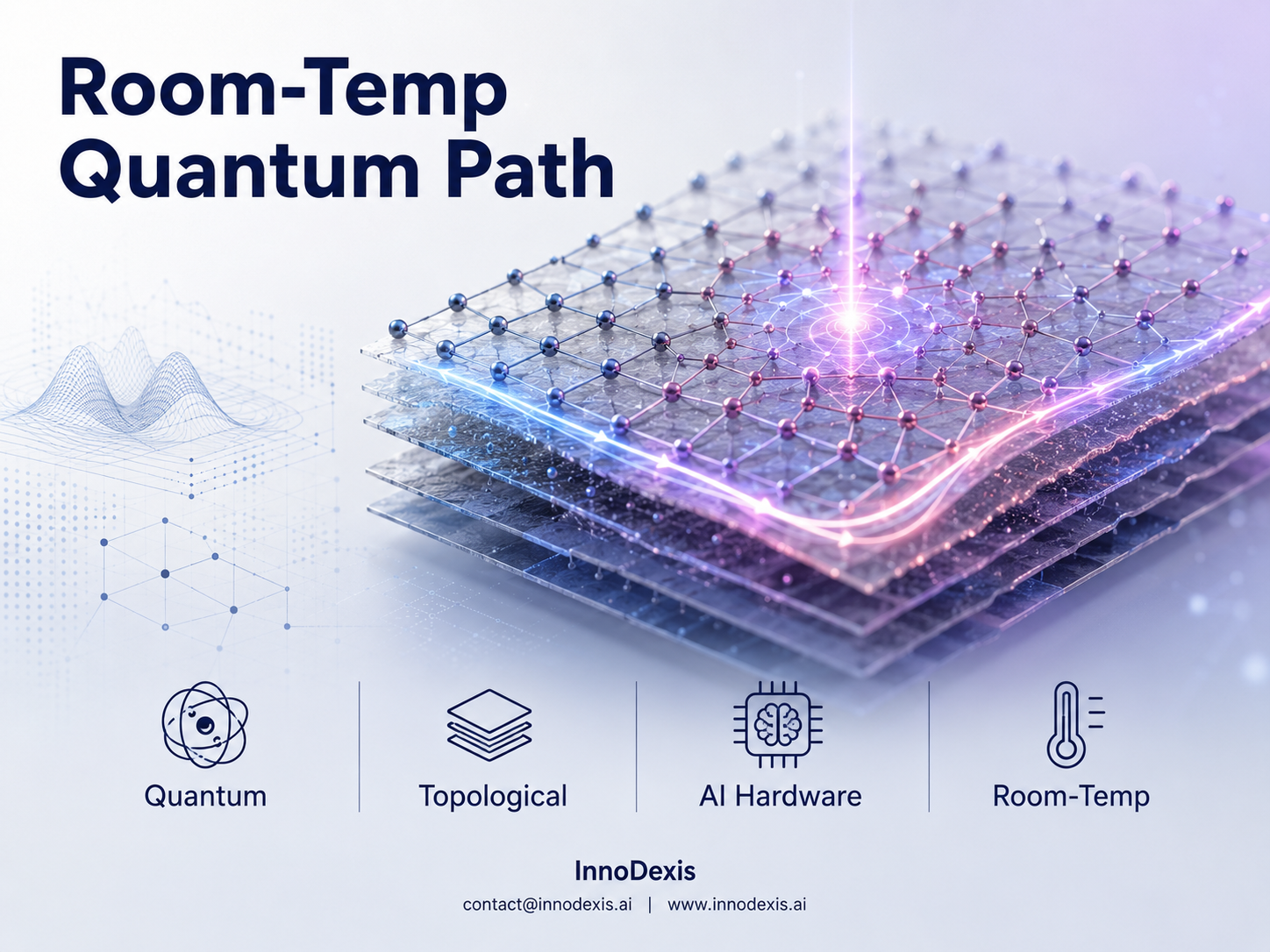
InnoDexis has published its latest Innovation Intelligence Report covering magnetic topological materials and next-generation computing architectures, analyzing emerging developments in quantum-enabled material systems and low-energy information transport. The report reveals that researchers from the University of Ottawa and the Massachusetts Institute of Technology have outlined a long-term roadmap for magnetic topological materials capable of supporting ultra-efficient electronic behavior with minimal energy loss. The findings indicate that future advances in AI infrastructure, memory systems, and neuromorphic computing may increasingly depend on discovering and engineering quantum materials capable of operating under practical conditions, including at room temperature.
Key Findings
The report identifies magnetic topological materials as an increasingly important research domain in future computing infrastructure. Researchers reviewed more than two decades of global scientific work examining how these materials conduct electrical current along their surfaces or edges with extremely low energy dissipation. This behavior differs fundamentally from conventional electronic transport mechanisms and may support significantly more energy-efficient computing systems.
Another major finding concerns the potential use of these materials in non-volatile memory technologies. Researchers highlighted that magnetic topological systems could retain stored information even when electrical power is removed, reducing continuous energy requirements associated with modern memory architectures. Such capabilities may become increasingly important as AI systems require larger-scale data storage and continuous computational operation.
The report also highlights the growing relevance of magnetic topological materials for AI hardware and neuromorphic computing systems. Researchers suggest that these materials may enable new chip architectures designed to process information more efficiently while reducing thermal losses and power consumption. This could prove significant as current semiconductor scaling approaches encounter increasing physical and thermal limitations.
A further finding involves the integration of AI-assisted material discovery methods into quantum materials research. Artificial intelligence is increasingly being used to identify promising material combinations, predict quantum behaviors, and accelerate experimental discovery cycles. Researchers also identified engineered layered material structures as an important development pathway for improving material performance and stability.
The report additionally notes that many of these material systems currently operate only under extremely low-temperature conditions, creating a major challenge for practical deployment. As a result, global research efforts are increasingly focused on discovering room-temperature quantum materials capable of supporting stable and scalable operation for commercial computing applications.
Strategic Insight and Trend Analysis
The broader significance of these findings reflects a structural transition in the future direction of computing research. The report suggests that the industry is gradually moving beyond an exclusive focus on transistor miniaturization toward the search for entirely new physical mechanisms capable of supporting information processing and data storage.
For decades, computing performance improvements were driven primarily through semiconductor scaling and denser chip architectures. However, rising energy demands, thermal constraints, and physical miniaturization limits are increasingly challenging the sustainability of existing approaches. Magnetic topological materials represent one possible pathway toward overcoming these limitations by enabling near-lossless electronic transport and alternative forms of computational architecture.
The convergence of quantum physics, topology, materials science, and artificial intelligence is also becoming increasingly significant. Rather than advancing through isolated scientific disciplines, future computing breakthroughs may emerge from highly interdisciplinary research ecosystems combining material engineering, quantum behavior modeling, AI-assisted discovery, and photonic or spin-based information systems.
The focus on room-temperature operation is particularly important because it represents the transition point between laboratory-scale physics and scalable industrial deployment. Many quantum materials demonstrate highly promising properties under specialized conditions but remain impractical for mainstream computing environments. The current research emphasis therefore centers not only on discovering novel materials, but on engineering systems capable of stable performance under commercially viable operating conditions.
Collectively, the findings indicate that future AI infrastructure may increasingly depend on breakthroughs in material physics as much as advances in software algorithms or chip fabrication processes. The long-term competitive landscape of computing could therefore be shaped by the ability to discover and industrialize entirely new classes of quantum-enabled materials.
Global and Industry Implications
For corporates and R&D teams, the findings reinforce the growing importance of advanced materials research within future computing strategies. Semiconductor companies, AI infrastructure developers, and electronics manufacturers may increasingly need to integrate quantum materials expertise into long-term product development and hardware innovation programs.
For investors and capital allocators, the report highlights expanding strategic opportunities across quantum materials, spintronics, low-power computing systems, and AI hardware infrastructure. As computational energy demand continues to rise globally, technologies capable of improving efficiency at the material level may attract increasing long-term commercial and strategic interest.
For policymakers and national innovation bodies, the findings emphasize the importance of sustained investment in quantum science, semiconductor research, and advanced materials ecosystems. Countries seeking technological competitiveness in AI and next-generation computing may increasingly prioritize domestic capabilities in quantum materials discovery, fabrication infrastructure, and interdisciplinary research collaboration.
InnoDexis Statement
“The future performance and sustainability of advanced computing systems may increasingly depend on discovering new material-level mechanisms for information transport, storage, and energy efficiency,” noted InnoDexis in its latest intelligence report.
Conclusion
The University of Ottawa and MIT roadmap suggests that magnetic topological materials may become increasingly important in the search for future computing architectures capable of overcoming current energy and performance constraints. As AI systems continue driving global computational demand, research into low-loss quantum materials and alternative information transport mechanisms is likely to accelerate. The long-term challenge will center on translating promising quantum behaviors from laboratory environments into scalable room-temperature technologies suitable for commercial deployment. InnoDexis will continue monitoring developments in quantum materials, AI hardware systems, and next-generation semiconductor innovation shaping the future of computing infrastructure. The complete Magnetic Topological Materials and Future AI Infrastructure Intelligence Report is available to InnoDexis subscribers and enterprise clients.
About InnoDexis
InnoDexis is a global Innovation Intelligence platform that tracks, analyzes, and interprets breakthrough innovations, prototypes, and emerging technologies across industries and countries. Its intelligence helps corporates, investors, and policymakers understand the true structure and direction of global innovation. Learn more at innodexis.ai.