Ultrafast Electron Transfer Observed in 18 Femtoseconds Signals New Design Principles for Solar Energy Materials
Research from the University of Cambridge shows that molecular vibrations can drive directional electron motion, challenging long-standing assumptions in organic solar material design.
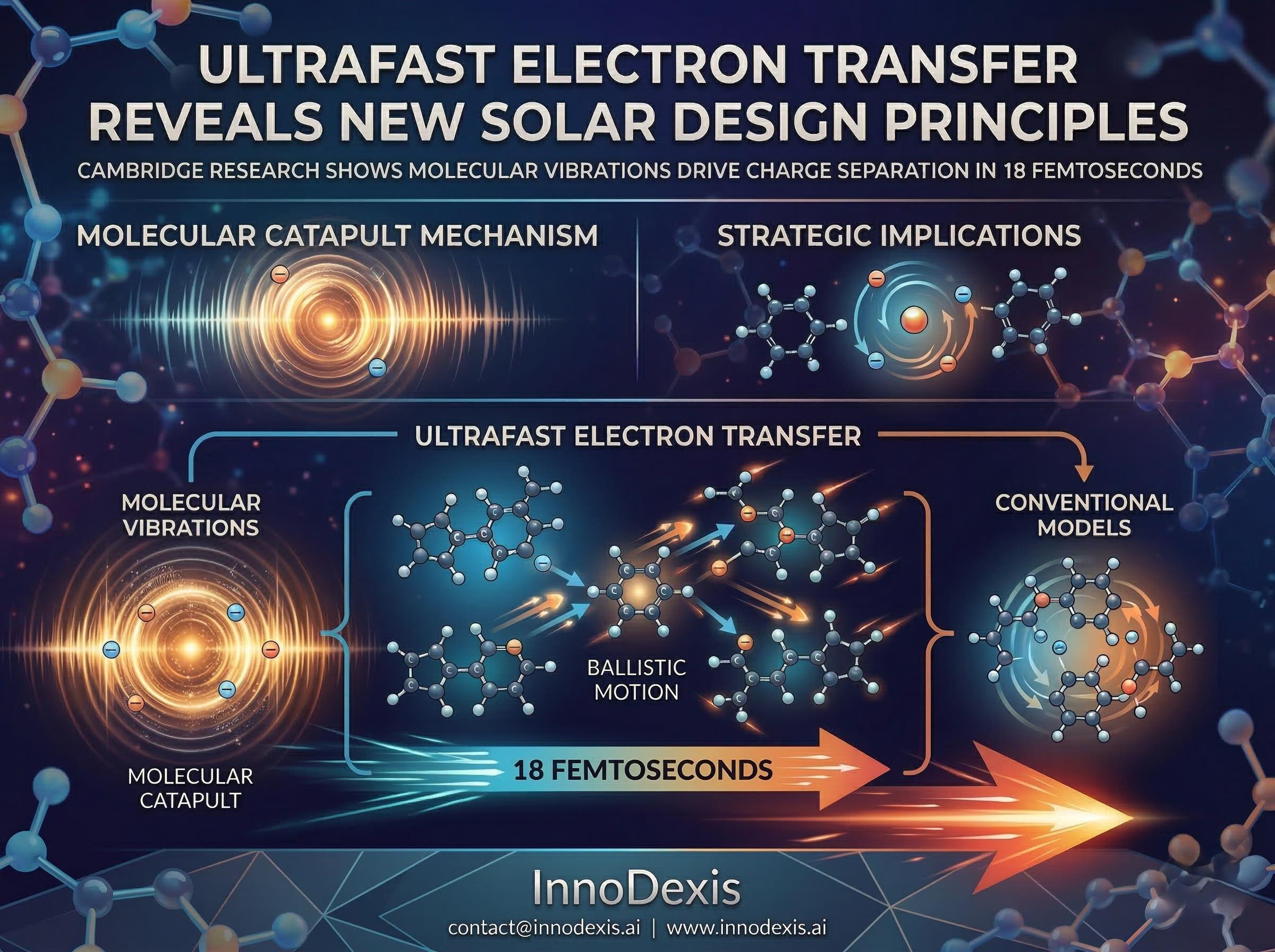
InnoDexis has published its latest Innovation Intelligence Report covering ultrafast charge dynamics in solar energy materials, analyzing recent research into electron transfer mechanisms within organic systems. The report reveals that researchers at the University of Cambridge observed electrons moving across molecules in just 18 femtoseconds in an organic solar material system. The findings indicate that atomic vibrations within molecules can actively drive charge separation rather than hinder it. This mechanism suggests new design principles for light-harvesting materials used in solar cells, photodetectors, and photocatalytic systems for hydrogen fuel production.
Key Findings
Researchers at the University of Cambridge have measured electron transfer across molecules in organic solar materials occurring within 18 femtoseconds. This time scale represents one of the fastest charge separation events observed in these systems and provides new insight into the dynamics of electron movement within light-harvesting materials.
The experimental system was intentionally designed with minimal energy difference between the interacting materials and relatively weak electronic coupling. Conventional theoretical models typically predict slow electron transfer under these conditions, as strong energy gradients are generally considered necessary for efficient charge separation.
Instead of slow transfer, the researchers observed rapid directional motion of electrons between molecules. Using ultrafast laser spectroscopy techniques, the team was able to track electron behavior on extremely short time scales and measure the transfer event directly.
The study revealed that atomic vibrations within the molecular structure can act as a dynamic driver of electron movement. These vibrations function as what the researchers describe as a “molecular catapult,” enabling electrons to move across molecules in a directional and ballistic manner rather than through slower diffusion processes.
The discovery suggests that molecular motion itself can contribute to efficient charge separation. This observation introduces a different perspective on the relationship between molecular vibrations and electronic processes in solar materials, an area traditionally viewed as a source of energy loss.
Strategic Insight and Trend Analysis
The Cambridge findings indicate a potential shift in the theoretical framework used to design organic solar materials. Conventional design strategies have often attempted to suppress molecular vibrations, as these motions were typically associated with energy dissipation and reduced device efficiency.
However, the observation that atomic vibrations can actively drive ultrafast electron transfer suggests that molecular motion may serve as a functional mechanism rather than a limitation. By enabling electrons to move across molecules in directional bursts of motion, vibrations may assist charge separation in ways that conventional energy gradient models do not fully capture.
The discovery also highlights the importance of ultrafast measurement technologies in advancing materials science. Techniques such as ultrafast laser spectroscopy allow researchers to observe electronic processes occurring on femtosecond time scales, revealing behaviors that cannot be detected through slower analytical methods.
More broadly, the research reflects a growing emphasis on understanding the fundamental physics governing energy materials. Rather than focusing exclusively on improving device architectures, scientists are increasingly examining the microscopic mechanisms that control how energy moves within molecular systems.
If the principles observed in this study can be translated into practical material design strategies, future solar energy technologies may be able to exploit molecular motion as a mechanism for improving charge separation efficiency.
Global and Industry Implications
For corporates and R&D teams developing solar and photonic technologies, the findings introduce a potential new design variable in organic energy materials. Harnessing molecular vibrations as an active mechanism could influence the development of next-generation organic solar cells and optoelectronic devices.
For investors and capital allocators, the discovery highlights the continued importance of advanced materials research in renewable energy innovation. Breakthroughs in charge transfer physics may contribute to future improvements in device efficiency and performance across solar and light-harvesting technologies.
For policymakers and national innovation bodies, research into high-efficiency energy materials supports long-term energy transition strategies. Advances in solar energy conversion and photocatalytic systems may also contribute to emerging clean hydrogen production technologies.
InnoDexis Statement
“The observation of femtosecond-scale electron transfer driven by molecular vibrations suggests that future solar materials may be designed to harness, rather than suppress, atomic motion,” noted InnoDexis in its latest intelligence report.
Conclusion
The discovery of ultrafast electron transfer occurring in 18 femtoseconds offers a new perspective on how energy moves within organic solar materials. By demonstrating that molecular vibrations can act as a driving force for directional charge separation, the research challenges established assumptions in solar material design. As scientists continue exploring the role of ultrafast molecular dynamics, these insights may inform new strategies for improving solar cells, photodetectors, and photocatalytic systems.
The complete Ultrafast Solar Materials Innovation Intelligence Report is available to InnoDexis subscribers and enterprise clients.
About InnoDexis
InnoDexis is a global Innovation Intelligence platform that tracks, analyzes, and interprets breakthrough innovations, prototypes, and emerging technologies across industries and countries. Its intelligence helps corporates, investors, and policymakers understand the true structure and direction of global innovation. Learn more at innodexis.ai.