Ultracold Dark Matter Experiment Reaches Calibration Phase, Targeting Previously Inaccessible Low-Mass Particle Regime
A multi-institutional cryogenic experiment operating near absolute zero advances toward detecting low-mass dark matter particles with unprecedented sensitivity.
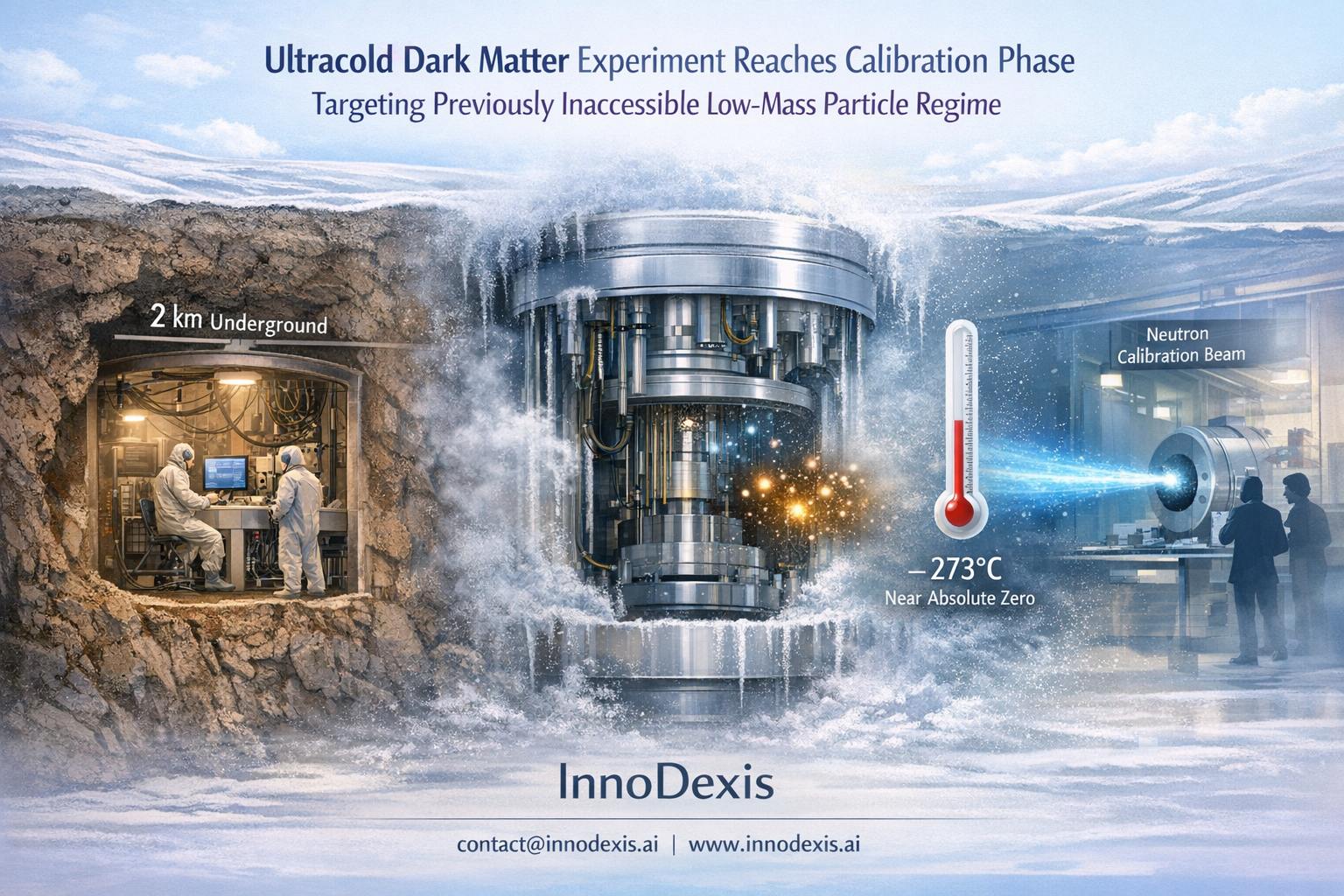
InnoDexis has published its latest Innovation Intelligence Report covering dark matter detection and cryogenic particle physics, analyzing a large-scale international experiment operating across the United States and Canada during March 2026. The report reveals that the Super Cryogenic Dark Matter Search (SuperCDMS) experiment has achieved its target operating temperature—thousandths of a degree above absolute zero—enabling transition into its calibration phase. This milestone positions the experiment at the threshold of active detection, targeting low-mass dark matter particles at sensitivity levels not previously accessible in experimental physics.
Key Findings
The experiment operates at temperatures thousandths of a degree above absolute zero, approximately 100 times colder than deep space. This ultracold environment eliminates thermal noise, which is essential for detecting the extremely small energy signals expected from low-mass dark matter particle interactions. Achieving and maintaining this temperature in an operational underground facility represents a critical engineering milestone.
The detector system is located approximately 2 kilometres underground, using natural rock shielding to reduce interference from cosmic radiation. This configuration significantly minimizes background noise, enabling higher signal fidelity for rare particle interactions that would otherwise be obscured at surface-level environments.
The experiment targets low-mass dark matter particles with masses approximately half that of a proton. This parameter space has not been explored at this level of sensitivity in previous experiments, positioning SuperCDMS at the forefront of direct detection efforts in particle physics.
Detector architecture incorporates ultra-pure silicon and germanium crystals combined with superconducting sensors. These materials and sensor technologies are designed to capture extremely small energy deposits resulting from potential particle collisions within the detector medium.
A dedicated calibration facility, using a neutron beam, measures ionization response within the detectors. This calibration process is essential for distinguishing true dark matter signals from background particle interactions, improving the accuracy of experimental results.
Strategic Insight and Trend Analysis
The SuperCDMS experiment represents a convergence of multiple advanced scientific and engineering domains, including cryogenics, superconducting sensor technology, underground experimental physics, and artificial intelligence-driven data analysis. Each component contributes to the overall system capability, enabling detection sensitivity that is not achievable through isolated technological approaches.
Cryogenic engineering is central to this convergence. Operating at near-absolute-zero temperatures allows superconducting sensors to detect extremely small energy signals, which are otherwise masked by thermal noise. This level of sensitivity is required to explore the low-mass regime of dark matter particles, which has remained largely inaccessible to previous experiments.
The use of deep underground facilities highlights the importance of environmental control in high-precision physics experiments. Shielding from cosmic radiation reduces false signals, allowing researchers to isolate rare particle interactions with greater accuracy.
Artificial intelligence is also emerging as a critical analytical layer in the experiment. AI-enabled reconstruction methods are applied to distinguish potential dark matter signals from background noise, reflecting a broader trend of integrating machine learning techniques into fundamental scientific research.
The transition from construction to calibration phase marks a key inflection point. Calibration validates system performance under operational conditions and prepares the experiment for active data collection. This stage represents the final step before the experiment begins its primary objective of detecting dark matter particles.
Global and Industry Implications
For corporates and R&D teams, the technologies developed within this experiment—particularly in cryogenics, superconducting sensors, and data analysis—highlight potential applications beyond fundamental physics. These technologies may contribute to advancements in quantum computing, precision measurement systems, and advanced sensing platforms.
For investors and capital allocators, while the experiment itself does not represent a direct commercial opportunity, its underlying technologies indicate long-term innovation pathways. Developments in cryogenic systems and sensor technologies may translate into commercial applications in adjacent high-tech sectors.
For policymakers and national research bodies, the experiment demonstrates the value of large-scale international collaboration in addressing fundamental scientific questions. Coordinated funding across multiple institutions and countries enables the development of complex research infrastructure that would be difficult to achieve through isolated efforts.
InnoDexis Statement
“The convergence of cryogenic engineering, superconducting sensing, and AI-driven analysis in dark matter detection represents a frontier in scientific instrumentation and collaborative research,” noted InnoDexis in its latest intelligence report.
Conclusion
The advancement of the SuperCDMS experiment into its calibration phase marks a significant milestone in the search for dark matter. By achieving operational conditions required for high-sensitivity detection, the experiment is positioned to explore a previously inaccessible region of particle physics.
Whether the experiment results in a direct detection or further constrains the properties of dark matter, its outcomes will contribute to a deeper understanding of the fundamental composition of the universe. Continued monitoring of calibration progress and subsequent data collection will be essential for evaluating the impact of this experiment on future scientific research.
The complete Dark Matter Detection — Cryogenic Particle Physics & Underground Experimentation Innovation Intelligence Report is available to InnoDexis subscribers and enterprise clients.
About Innodexis
InnoDexis is a global Innovation Intelligence platform that tracks, analyzes, and interprets breakthrough innovations, prototypes, and emerging technologies across industries and countries. Its intelligence helps corporates, investors, and policymakers understand the true structure and direction of global innovation. Learn more at innodexis.ai.