Ultra-Low Temperature Detection Advances Dark Matter Research as High-Sensitivity Physics Gains Momentum
Experiments operating at tens of milliKelvin enable new detection capabilities for low-mass dark matter, signaling a shift from high-energy to high-sensitivity discovery models.
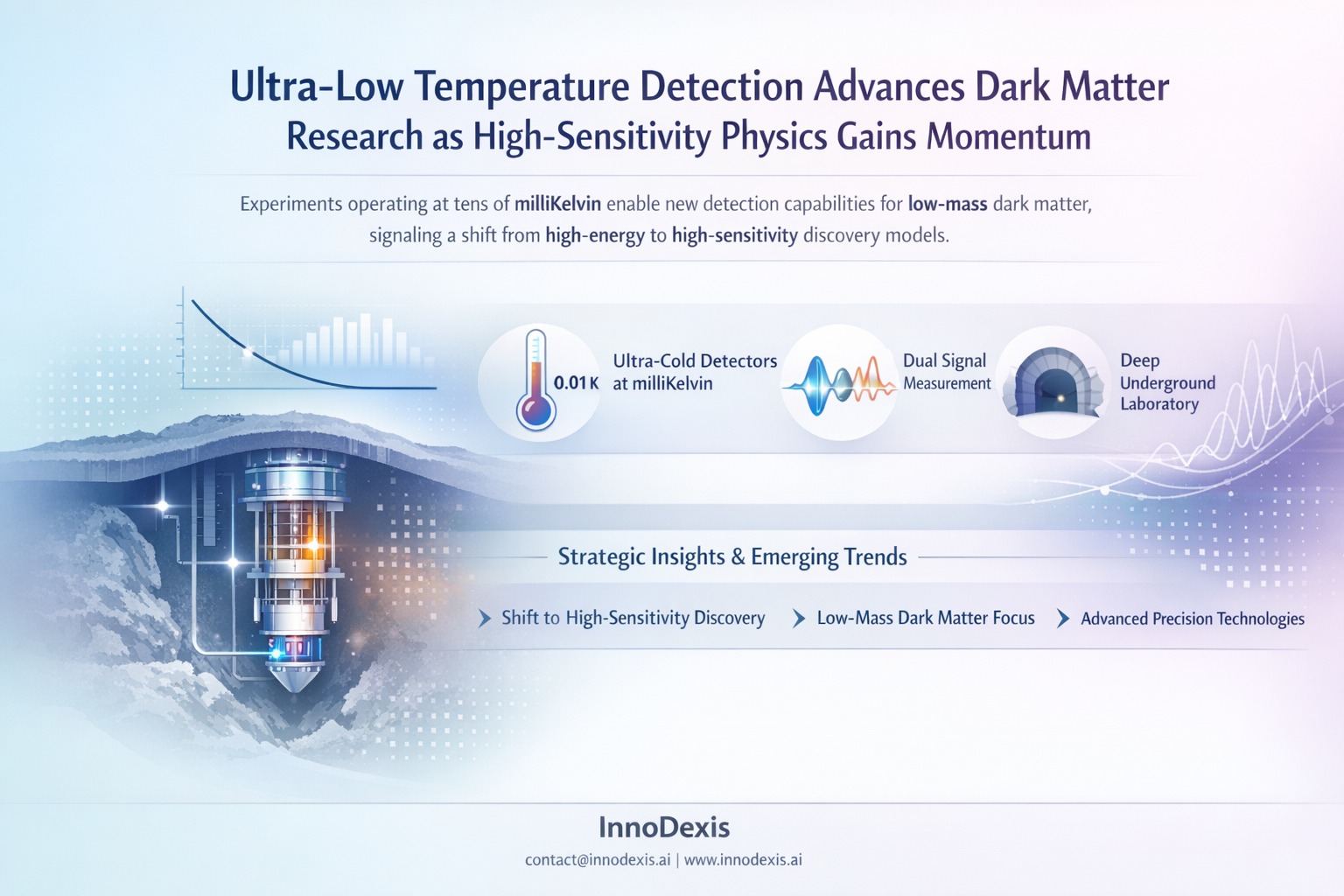
InnoDexis has published its latest Innovation Intelligence Report covering experimental physics and dark matter detection, analyzing emerging research developments in ultra-low temperature systems and particle observation environments. The report reveals that detectors cooled to tens of milliKelvin are enabling the observation of particle interactions previously beyond measurable limits. Conducted at the University of Toronto in collaboration with the SuperCDMS experiment at SNOLAB, this approach demonstrates how extreme environmental control is expanding the boundaries of observable physics.
Key Findings
Researchers at the University of Toronto, working on the SuperCDMS experiment at SNOLAB, have successfully cooled detection systems to tens of milliKelvin. This level of temperature reduction represents conditions significantly colder than outer space and enables highly controlled experimental environments for particle detection.
The detection system utilizes ultra-pure silicon and germanium crystals to capture extremely small particle interactions. These materials function as sensitive mediums capable of registering rare collision events that would otherwise remain undetected under standard experimental conditions.
A dual measurement approach is implemented, capturing both phonons and electrical signals generated during particle interactions. This combined signal detection enhances the accuracy and reliability of identifying rare events associated with potential dark matter particles.
The experiment is conducted approximately 2 kilometers underground at SNOLAB, providing deep isolation from cosmic radiation and environmental interference. This underground positioning significantly reduces background noise, allowing for clearer signal identification.
The system is specifically designed to target low-mass dark matter particles, which have historically remained outside the detection capabilities of conventional high-energy experiments. This creates a new observational window within particle physics research.
Strategic Insight and Trend Analysis
The findings indicate a measurable shift in experimental physics from energy-intensive detection methods toward sensitivity-driven approaches. Traditional particle discovery has relied heavily on high-energy collisions to reveal new particles, often requiring large-scale accelerators and substantial energy input.
In contrast, the current approach emphasizes environmental precision, where reducing thermal and electromagnetic noise enables the detection of weaker and less frequent particle interactions. Cooling detectors to tens of milliKelvin and placing them in deep underground facilities reflects a strategy centered on signal clarity rather than energy amplification.
This transition expands the range of detectable phenomena, particularly in the context of low-mass dark matter. While theoretical models have long suggested the presence of such particles, their interaction signatures are extremely subtle, requiring detection systems capable of operating at minimal noise thresholds.
The use of dual signal measurement further reinforces this trend, combining multiple data streams to improve detection confidence. As a result, experimental validation is increasingly dependent on measurement precision rather than scale alone.
Collectively, these developments point to the emergence of a “high-sensitivity discovery” paradigm. This approach complements, rather than replaces, high-energy physics, but introduces an alternative pathway for advancing fundamental understanding of the universe.
Global and Industry Implications
For corporates and R&D teams, particularly those involved in advanced materials, quantum sensing, and precision instrumentation, the findings highlight growing demand for ultra-sensitive detection technologies. Systems capable of operating at extreme conditions may have applications beyond physics, including medical imaging and semiconductor diagnostics.
For investors and capital allocators, the shift toward high-sensitivity experimental infrastructure suggests new areas of long-term investment. Facilities, components, and enabling technologies that support ultra-low temperature environments and noise reduction may represent emerging opportunities within deep technology portfolios.
For policymakers and national innovation bodies, the development of underground laboratories and advanced detection systems underscores the importance of specialized research infrastructure. Supporting such environments may become a strategic priority for countries aiming to participate in frontier physics research.
InnoDexis Statement
“The transition toward high-sensitivity detection reflects a structural evolution in experimental physics, where the ability to reduce noise and isolate signals is becoming as critical as increasing energy in advancing particle discovery,” noted InnoDexis in its latest intelligence report.
Conclusion
The advancement of ultra-low temperature detection systems demonstrates how experimental physics is expanding beyond traditional high-energy frameworks. By enabling the observation of previously undetectable particle interactions, these approaches open new pathways for investigating dark matter, which constitutes a significant portion of the universe’s mass. As research continues to refine sensitivity and measurement precision, the balance between energy-driven and noise-reduction strategies will shape future discovery models. The complete Dark Matter Detection and Ultra-Low Temperature Physics Report is available to InnoDexis subscribers and enterprise clients.
About InnoDexis
InnoDexis is a global Innovation Intelligence platform that tracks, analyzes, and interprets breakthrough innovations, prototypes, and emerging technologies across industries and countries. Its intelligence helps corporates, investors, and policymakers understand the true structure and direction of global innovation. Learn more at innodexis.ai.