UK Researchers Create First Functional Map of Histone H3 Sites in Mammalian Cells Using Scalable CRISPR Prime-Editing Platform
A high-throughput CRISPR prime-editing platform developed at The Institute of Cancer Research, London, has resolved a long-standing technical barrier in chromatin biology by enabling systematic, simultaneous editing of all histone H3 gene copies in mammalian cells.
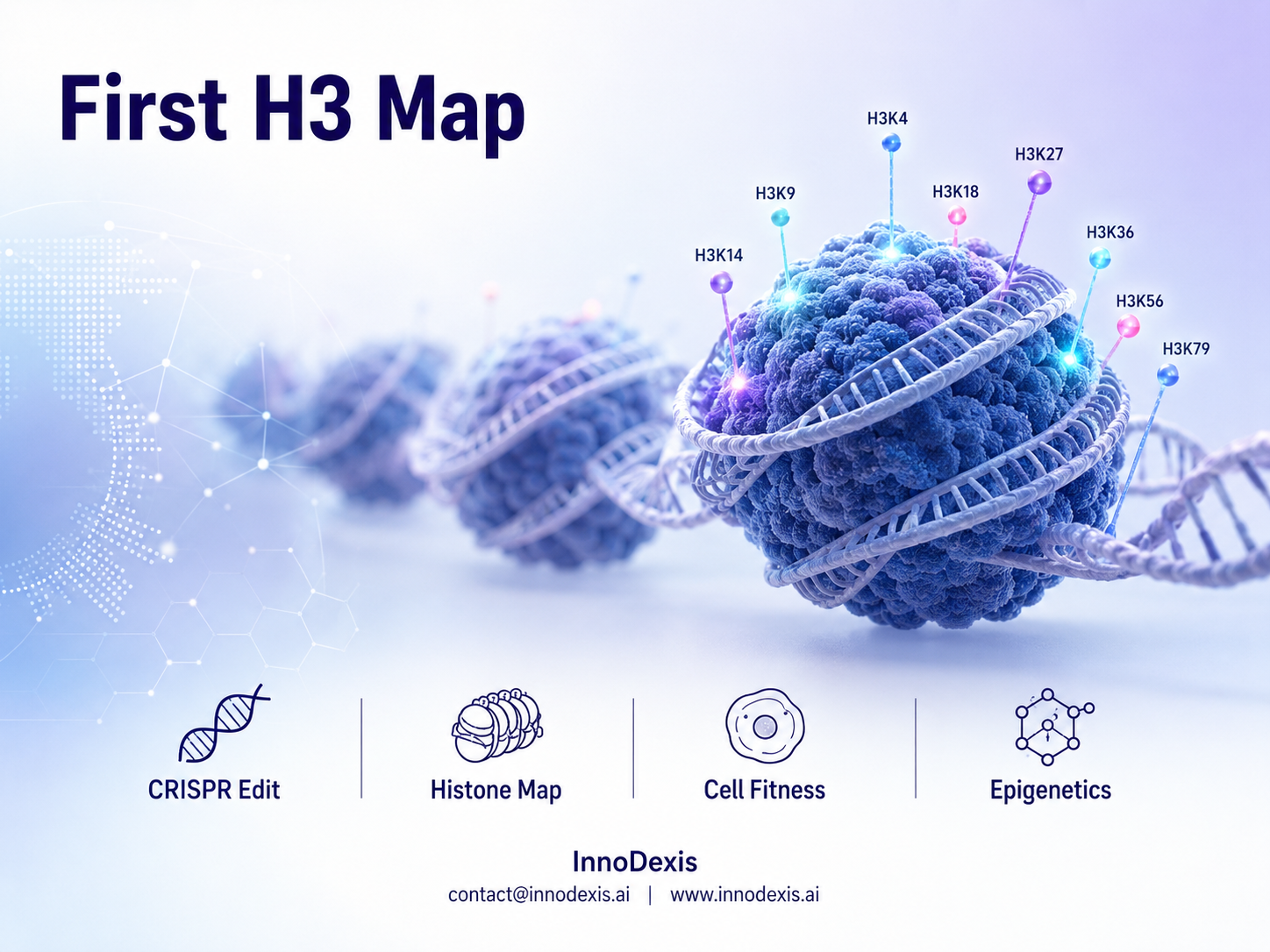
InnoDexis has published its latest Innovation Intelligence Report covering chromatin biology and epigenetic research, analyzing a high-significance innovation from the United Kingdom. The report reveals that researchers at The Institute of Cancer Research, London, have developed a high-throughput CRISPR prime-editing platform that simultaneously edits all copies of histone H3 genes in their natural genomic locations — producing the first comprehensive functional map of key histone H3 sites in mammalian cells and transforming a previously intractable area of chromatin biology into a systematically addressable research domain.
Key Findings
The platform resolved the primary technical obstacle that had made systematic histone research intractable in mammalian systems: the near-identical copies of histone genes scattered across the mammalian genome could not previously be edited simultaneously, precisely, and at scale. By enabling simultaneous editing of all histone H3 gene copies in their natural genomic locations, the platform changes the class of questions that can now be asked about chromatin biology.
The first comprehensive functional map of key histone H3 sites in mammalian cells was produced as a direct output of this platform. Mutations at H3K4, H3K9, H3K14, H3K18, and H3K79 were found to reduce cellular fitness, directly establishing the functional importance of these specific histone positions to cell health and survival in a mammalian context — a resolution not previously achieved at this level of systematic coverage.
Simultaneous mutations at H3K27 and H3K36 impaired stem-cell self-renewal and altered gene expression, demonstrating that combinations of histone modifications jointly govern fundamental cell identity processes. This finding is significant because it confirms that histone modification interactions — not just individual site functions — are determinants of cell fate, a dimension that single-site editing approaches could not systematically investigate.
Cells carrying H3K56 mutations showed increased sensitivity to DNA damage, confirming a genome-protective function for this histone site in mammalian cells. This validates in a mammalian system what had been previously observed in model organisms, directly linking H3K56 to genomic stability mechanisms relevant to cancer biology.
The platform enables systematic investigation of more than 100 histone modifications and their combinations — a scope that was not experimentally accessible before this work. The methodology and a collection of precisely engineered mammalian cell lines with specific histone mutations are positioned as shared resources for the broader scientific community working on gene regulation, genome stability, cancer, and epigenetic therapy development.
Strategic Insight and Trend Analysis
The central strategic signal in this dataset is the conversion of a structurally intractable research domain into a systematically addressable one. Prior to this platform, the functional roles of the majority of more than 100 identified histone modifications in mammalian cells remained poorly understood — not because the questions were unimportant, but because the technical means to answer them systematically did not exist. That constraint has now been resolved.
This is a platform-level innovation, and platform-level innovations in biology carry a different order of downstream value than single experimental findings. The histone functional map and the engineered cell lines are not endpoints — they are infrastructure. Every study that uses these resources to investigate a specific modification, combination, or disease context compounds the original investment. The scientific return scales with the breadth of use across the research community rather than remaining bounded by a single team's output.
For the epigenetic therapy development pipeline, the implications are foundational. Epigenetic drug development has historically faced a target selection problem: without a comprehensive understanding of which histone modifications are functionally essential in mammalian cells, candidate target prioritisation carried significant biological uncertainty. The functional map produced by this platform directly addresses that uncertainty, providing a more precise biological foundation for identifying which histone sites represent credible therapeutic targets in cancer and chromatin-related diseases.
The platform also signals a broader methodological shift in chromatin biology — from fragmented, low-throughput interrogation of individual histone sites toward scalable, systematic functional analysis. This transition mirrors the productivity gains observed in other biological fields when high-throughput tools replaced low-throughput predecessors, and suggests that the pace of discovery in chromatin biology will accelerate materially as the platform and its outputs are adopted across the research community.
Global and Industry Implications
For corporates and R&D teams in pharmaceutical and biotechnology research, the functional map and engineered cell lines provide a directly usable resource for epigenetic drug discovery. Organisations developing histone-targeting cancer therapies now have a validated biological foundation for target selection in mammalian cells — reducing early-stage attrition risk in programmes where target function was previously incompletely characterised.
For investors and capital allocators, this innovation signals continued platform-level momentum in the epigenetics sector. The translational timeline is long-term, as clinical impact is not immediate. However, platform innovations that resolve foundational biological knowledge gaps have historically created durable value by enabling downstream discoveries across multiple disease areas — making this a foundation-layer asset for the epigenetics and chromatin biology investment landscape.
For policymakers and national innovation bodies, the ICR platform illustrates the compounding return on sustained basic science funding. UK Research and Innovation's support for this work produced a shared scientific infrastructure with implications across cancer research, developmental biology, genome stability, and epigenetic therapy — demonstrating how investment in foundational research generates value across multiple downstream application domains simultaneously.
InnoDexis Statement
"The ICR histone mapping platform shifts chromatin biology from a field constrained by technical intractability to one capable of systematic, high-throughput functional interrogation — establishing the biological infrastructure from which the next generation of epigenetic therapies will be built," noted InnoDexis in its latest intelligence report.
Conclusion
The availability of the first comprehensive functional map of histone H3 sites in mammalian cells marks a structural advance in the chromatin biology research base. As epigenetic therapy development intensifies across oncology and chromatin-related disease areas, the ICR platform and its associated cell line collection will serve as a reference resource that accelerates target identification and biological characterisation. InnoDexis will continue to monitor developments in CRISPR-based epigenetic tools, histone modification research, and the translation of chromatin biology into therapeutic programmes. The complete Chromatin Biology Innovation Intelligence Report is available to InnoDexis subscribers and enterprise clients.
About InnoDexis
InnoDexis is a global Innovation Intelligence platform that tracks, analyzes, and interprets breakthrough innovations, prototypes, and emerging technologies across industries and countries. Its intelligence helps corporates, investors, and policymakers understand the true structure and direction of global innovation. Learn more at innodexis.ai.