UK Medical Research Council Commits £16.5 Million to Translational Dementia Research Across Five Experimental Medicine Studies
The initiative targets a structural gap in neurodegenerative disease research by testing interventions directly in living patients, spanning Alzheimer's, Parkinson's, and cerebral small vessel disease.
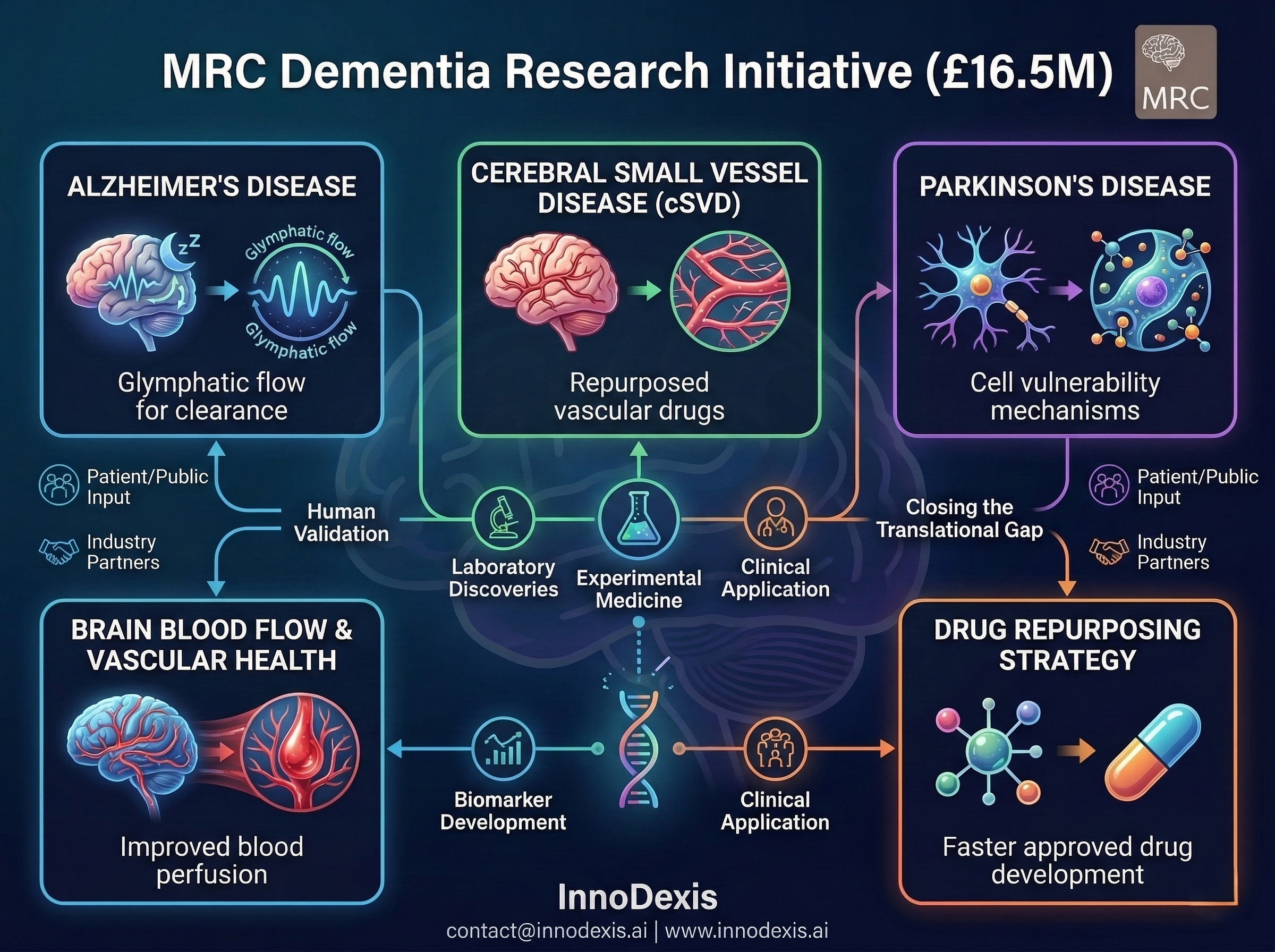
InnoDexis has published its latest Innovation Intelligence Report covering translational dementia research, analyzing 5 innovations across 1 country during the current funding cycle. The report reveals that the UK's Medical Research Council has committed £16.5 million to an initiative designed to close the translation gap between laboratory neuroscience and clinical treatment — studying biological disease mechanisms directly in living patients rather than relying on preclinical models alone. This initiative, structured around mandatory patient involvement and cross-sector industry partnerships, spans Alzheimer's disease, Parkinson's disease, and cerebral small vessel disease across four leading UK research institutions.
Key Findings
The £16.5 million investment funds five distinct experimental medicine projects spanning Alzheimer's disease, Parkinson's disease, and cerebral small vessel disease. Each project is led by a named principal investigator and based at a major UK research institution, including the University of Edinburgh, Imperial College London, University College London, and the University of Bristol. The scope and institutional breadth of the initiative reflect a deliberate effort to distribute translational research capacity across the national system.
Cerebral small vessel disease emerges as a particularly significant target within the portfolio. According to the report, the condition accounts for approximately 40% of all dementia cases globally, yet currently lacks specific approved treatments. The inclusion of two projects addressing vascular mechanisms — one testing repurposed drugs to improve cerebral blood flow and another targeting small vessel pathology directly — signals a strategic rebalancing of dementia research toward a disease category that has been historically under-resourced relative to its clinical burden.
Multiple projects employ drug repurposing as their primary intervention strategy. Rather than developing novel compounds from scratch, studies led by Dr. Alastair Webb and Professor Joanna Wardlaw test medications already approved for other conditions. The report identifies three structural advantages of this approach: established human safety data from prior use, the ability to bypass early development phases, and existing manufacturing infrastructure that could support accessible pricing if interventions prove effective.
The SleepBoost study, investigating whether enhancing slow-wave sleep can slow Alzheimer's progression, introduces a mechanistic pathway centered on the glymphatic system — a brain waste clearance network most active during deep sleep. The report notes that disrupted slow-wave sleep may reduce clearance of beta-amyloid, the protein associated with Alzheimer's pathology, potentially creating a self-reinforcing cycle of accumulation and cognitive decline. The study employs non-invasive interventions, brain imaging, and biomarker measurement to determine whether restoring healthy sleep architecture produces measurable changes in amyloid burden.
Patient and public involvement is embedded as a mandatory requirement across all five projects — not as an advisory mechanism but as an active governance function. The report states that people with lived experience of dementia reviewed funding applications alongside scientific reviewers, evaluating whether proposed research addressed priorities meaningful to patients and families. Patient representatives also participate in study steering committees, contributing to protocol refinement and interpretation of findings throughout the research process.
Strategic Insight and Trend Analysis
The collective architecture of this initiative points to a structural shift in how translational neuroscience is being organized in the United Kingdom. Rather than funding isolated discovery projects, the MRC has assembled a portfolio that tests multiple mechanistic hypotheses simultaneously — sleep physiology, neural circuit modulation, vascular biology, cerebral perfusion, and cellular resilience in Parkinson's — within a shared experimental medicine framework.
This portfolio approach carries strategic logic. Neurodegenerative diseases are heterogeneous conditions with overlapping and interacting pathological processes. A study that improves cerebral blood flow may have relevance beyond vascular dementia; a biomarker developed for the SleepBoost study may prove useful in trials targeting amyloid through pharmacological means. The requirement for mandatory industry partnerships in each project further accelerates the pathway from proof-of-concept data to scalable intervention, by embedding commercialization expertise at the research stage rather than treating it as a downstream problem.
The emphasis on repurposed drugs reflects a pragmatic recalibration of risk in a field where novel compound development has yielded limited clinical success. By testing interventions with established safety profiles in human patients, these studies generate actionable evidence at a fraction of the cost and timeline associated with new drug development. If successful, repurposed medications can reach patients years earlier than novel therapeutics — a factor of considerable significance given the pace at which aging populations are expanding dementia prevalence.
The mandatory patient involvement requirement represents an additional analytical signal. The report indicates that people with dementia reviewed applications and assessed whether study designs respected participant burden and measured outcomes meaningful to daily life. This governance structure reduces the risk of funding scientifically rigorous research that fails to translate into clinically meaningful benefit — a recurrent challenge in late-stage trial failures across the broader pharmaceutical landscape.
Global and Industry Implications
For corporates and R&D teams, the initiative identifies several intervention domains — sleep enhancement, non-invasive neural stimulation, vascular drug repurposing — now supported by structured translational evidence generation. Organizations developing technologies in neuroimaging, wearables, brain stimulation devices, or biofluid diagnostics will find that each of the five projects generates comparative data on methodology performance, patient stratification, and biomarker utility. The mandatory industry partnership model embedded in the initiative also creates defined entry points for technology providers seeking validated clinical environments.
For investors and capital allocators, the drug repurposing strategy deployed across multiple projects shortens the timeline to proof-of-concept data. Positive results from these experimental medicine studies would support Phase 3 investment decisions with human-validated mechanistic evidence — a materially different risk profile than early-stage novel compound investment. The cerebral small vessel disease projects are particularly noteworthy given the absence of approved disease-specific treatments for a condition affecting 40% of dementia cases.
For policymakers and national innovation bodies, the initiative offers a replicable model for organizing translational research portfolios: multi-institution, cross-sector, patient-governed, and aligned to national strategic goals through the Dame Barbara Windsor Dementia Goals Programme. The structural requirement for patient involvement at the application review stage represents a governance innovation that other funding bodies may consider as a mechanism for improving research relevance and public accountability.
InnoDexis Statement
"The MRC's experimental medicine framework positions translational validation — not discovery alone — as the primary constraint in neurodegenerative disease treatment development, a structural insight with direct implications for how research portfolios and capital should be allocated," noted InnoDexis in its latest intelligence report.
Conclusion
As these five studies progress toward proof-of-concept readiness, the findings will determine which mechanistic targets warrant major investment in Phase 3 efficacy trials. The biomarkers, imaging protocols, and patient stratification tools developed across the portfolio will extend beyond individual projects, strengthening the infrastructure for future dementia trials globally. Developments in cerebral small vessel disease therapeutics and sleep-based interventions merit particular attention in the near term. InnoDexis will continue tracking this initiative and the broader translational neuroscience landscape as evidence emerges. The complete £16.5 Million Investment in Translational Dementia Research: InnoDexis Innovation Intelligence Report is available to InnoDexis subscribers and enterprise clients.
About InnoDexis
InnoDexis is a global Innovation Intelligence platform that tracks, analyzes, and interprets breakthrough innovations, prototypes, and emerging technologies across industries and countries. Its intelligence helps corporates, investors, and policymakers understand the true structure and direction of global innovation. Learn more at innodexis.ai.