TRL 5 Accounts for 1.6% of Research Readiness Levels Against 27.6% at TRL 3 as Two Independent Instruments Locate the Same Mid-Ladder Trough in July 2026
A cross-stream readiness analysis of 254 stated and 5,519 inferred Technology Readiness Levels finds that assessed quality peaks at TRL 7 not TRL 9, that Advanced Materials carries the widest Research-to-Corporate handoff distance at 5.5 rungs, and that the TRL 5–6 trough is now independently corroborated across three consecutive measurement approaches.
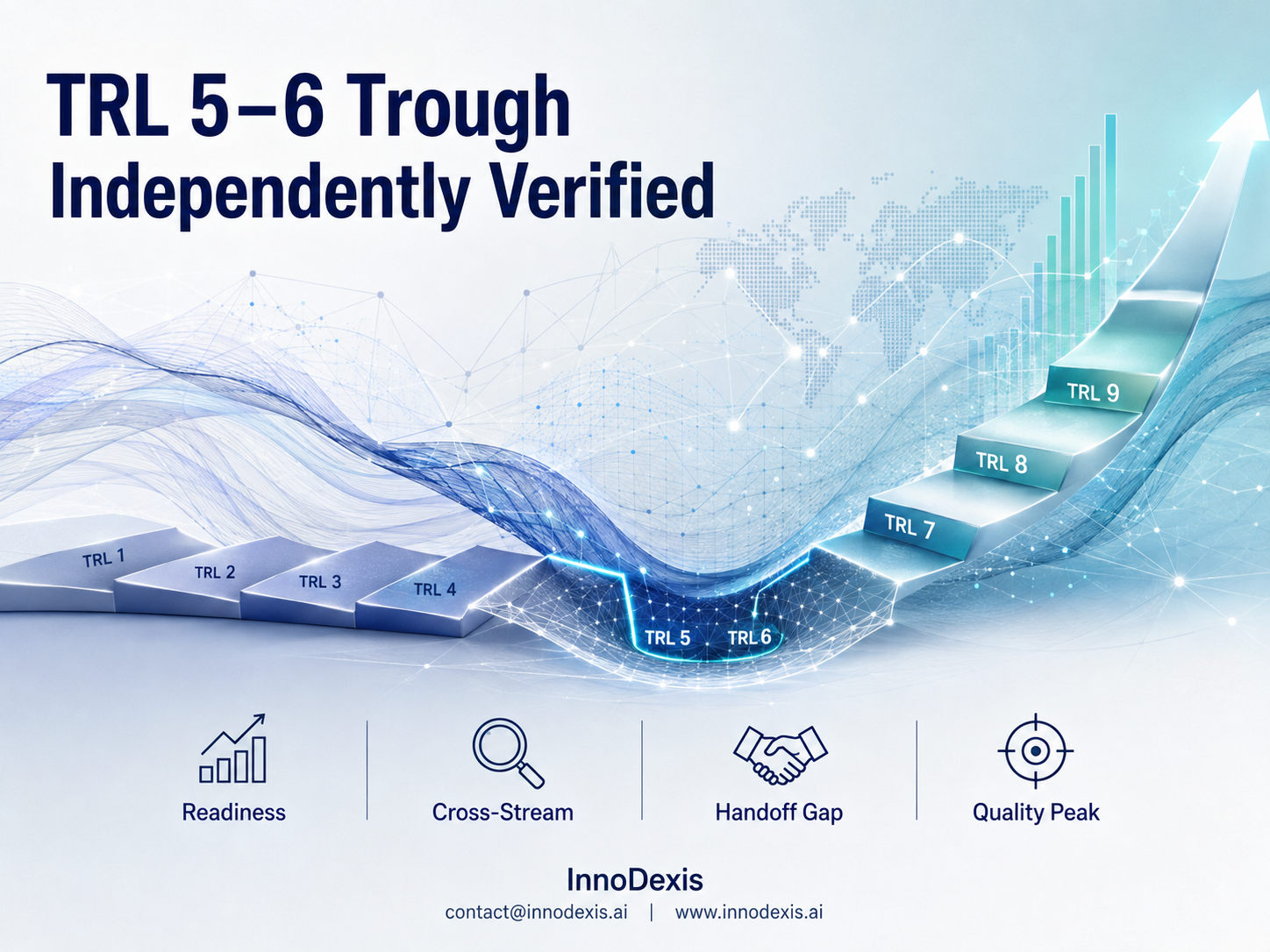
InnoDexis has published its latest Cross-Stream Intelligence Report — The Ladder — placing 254 stated Research-stream readiness levels and 5,519 inferred Corporate-stream readiness levels on a single nine-rung Technology Readiness Level scale across July 2026. The report reveals that 67.7% of Research readiness levels fall at TRL 1–4 while 86.3% of Corporate ones fall at TRL 7–9, that both streams independently show a pronounced trough at TRL 5–6, and that the Corporate quality curve peaks at TRL 7 at a mean InnoDexis score of 6.73 — against 5.20 at TRL 9 where 64.9% of Corporate records sit.
Key Findings
The two-stream architecture places research and corporate activity at close to mirror-image positions on the TRL scale. Research readiness levels peak at TRL 3 — analytical and experimental proof of concept — accounting for 27.6% of stated levels, with TRL 2 at 18.9% and TRL 4 at 13.0%. The Corporate stream inverts this entirely: TRL 9 accounts for 64.9% and TRL 8 for a further 16.2%, while below TRL 4 the Corporate stream accounts for just 2.5% across TRL 1–3 combined. The report identifies this as the first month the InnoDexis two-stream architecture has been demonstrated on a single common axis rather than asserted.
The TRL 5–6 trough is the report's most consequential structural finding and is independently corroborated by both instruments. In the Research stream, TRL 5 accounts for 1.6% of stated readiness levels — four records — against 13.0% at TRL 4 immediately below, the sharpest single discontinuity anywhere on the Research ladder. In the Corporate stream, TRL 5 at 3.0% and TRL 6 at 2.9% form a local minimum between TRL 4 at 5.3% and TRL 7 at 5.1%. Because the Research figure is self-reported and the Corporate figure is inferred by a separate method, their agreement is genuine corroboration rather than a shared-method artefact — both instruments locate the trough in the same place.
The Corporate quality curve inverts the volume curve monotonically above TRL 3. Mean InnoDexis score peaks at TRL 7 at 6.73 and TRL 4 at 6.60, then declines through TRL 8 at 5.96 to TRL 9 at 5.20 — the lowest-scoring rung above TRL 3. The 902 records in the TRL 4–7 band average 6.51 against 5.35 for the 4,480 records at TRL 8–9. This is the third independent measurement within the July 2026 report series — after prototype stage in the Prototypes and Signals report and launch availability in the What Shipped report — to locate assessed innovation quality below the point of full deployment rather than at it.
TRL disclosure in the Research stream is not evenly distributed and reflects funding culture more than technical maturity. Neuroscience and NeuroTech leads all domains at 24.0% TRL disclosure, followed by Photonics and Sensing at 20.8% and Quantum and Advanced Computing at 15.9%. AI and Machine Learning discloses at 3.7% and Space and Aerospace at 1.4% — both far below the 8.0% stream average. The report identifies TRL disclosure as embedded in the grant reporting requirements of European framework programmes, national defence agencies, and translational medical funders, meaning domains whose money arrives through those channels state readiness levels routinely while domains funded through general research councils do not.
The domain-level handoff distance — the gap between median stated Research TRL and median inferred Corporate TRL — ranges from three rungs in AI and Machine Learning and Medical Devices and Diagnostics to approximately 5.5 rungs in Advanced Materials. Advanced Materials research is announced at proof of concept and reappears commercially only once embedded in a finished product, with the intervening qualification work largely invisible — identifying it as the widest early-signal window in the data and correspondingly the longest wait. Biotech and Pharmaceuticals is the only domain whose Corporate median sits below TRL 9 at approximately TRL 7, because clinical trials are corporate in origin and pre-deployment by definition.
Five valley-crossing technologies illustrate what the TRL 5–7 crossing actually looks like in practice. The University of Liverpool dosed the world's first patient with a personalised non-small-cell lung cancer vaccine using a doggybone DNA manufacturing method at TRL 6 — where the manufacturing process is the readiness-determining constraint rather than the science. Lawrence Livermore National Laboratory and Pacific Fusion's SIRIUS impedance-matched Marx generator has completed 3,000 shots at TRL 5, demonstrating the hardware reliability required to scale a fusion driver — one of only four Research records at TRL 5 this month. ITEN's surface-mount solid-state battery achieving a 200C discharge rate is at TRL 7 with manufacturing underway, optimising for discharge rate rather than energy density for pulse and edge-device applications. Stratolaunch has completed more than ten successful hypersonic flights with the Talon-A reusable autonomous vehicle at TRL 7, converting hypersonic testing from a single-use event into a repeatable service. KAIST's APT-RL quadruped robot achieves autonomous gait selection and switching across unstructured outdoor terrain at 6 metres per second at TRL 6.
Strategic Insight and Trend Analysis
The most consequential structural finding of The Ladder report is the independent corroboration of the TRL 5–6 trough across two instruments that share no methodology. This matters analytically because a pattern visible in only one stream could plausibly be an artefact of how that stream measures readiness. A pattern visible in both — through one field that reads stated assertions and one that infers from announcement content — is structurally harder to explain as a measurement artefact and much more likely to be a genuine property of the innovation pipeline.
The practical interpretation of the trough is precise. Technologies at TRL 5–6 have already been validated in a laboratory. What none of them has yet is a partner willing to accept the technology in its current state for a defined application. The work required to reach TRL 7 is engineering rather than discovery, it is expensive, it produces no publications, and it typically begins after public research funding has been exhausted and before commercial investment considers the risk acceptable. The scarcity of announcements is not evidence that little is happening — it is evidence that what happens at this stage generates nothing to announce.
The three-times-replicated quality-versus-maturity pattern — documented in the prototype report at TRL 4–6, in the product report at pilot and regulatory-pathway stage, and now in the readiness report at TRL 4–7 — establishes the finding across independent framings within a single monthly cycle. Each approach uses different fields and different analytical logic, and all three arrive at the same conclusion: assessed innovation quality in the Corporate stream is concentrated below the point of full deployment, while the bulk of corporate volume sits above it. The report flags the shared extraction pipeline between the inferred readiness level and the quality score as a dependency requiring a controlled test before the relationship is treated as definitively causal.
Global and Industry Implications
For corporates and R&D teams, the five valley-crossing technologies provide the most specific near-term engagement map in the July 2026 data. At TRL 5–7, each has demonstrated the underlying capability and lacks a first adopter willing to accept current-state performance for a defined task — which is precisely the profile where a named corporate partner determines whether the technology advances or stalls. The KAIST APT-RL quadruped and the University of Liverpool personalised vaccine both require a domain-specific first adopter — inspection or agricultural monitoring in the former case, a named clinical trial partner with a comparator protocol in the latter — as the specific missing element identified in the report. The domain handoff distance analysis provides a directly actionable calibration for cross-stream partnership strategy: domains at three rungs of distance such as AI and Medical Devices are likely to produce InnoGraph matches between Research and Corporate records at close temporal range, while Advanced Materials at 5.5 rungs requires a multi-year horizon before Research-stream signals surface as Corporate-stream announcements.
For investors and capital allocators, the 24 Research records at TRL 5–6 represent the smallest and most specific sourcing cohort the InnoDexis platform produces. They are technologies that work and lack a first adopter — the profile structurally suited to patient capital with a five to seven year horizon rather than venture timelines calibrated to faster translation cycles. The LLNL and Pacific Fusion SIRIUS partnership model — a national laboratory supplying the physics and engineering and a private company supplying the commercialisation path and capital — is identified as the specific institutional arrangement that crosses the trough and is explicitly rare in the data. Its rarity is a reasonable proxy for how infrequently the arrangement is assembled, and its presence in a monthly dataset is therefore a higher-signal event than most funding announcements of comparable disclosed value.
For policymakers and national innovation bodies, the TRL 5–6 trough independently corroborated across two instruments identifies a structural funding gap that policy programmes targeting either basic research or commercial deployment will systematically miss. The gap falls after typical public research grant periods end and before commercial investment enters — a timing mismatch that is structural rather than cyclical and that cannot be addressed by scaling either end of the existing funding architecture. The ITEN solid-state battery at TRL 7 with manufacturing underway and Stratolaunch's reusable hypersonic test service at TRL 7 each illustrate the institutional forms that emerge when the gap is crossed: not a single organisation but a partnership combining public-institution technical credibility with private commercialisation infrastructure, the arrangement the report identifies as the crossing mechanism and the one most directly addressable through targeted bridging capital programmes.
InnoDexis Statement
"Two independent instruments — one reading stated readiness levels from institutional text, one inferring them from corporate announcements — both locate a trough at TRL 5–6 in July 2026, and their agreement is evidence that the gap is a property of the innovation pipeline rather than a property of how either stream is measured," noted InnoDexis in its latest intelligence report.
Conclusion
The Ladder report establishes that the TRL 5–6 trough is independently corroborated across two instruments sharing no methodology, that the Corporate quality curve peaks at TRL 7 not TRL 9 and this pattern has now been replicated three times within a single monthly report cycle, and that handoff distance varies from three rungs in AI and Medical Devices to 5.5 in Advanced Materials — providing the first domain-level calibration of how far apart the Research and Corporate streams are observing the same technologies. Across 254 stated and 5,519 inferred readiness levels from 3,174 Research and 5,529 Corporate records, the evidence confirms a pipeline architecture that concentrates quality below the point of full deployment, a trough that is structurally real and structurally unfunded, and five valley-crossing technologies each one named adopter away from advancing to the next rung. As the TRL 5–6 count is tracked as a monthly series across both streams, the quality-versus-readiness curve is tested against independently assigned readiness levels, and the handoff distance metric is extended to further domain pairs, The Ladder will become the most precise structural map of the innovation pipeline the InnoDexis platform has yet produced. The complete The Ladder TRL Intelligence July 2026 Report is available to InnoDexis subscribers and enterprise clients.
About InnoDexis
InnoDexis is a global Innovation Intelligence platform that tracks, analyzes, and interprets breakthrough innovations, prototypes, and emerging technologies across industries and countries. Its intelligence helps corporates, investors, and policymakers understand the true structure and direction of global innovation. Learn more at innodexis.ai.