Tohoku University Achieves First Stable Borophene Structure and Discovers New Quantum Electronic State Within a 3D Crystal
By extracting a naturally occurring honeycomb boron layer from a bulk three-dimensional crystal rather than synthesising it as a free-standing sheet, researchers have produced the first stable borophene structure and uncovered a previously undiscovered electronic nematic state.
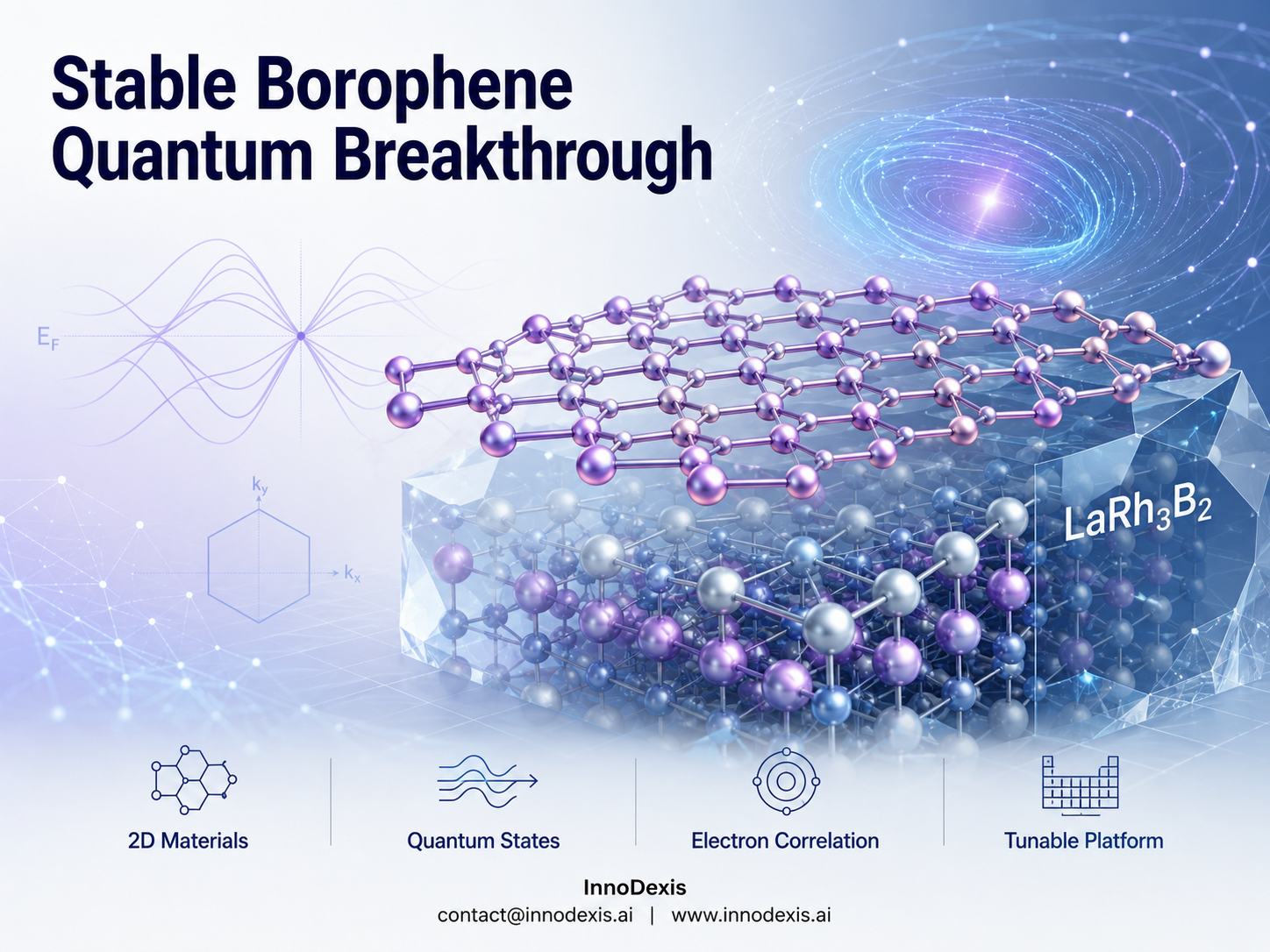
InnoDexis has published its latest Innovation Intelligence Report covering quantum materials science, analyzing a landmark innovation from Japan published by researchers at Tohoku University's Graduate School of Science and WPI-AIMR. The report reveals that a stable honeycomb borophene structure has been realised for the first time by exposing a naturally occurring boron layer embedded within the three-dimensional crystal LaRh₃B₂ — an approach that sidesteps the long-standing synthesis instability problem and simultaneously revealed a previously undiscovered electronic nematic quantum state in which electrons spontaneously align in one preferred direction.
Key Findings
The first stable honeycomb borophene structure has been achieved not through free-standing sheet synthesis but by exposing a naturally occurring boron layer within the bulk crystal LaRh₃B₂. This approach resolves the extreme structural instability that has rendered borophene practically unusable despite years of theoretical promise, by working with a material configuration that is inherently stable within its three-dimensional host crystal rather than attempting to stabilise a free-standing two-dimensional sheet.
A previously undiscovered electronic nematic state was identified within the stable borophene structure. In this quantum state, electrons spontaneously align in one preferred direction, breaking the six-fold crystal symmetry of the honeycomb lattice. Electronic nematic behaviour of this type is associated with strong electron interactions and is considered a key ingredient in understanding high-temperature superconductivity — making its discovery in a stable, accessible material system a significant finding for quantum physics research.
An unusually high electron concentration near the Fermi level — a van Hove singularity — was observed in the stable borophene structure. Van Hove singularities are of particular scientific interest because they enhance electron-electron interactions, which are relevant to the emergence of unconventional superconducting and other correlated electron phases. The presence of this feature in the LaRh₃B₂ boron layer strengthens the material's relevance to high-temperature superconductivity research.
The LaRh₃B₂ crystal family permits chemical element substitution, enabling precise tuning of the electronic properties of the exposed boron layer. This configurability positions the discovery not as a single material finding but as a platform — one in which electronic properties can be systematically adjusted through substitution, opening structured pathways for investigating a range of quantum phenomena within a chemically flexible host system.
The approach reframes the broader strategy for two-dimensional quantum material discovery from synthesis to extraction. If stable two-dimensional layers can be exposed from existing three-dimensional crystals across other crystal families, the pipeline of accessible quantum materials expands significantly beyond what free-standing synthesis approaches have been able to deliver.
Strategic Insight and Trend Analysis
The most strategically significant dimension of this discovery is methodological rather than material-specific. The prevailing approach to two-dimensional quantum material research has required the synthesis of free-standing sheets — a process that introduces structural instability as a fundamental constraint, particularly for borophene. The Tohoku University finding demonstrates that stable two-dimensional layers can instead be exposed from within existing bulk crystals, accessing a material configuration that is inherently stable because it exists within a three-dimensional host structure.
This extraction-over-synthesis approach, if it generalises across other crystal families, represents a structural shift in how the field identifies and accesses two-dimensional quantum materials. The implication is not limited to borophene — it suggests a broader strategy for discovering quantum materials by examining naturally occurring two-dimensional layers embedded within stable three-dimensional crystals that already exist, rather than attempting to engineer stability into inherently fragile free-standing structures.
The discovery of an electronic nematic state alongside the structural achievement compounds the significance. Electronic nematicity — where electrons break rotational symmetry by aligning preferentially — is one of the most actively studied phenomena in condensed matter physics, partly because of its association with high-temperature superconductivity. Finding it in a stable, chemically tunable boron-based system creates a new and accessible experimental platform for investigating these interactions under controllable conditions.
The chemical flexibility of the LaRh₃B₂ crystal family further elevates the strategic value of this finding. A configurable platform in which electronic properties can be tuned through element substitution is substantially more valuable for systematic research than a single-composition material, because it allows researchers to map the relationship between chemical composition and quantum behaviour in a controlled way.
Global and Industry Implications
For corporates and R&D teams in advanced materials, semiconductor research, and quantum device development, the LaRh₃B₂ platform offers a chemically tunable system for investigating strong electron correlations and quantum phase behaviour under stable conditions. The configurability of the crystal family through element substitution provides a structured research tool for organisations building capability in quantum materials characterisation and next-generation device substrates.
For investors and capital allocators, the discovery signals early-stage but structurally significant progress in the quantum materials pipeline. The translational timeline from fundamental quantum material discovery to deployable quantum device technology remains long. However, the resolution of the borophene stability problem and the identification of a configurable crystal platform represent foundational advances that reduce a key technical barrier in the pathway toward practical two-dimensional quantum material applications.
For policymakers and national innovation bodies, the Tohoku University finding reinforces the strategic value of sustained investment in fundamental quantum materials research. Japan's research leadership in this domain — demonstrated through the WPI-AIMR institutional framework — illustrates how long-term basic science programmes generate discoveries that reframe entire research fields and position national institutions at the frontier of globally competitive technology domains.
InnoDexis Statement
"The stable borophene achievement reframes two-dimensional quantum material discovery from a synthesis challenge to an extraction strategy — a methodological shift with implications extending well beyond a single material or institution," noted InnoDexis in its latest intelligence report.
Conclusion
The stabilisation of borophene through crystal extraction and the simultaneous discovery of an electronic nematic state mark a convergence of structural and quantum advances that positions the LaRh₃B₂ crystal family as a meaningful new platform for quantum materials research. As the extraction-over-synthesis approach is tested across other crystal families, and as the chemical tunability of the LaRh₃B₂ system is explored systematically, the implications for superconductivity research and quantum device development will become progressively clearer. InnoDexis will continue to monitor advances in two-dimensional quantum materials, borophene research, and correlated electron systems. The complete Quantum Materials Innovation Intelligence Report is available to InnoDexis subscribers and enterprise clients.
About InnoDexis
InnoDexis is a global Innovation Intelligence platform that tracks, analyzes, and interprets breakthrough innovations, prototypes, and emerging technologies across industries and countries. Its intelligence helps corporates, investors, and policymakers understand the true structure and direction of global innovation. Learn more at innodexis.ai.