Stanford Drives Rapid Innovation Output Across AI, Biotechnology, and Sustainability with 55 Breakthrough Projects in Six Weeks
A real-time intelligence review shows Stanford sustaining a research velocity of more than one breakthrough innovation per day across multiple high-impact technology domains.
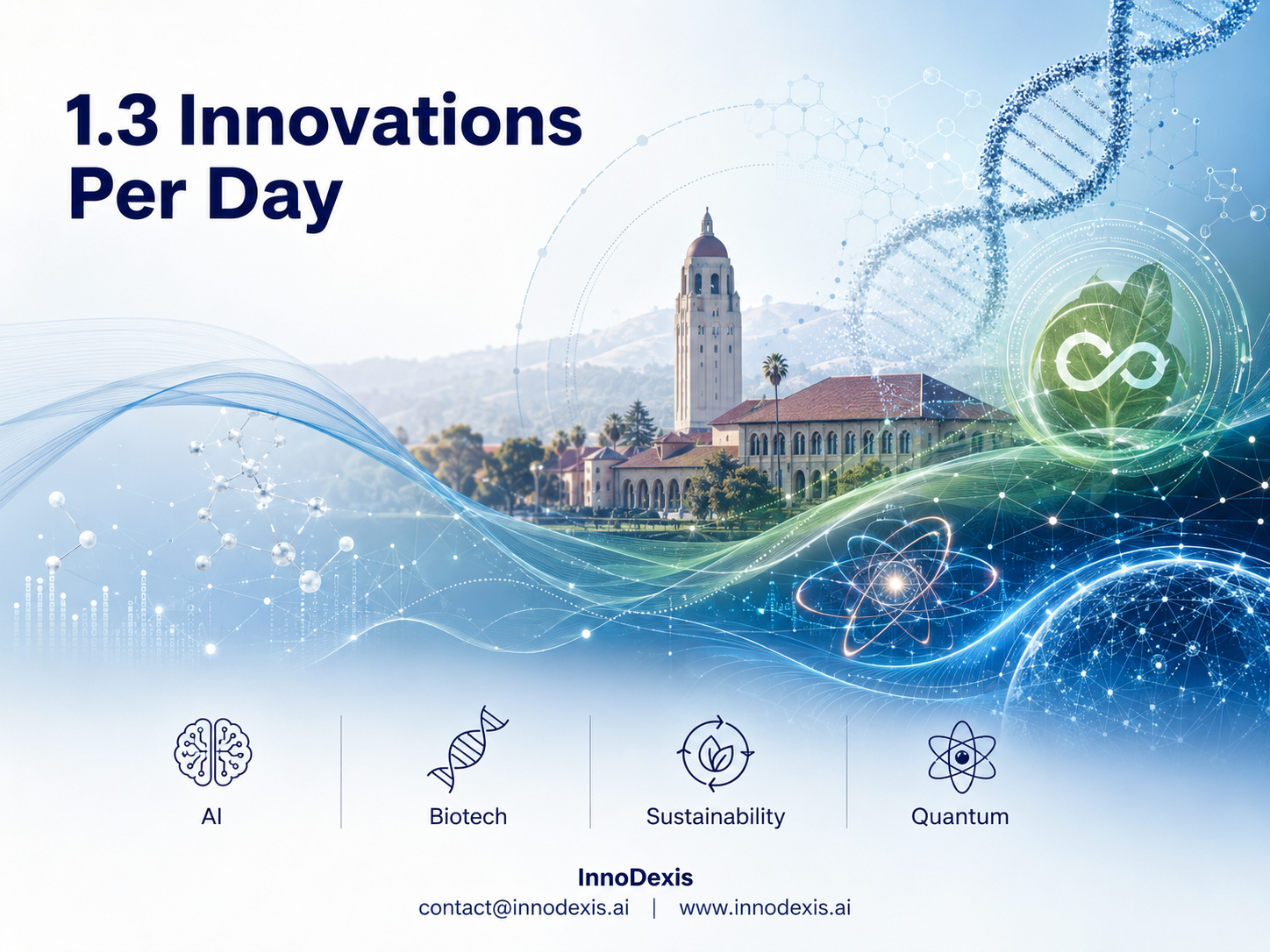
InnoDexis has published its latest Innovation Intelligence Report covering university-driven technological innovation, analyzing 55 breakthrough innovations produced by Stanford University during September 1 to October 10, 2025. The report reveals that Stanford maintained a consistent research output of approximately 1.3 to 1.4 innovation projects per day, driven by a network of 93 researchers across more than 15 research centers. These innovations span key domains including artificial intelligence, biotechnology, sustainability, and advanced physics, demonstrating a diversified portfolio with direct relevance to more than 70 industry sectors.
Key Findings
Stanford’s research portfolio shows strong concentration in sustainability and circular economy technologies, which account for 23.6% of all innovations during the period analyzed. Biotechnology and molecular biology represent 20.0% of the portfolio, while artificial intelligence and machine learning contribute 16.4%. Additional areas such as data science, social innovation, and legal technology further expand the technological footprint across computational and policy-driven fields.
Technology maturity levels indicate that a majority of innovations are approaching commercialization readiness. Approximately 35% of projects are already in Technology Readiness Levels (TRL) 8–9, representing operational or market-ready technologies. Another 30% fall within TRL 6–7, indicating technologies undergoing field testing or pilot demonstrations. Combined, this means that roughly 65% of Stanford innovations are within near-term commercialization range.
One of the most notable breakthroughs identified in the report is a circular economy membrane technology developed by chemical engineer William Tarpeh. The system separates molecules based on charge and volatility, enabling wastewater to be transformed into valuable materials such as ammonia for agriculture and lithium for battery production. The research received an $800,000 MacArthur Fellowship, reinforcing both its scientific impact and its potential commercial relevance.
The report also identifies rapid advancement in AI-enabled gene therapy platforms. Multiple Stanford research groups are applying machine learning to accelerate CRISPR-based gene editing by predicting optimal targets and reducing experimental development cycles. These systems could compress development timelines for gene therapies from several years to a significantly shorter timeframe.
Quantum sensing research represents another key innovation frontier. Stanford physicists are advancing attosecond-scale physics and gravitational wave detection technologies. These systems support emerging applications in quantum computing infrastructure, advanced materials discovery, and ultra-precise sensing systems for scientific and industrial environments.
Strategic Insight and Trend Analysis
The findings collectively indicate that Stanford operates as a continuous innovation engine characterized by steady research velocity, diversified technology domains, and strong institutional resources. The consistent production rate of more than one innovation per day suggests a structured research ecosystem capable of sustaining long-term output rather than episodic breakthrough cycles.
A defining structural feature is the integration of interdisciplinary research centers. More than fifteen institutes contribute to the innovation pipeline, including the Woods Institute for Environment, Stanford Law School innovation programs, the School of Medicine, the Graduate School of Business, and the Doerr School of Sustainability. These institutional hubs facilitate collaboration across scientific, technological, and policy-oriented disciplines.
Another strategic characteristic is Stanford’s approach to faculty development. The report highlights a model where assistant professors and early-career researchers receive significant institutional support, including research funding, laboratory infrastructure, and public recognition for breakthrough work. This model increases the probability that new research directions emerge from younger faculty members willing to pursue unconventional or high-risk ideas.
Funding momentum further reinforces Stanford’s research trajectory. During the six-week observation period, documented funding exceeded $66 million, including a $50 million institutional gift, multiple NIH high-risk research grants, and philanthropic contributions supporting innovation programs. In addition, Stanford’s endowment of $40.8 billion provides long-term financial stability that allows researchers to pursue projects with extended development timelines.
The report also emphasizes the role of recognition signals in shaping innovation momentum. Awards such as MacArthur Fellowships and APS Fellow recognition often validate research conducted years earlier, suggesting that breakthrough recognition reflects long development cycles rather than immediate discovery events. This dynamic indicates that the current funding and research investments will shape innovation outcomes over the coming decade.
Global and Industry Implications
For corporates and R&D teams, Stanford’s portfolio represents a source of technologies that are already approaching practical deployment. With more than half of innovations at advanced TRL stages, companies seeking partnerships in areas such as biotechnology platforms, sustainability technologies, and advanced materials can engage earlier in commercialization cycles.
For investors and capital allocators, the research pipeline demonstrates strong signals for startup formation in fields including circular economy infrastructure, AI-enabled drug development, and quantum sensing systems. The presence of near-commercial technologies suggests that new venture opportunities could emerge rapidly as spinouts or licensing partnerships.
For policymakers and national innovation bodies, the report highlights how long-term funding commitments and interdisciplinary collaboration can sustain consistent research output. Stanford’s model demonstrates how universities can function as economic innovation engines capable of influencing industries ranging from healthcare and agriculture to climate technologies and artificial intelligence.
InnoDexis Statement
“Stanford’s sustained research velocity and diversified technology portfolio illustrate how institutional infrastructure, interdisciplinary collaboration, and long-term funding alignment can create a continuous innovation pipeline,” noted InnoDexis in its latest intelligence report.
Conclusion
The Stanford Innovation Intelligence analysis demonstrates how a research institution can maintain consistent breakthrough output while simultaneously advancing technologies across multiple strategic domains. The combination of strong financial resources, interdisciplinary research networks, and early-stage talent development has produced a diversified pipeline spanning AI, biotechnology, sustainability, and quantum technologies.
As global industries accelerate demand for climate solutions, advanced computing systems, and precision healthcare technologies, the trajectory of Stanford’s research ecosystem offers insight into how university innovation can translate into market-ready opportunities. Continued monitoring of commercialization activity, startup formation, and cross-industry partnerships will determine how these research breakthroughs transition into large-scale technological impact.
The complete Stanford University Institution-Specific Intelligence Report is available to InnoDexis subscribers and enterprise clients.
About Innodexis
InnoDexis is a global Innovation Intelligence platform that tracks, analyzes, and interprets breakthrough innovations, prototypes, and emerging technologies across industries and countries. Its intelligence helps corporates, investors, and policymakers understand the true structure and direction of global innovation. Learn more at innodexis.ai.