Soft Robotics Advances as Self-Contained Artificial Muscle Fibers Achieve Untethered Operation and 4 kg Lifting Capacity
New electrically driven muscle systems demonstrate portable, high-strength actuation without external hardware, signaling a shift toward biologically inspired robotic architectures.
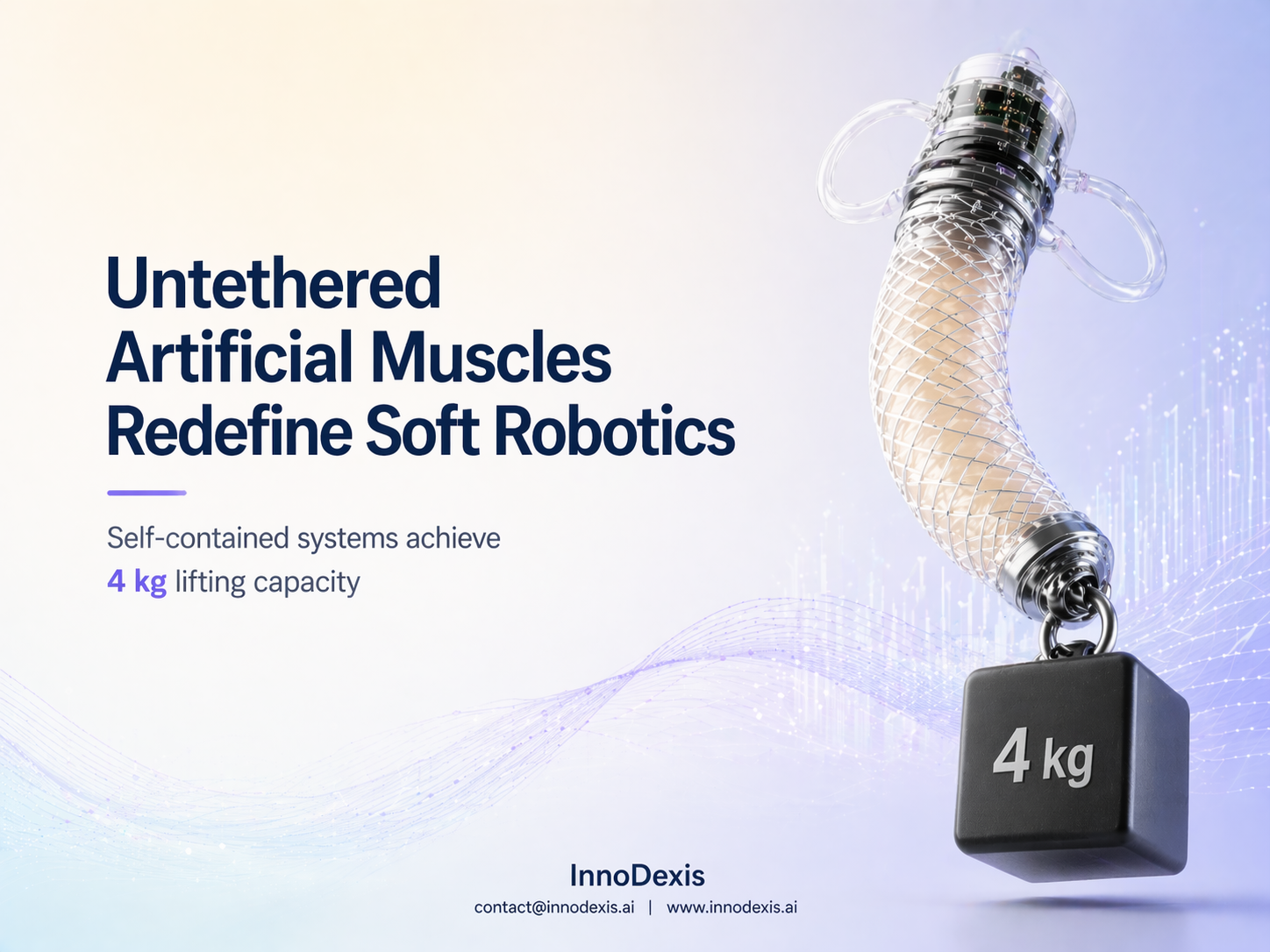
InnoDexis has published its latest Innovation Intelligence Report covering soft robotics and artificial muscle systems, analyzing recent developments in electrically driven actuation technologies. The report reveals that researchers have successfully engineered fully self-contained artificial muscle fibers capable of untethered operation while lifting loads up to 4 kilograms. Developed at Massachusetts Institute of Technology, the system integrates miniaturized electrohydrodynamic pumps, thin McKibben actuators, and closed fluidic circuits, demonstrating a new approach to achieving strength, portability, and compliance in robotic systems.
Key Findings
Researchers developed artificial muscle fibers that operate without external pumps or reservoirs, marking a transition toward fully self-contained actuation systems. This design eliminates dependence on bulky hardware, enabling greater portability and system integration.
The system combines miniaturized electrohydrodynamic pumps with thin McKibben actuators and closed fluidic circuits. This integrated architecture enables electrically driven muscle-like motion while maintaining compact form factors at the millimeter scale.
The artificial muscle fibers demonstrate the ability to lift loads of up to 4 kilograms and launch objects in approximately 0.2 seconds. These performance metrics indicate that soft robotic systems can achieve high القوة output while retaining flexibility and lightweight characteristics.
The use of gram-scale pumps to power millimeter-scale fibers highlights significant miniaturization in actuation systems. This advancement suggests improved scalability for embedding such systems into distributed robotic structures.
The system supports soft and compliant interaction, enabling safe direct contact with humans. This characteristic is particularly relevant for applications where human-robot interaction requires both adaptability and safety.
The fully untethered design represents a departure from traditional soft robotic systems that rely on centralized and external actuation sources. This shift enables greater operational autonomy and expands potential deployment environments.
Strategic Insight and Trend Analysis
The reported development indicates a structural shift in soft robotics from centralized, rigid actuation systems toward distributed, biologically inspired architectures. Traditional robotic systems have relied on external pumps or rigid motors, creating limitations in portability, responsiveness, and safe interaction. The integration of actuation, pumping, and fluidic control within a compact system suggests that these constraints are beginning to be addressed at the design level.
The ability to achieve high القوة output while maintaining compliance and miniaturization reflects convergence between mechanical engineering and biological system design. The architecture mirrors characteristics observed in living muscle systems, where distributed actuation enables adaptive and coordinated movement. This indicates a broader trend in robotics toward replicating biological efficiency rather than optimizing purely mechanical performance.
The elimination of external hardware dependencies reduces system complexity and enables new categories of deployment. Untethered operation allows robotic systems to function in environments where mobility, autonomy, and human proximity are critical. This development suggests that soft robotics is transitioning from experimental prototypes toward more application-ready systems.
The emergence of muscle-like actuation architectures also signals a shift in how robotic systems may be designed and scaled. Instead of centralized القوة sources, future systems may incorporate distributed actuation layers embedded throughout structures. This transition has implications for system resilience, flexibility, and functional adaptability across use cases.
Global and Industry Implications
For corporates and R&D teams, the development introduces a pathway to integrate compact, self-contained actuation systems into next-generation products. Applications in prosthetics, wearable systems, and collaborative robotics may benefit from improved portability, responsiveness, and safety characteristics.
For investors and capital allocators, the findings highlight a maturing segment within soft robotics where performance metrics such as lifting capacity, speed, and autonomy are being demonstrated simultaneously. This convergence may indicate emerging opportunities in platforms that combine hardware innovation with application-specific deployment.
For policymakers and national innovation bodies, advancements in soft, human-safe robotics systems suggest increasing relevance for workforce integration, healthcare technologies, and assistive devices. The ability to deploy robots in close proximity to humans may influence regulatory frameworks and safety standards.
InnoDexis Statement
“The transition from centralized mechanical actuation to distributed, muscle-like systems reflects a structural evolution in robotics, where performance, safety, and adaptability are increasingly shaped by biologically inspired design principles,” noted InnoDexis in its latest intelligence report.
Conclusion
The development of untethered, electrically driven artificial muscle fibers represents a notable progression in soft robotics, combining strength, portability, and compliance within a single system architecture. As robotic systems increasingly adopt biologically inspired designs, the boundary between mechanical devices and adaptive systems may continue to narrow. Applications in healthcare, wearable technologies, and human-interactive environments are likely to expand as these systems mature. The complete Soft Robotics and Artificial Muscle Systems Report is available to InnoDexis subscribers and enterprise clients.
About InnoDexis
InnoDexis is a global Innovation Intelligence platform that tracks, analyzes, and interprets breakthrough innovations, prototypes, and emerging technologies across industries and countries. Its intelligence helps corporates, investors, and policymakers understand the true structure and direction of global innovation. Learn more at innodexis.ai.