Single-Laser Photonics System Simplifies Multi-Color Two-Photon Microscopy While Maintaining Imaging Performance
A research system developed at University Medical Center Hamburg-Eppendorf demonstrates how a single ultrafast laser can replace complex multi-laser microscopy setups without compromising capability.
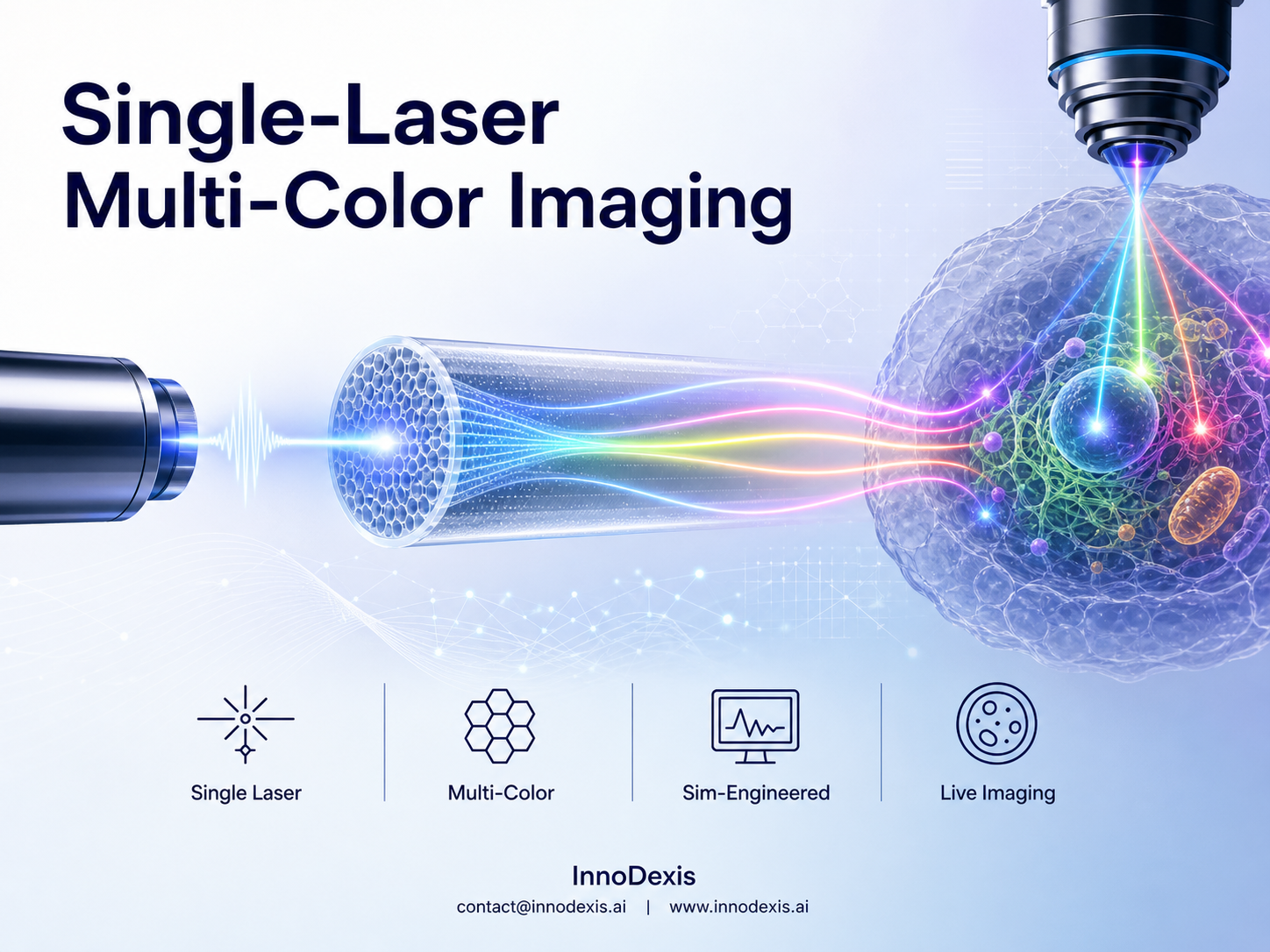
InnoDexis has published its latest Innovation Intelligence Report covering advanced photonics and biomedical imaging, analyzing a novel microscopy system developed at University Medical Center Hamburg-Eppendorf. The report reveals that a single ultrafast fiber laser, combined with photonic crystal fiber engineering, can replace conventional multi-laser configurations in two-photon microscopy. This approach maintains multi-color imaging capability while reducing system complexity, indicating a shift toward more accessible and compact high-performance imaging platforms.
Key Findings
A single ultrafast fiber laser has been demonstrated as a replacement for conventional multi-laser systems in two-photon microscopy. This configuration simplifies the optical architecture while preserving the ability to generate multiple excitation wavelengths required for advanced imaging applications.
Photonic crystal fiber plays a central role in enabling multi-color output. By transmitting the laser through engineered fiber structures, multiple excitation colors can be generated from a single source, removing the need for separate laser units traditionally required for each wavelength.
Spectral outputs are designed deterministically using simulation-based methods. Rather than relying on incremental tuning, the system uses computational modeling to engineer precise spectral characteristics, improving predictability and system control.
The platform enables simultaneous multi-color imaging of cellular interactions. This capability supports the observation of complex biological processes in real time, maintaining the functional advantages of high-end microscopy systems while operating with reduced hardware requirements.
The reduction in system complexity does not compromise imaging performance. The findings indicate that simplified configurations can achieve comparable or improved functionality relative to traditional multi-laser setups, challenging assumptions about the necessity of hardware-intensive designs.
Strategic Insight and Trend Analysis
The system developed at University Medical Center Hamburg-Eppendorf reflects a broader trend toward simplification in advanced scientific instrumentation. Rather than pursuing performance gains through additional hardware layers, innovation is increasingly focused on optimizing system architecture through photonics engineering and simulation-driven design.
The use of a single ultrafast laser combined with photonic crystal fiber represents a shift from component-based scaling to integrated system design. This transition reduces the number of physical elements required while maintaining functional capability, indicating a move toward more compact and efficient research tools.
Simulation-driven spectral engineering further reinforces this trend. By designing optical outputs computationally, researchers can achieve targeted performance characteristics without iterative physical adjustments. This approach reduces development complexity and enables more reproducible system configurations.
Collectively, these developments suggest that the next phase of innovation in microscopy and photonics may prioritize accessibility and deployability alongside performance. As systems become less dependent on complex hardware assemblies, the barrier to adoption across laboratories may decrease, enabling broader utilization of advanced imaging techniques.
Global and Industry Implications
For corporates and R&D teams, the findings indicate an opportunity to develop compact, integrated imaging systems that reduce cost and operational complexity. Simplified photonics architectures may enable wider deployment across research, diagnostics, and applied laboratory environments.
For investors and capital allocators, the shift toward hardware simplification suggests potential in platforms that combine performance with scalability. Technologies that lower adoption barriers while maintaining capability may achieve broader market penetration across life sciences and research tools sectors.
For policymakers and national innovation bodies, increased accessibility to advanced imaging systems may support expansion of research capacity across institutions. Encouraging development and deployment of simplified instrumentation could enhance scientific productivity and enable participation from a wider range of laboratories.
InnoDexis Statement
“The transition from multi-component optical systems to integrated, simulation-driven photonics platforms indicates that simplification, rather than incremental performance gains, may define the next phase of innovation in advanced imaging,” noted InnoDexis in its latest intelligence report.
Conclusion
The emergence of single-laser, multi-color microscopy systems signals a structural shift in how advanced imaging technologies are designed and deployed. By reducing hardware complexity while maintaining performance, such systems may expand accessibility and accelerate biological research workflows. As adoption increases, the focus may increasingly shift from instrumentation constraints to data interpretation and analysis. The complete Photonics and Biomedical Imaging Innovation Intelligence Report is available to InnoDexis subscribers and enterprise clients.
About InnoDexis
InnoDexis is a global Innovation Intelligence platform that tracks, analyzes, and interprets breakthrough innovations, prototypes, and emerging technologies across industries and countries. Its intelligence helps corporates, investors, and policymakers understand the true structure and direction of global innovation. Learn more at innodexis.ai.