Single-Dose Gene Therapy Demonstrates 83% Tumor Clearance in Glioblastoma Models with No Recurrence
Preclinical findings indicate a targeted gene therapy approach combining tumor eradication with immune memory, suggesting a potential shift toward durable oncology interventions.
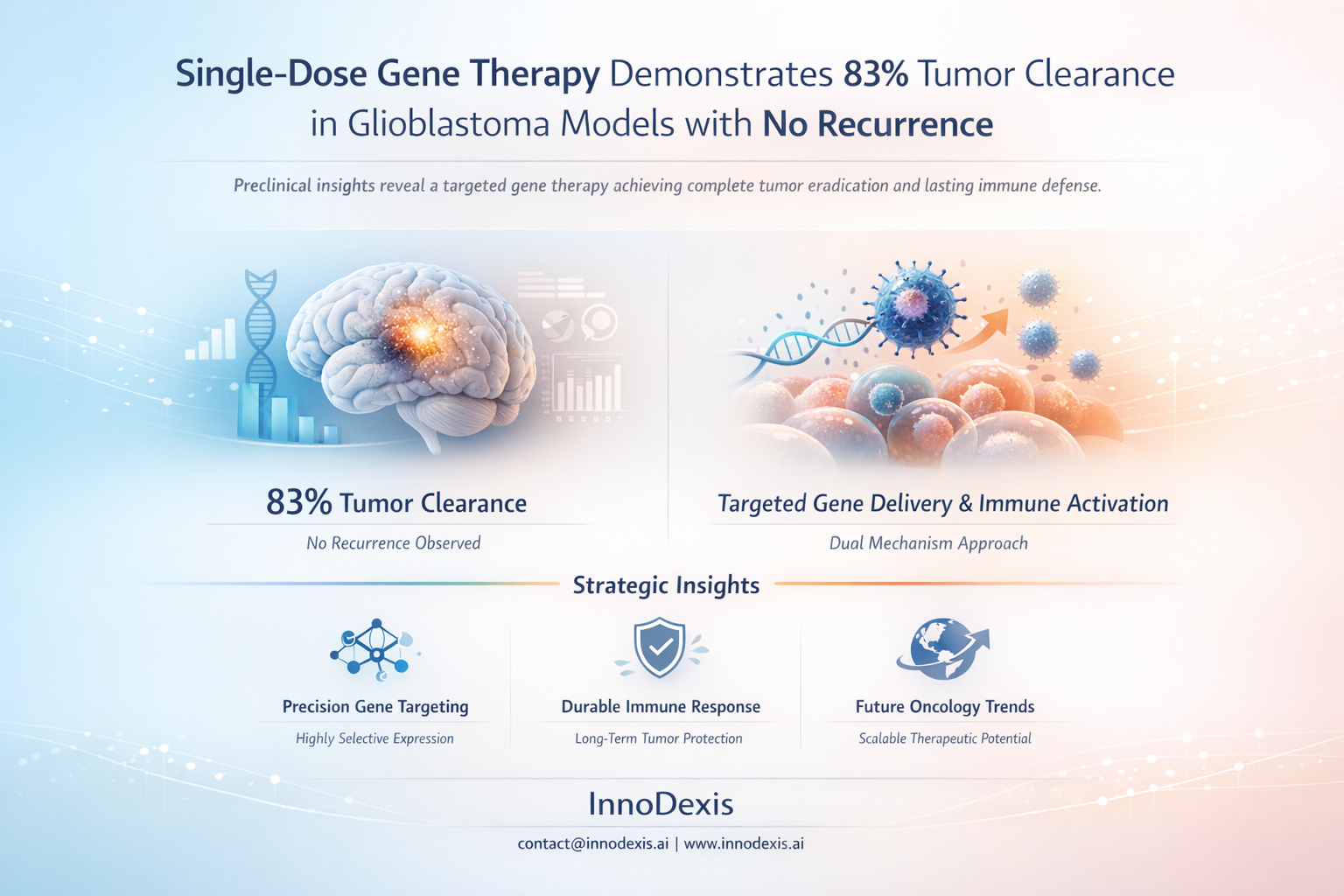
InnoDexis has published its latest Innovation Intelligence Report covering gene therapy in oncology, analyzing a breakthrough preclinical innovation in glioblastoma treatment. The report reveals that a single-dose gene therapy developed at the University of Edinburgh achieved 83% complete tumor clearance in mouse models, with no observed toxicity and no recurrence following tumor reintroduction. The findings indicate a combined mechanism of precise tumor targeting and immune system activation, pointing to a potential transition from repetitive treatment cycles toward durable therapeutic strategies.
Key Findings
A single-dose gene therapy demonstrated 83% complete tumor clearance in glioblastoma mouse models. The results indicate a high level of therapeutic efficacy in one of the most treatment-resistant forms of brain cancer, with outcomes measured through complete tumor eradication.
No toxicity was observed during the preclinical evaluation. The absence of detectable adverse effects suggests that the therapy may achieve selective targeting without damaging surrounding healthy tissue, an ongoing challenge in brain cancer treatment.
No recurrence was reported following tumor reintroduction. The therapy not only eliminated existing tumors but also prevented regrowth, indicating the activation of a sustained biological response beyond initial treatment.
The approach uses a synthetic super enhancer to drive highly selective gene expression. This precision-targeting mechanism enables the therapy to focus activity within tumor cells, reducing off-target effects and increasing treatment specificity.
A viral “Trojan horse” delivery system was employed to reach tumor cells effectively. This delivery method facilitates the transport of therapeutic genetic material into cancer cells, overcoming biological barriers typically associated with gene therapy.
The therapy combines tumor destruction with immune system activation. This dual mechanism indicates that the treatment may prime long-term immune defense, enabling the body to recognize and respond to future tumor formation.
Strategic Insight and Trend Analysis
The findings point to a convergence between gene therapy and immunological memory as a defining trend in next-generation oncology. The ability of a single intervention to both eliminate tumors and prevent recurrence suggests a shift in therapeutic design from short-term disease management toward sustained biological reprogramming.
Glioblastoma has historically been resistant to conventional treatment modalities, including surgery, radiation, and chemotherapy. The demonstrated efficacy of a single-dose intervention in preclinical models indicates that precision-targeted genetic approaches may address limitations associated with repeated and invasive treatment cycles.
The use of a synthetic super enhancer for selective gene expression reflects a broader movement toward programmable biological systems. By enabling highly targeted activation within tumor cells, this approach aligns with emerging strategies that seek to increase efficacy while minimizing systemic exposure.
The integration of immune activation within the therapeutic mechanism suggests that gene therapies are increasingly being designed not only to treat existing disease but to establish long-term defense. This dual-action model reflects a structural evolution in how oncology interventions are conceptualized, combining immediate therapeutic outcomes with preventive functionality.
If replicated in human clinical settings, this approach could extend beyond glioblastoma into a broader platform applicable to multiple solid tumor types. The combination of precision targeting, effective delivery, and immune priming positions this innovation within a category of therapies focused on durability rather than continuous intervention.
Global and Industry Implications
For corporates and R&D teams, the findings indicate a potential shift toward integrated therapeutic platforms that combine gene delivery with immune activation. This approach may influence future pipeline development, particularly in areas where conventional treatments have shown limited effectiveness.
For investors and capital allocators, the emergence of single-dose, durable therapies highlights a category of innovation that may redefine value creation in oncology. Technologies demonstrating both efficacy and recurrence prevention in preclinical stages may represent early signals of scalable therapeutic platforms.
For policymakers and national innovation bodies, advancements in gene therapy and precision oncology may require updated regulatory frameworks that address both safety and long-term immune effects. The transition from repeated treatments to one-time interventions may also have implications for healthcare delivery models and reimbursement structures.
InnoDexis Statement
“The emergence of single-dose gene therapies that combine tumor eradication with immune memory reflects a structural shift in oncology, where durability and long-term biological response are becoming central to therapeutic design,” noted InnoDexis in its latest intelligence report.
Conclusion
The development of a single-dose gene therapy demonstrating tumor clearance and recurrence prevention in glioblastoma models signals a potential transition in cancer treatment paradigms. By integrating precision targeting with immune system activation, the approach moves beyond incremental improvement toward sustained therapeutic impact. As the field progresses toward clinical validation, the scalability and applicability of such models across other cancers will be a critical area to monitor. The complete Gene Therapy in Glioblastoma Innovation Intelligence Report is available to InnoDexis subscribers and enterprise clients.
About InnoDexis
InnoDexis is a global Innovation Intelligence platform that tracks, analyzes, and interprets breakthrough innovations, prototypes, and emerging technologies across industries and countries. Its intelligence helps corporates, investors, and policymakers understand the true structure and direction of global innovation. Learn more at innodexis.ai.