Risk-Based Food Safety Models Emerge as Alternative to Zero-Tolerance Standards Amid Rising Waste Concerns
Research indicates that increasingly sensitive detection systems may be driving unnecessary food rejection, prompting a shift toward AI-enabled, context-aware safety frameworks.
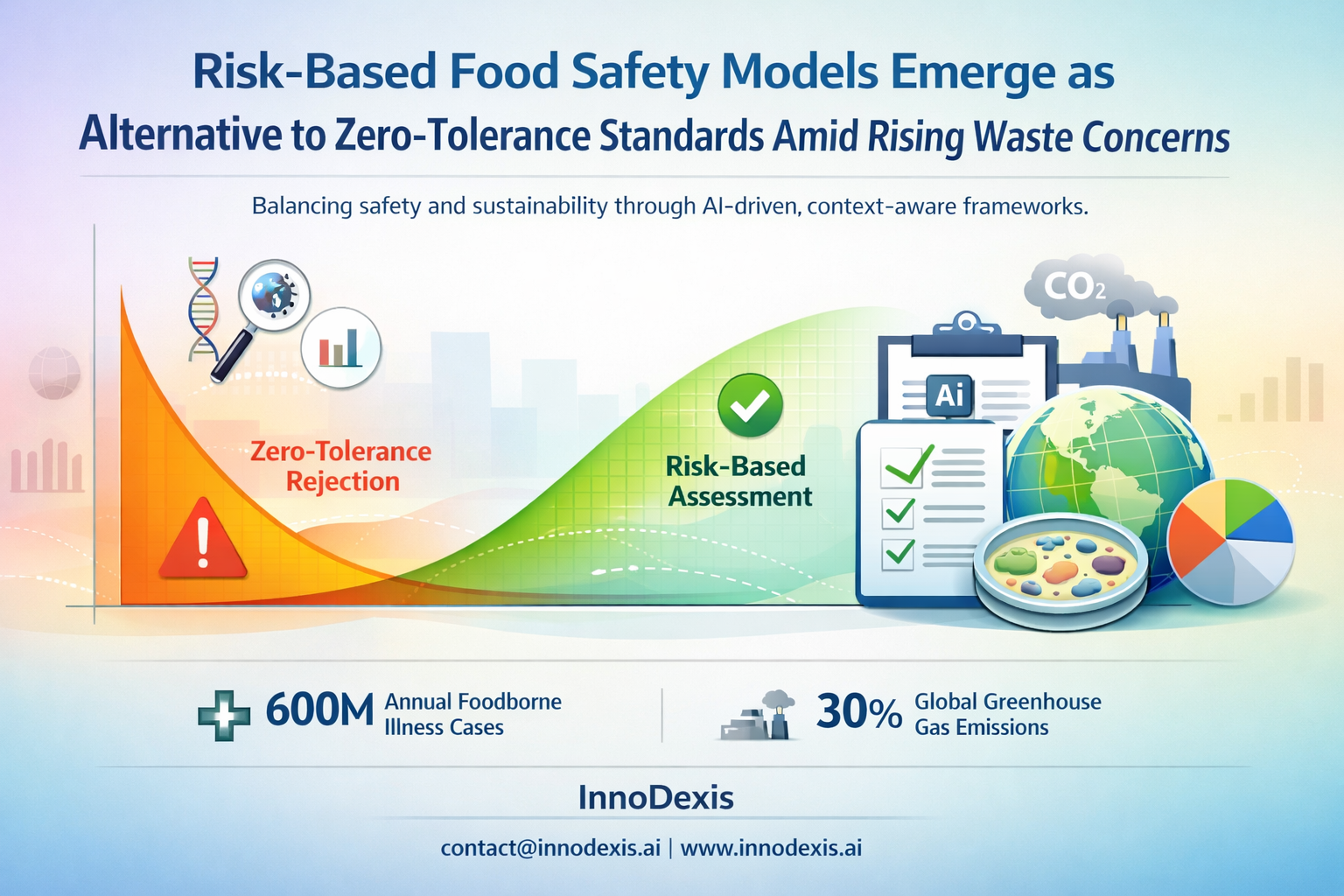
InnoDexis has published its latest Innovation Intelligence Report covering food safety systems and risk assessment models, analyzing emerging research on the balance between safety standards and food system efficiency. The report reveals that researchers from Ludwig Maximilian University of Munich are proposing a transition from zero-tolerance frameworks toward risk-based, data-driven decision systems. With advances in AI, genomics, and predictive modeling enabling highly sensitive detection of contaminants, the findings indicate that current safety approaches may contribute to avoidable food waste without proportionate public health benefit.
Key Findings
Advances in detection technologies have significantly increased the sensitivity of food safety systems. Modern analytical methods are now capable of identifying extremely low levels of pathogens, including those that may not pose a meaningful health risk under typical consumption conditions.
This increased sensitivity is influencing regulatory and operational decisions within food systems. In many cases, the detection of minimal contamination levels results in the rejection of food products, reflecting the persistence of zero-tolerance standards across multiple regulatory environments.
Researchers from Ludwig Maximilian University of Munich propose a shift toward risk-based frameworks that incorporate contextual evaluation of contamination levels. These systems leverage artificial intelligence, genomics, and predictive modeling to assess the actual likelihood and severity of health outcomes rather than relying solely on presence-based detection.
The proposed approach includes the concept of evidence-based acceptable pathogen thresholds. By distinguishing between negligible and significant risks, such frameworks aim to reduce unnecessary food rejection while maintaining public health protections.
The broader system context highlights the scale of the challenge. Approximately 600 million foodborne illness cases and 420,000 associated deaths occur annually worldwide, while food systems contribute roughly 30% of global greenhouse gas emissions. This dual pressure underscores the need to balance safety, sustainability, and food security objectives.
Strategic Insight and Trend Analysis
The emergence of risk-based food safety models reflects a structural shift from binary decision-making toward probabilistic and context-aware systems. Traditional zero-tolerance frameworks operate on the principle that any detectable presence of a contaminant constitutes unacceptable risk, regardless of concentration or exposure conditions.
However, advances in AI, genomics, and predictive analytics are enabling a more nuanced understanding of contamination. By integrating data on pathogen behavior, environmental conditions, and exposure pathways, these systems can estimate actual risk levels rather than relying on detection alone.
This shift aligns with broader trends in digital transformation across food and agricultural systems, where data-driven decision-making is replacing static regulatory thresholds. The ability to differentiate between negligible and material risk introduces the possibility of optimizing food safety outcomes while reducing system inefficiencies.
The findings also highlight an emerging convergence between food safety and sustainability objectives. Rejecting food products based on minimal or non-impactful contamination may reduce perceived risk but can contribute to increased waste and associated environmental impact. As food systems account for a significant share of global emissions, reducing unnecessary waste becomes an important component of climate strategy.
The transition from zero tolerance to risk-optimized systems does not imply a reduction in safety standards. Instead, it reflects a redefinition of how safety is measured and managed, incorporating scientific evidence, probabilistic modeling, and system-level impact considerations.
Global and Industry Implications
For corporates and R&D teams within food production and supply chains, risk-based safety frameworks may enable more efficient quality control processes. Integrating AI-driven assessment tools could reduce unnecessary product rejection while maintaining compliance with evolving safety standards.
For investors and capital allocators, the convergence of food safety, sustainability, and data analytics presents opportunities in technologies that support precision risk assessment. Platforms combining genomics, AI, and predictive modeling may become increasingly relevant within agri-food innovation ecosystems.
For policymakers and national innovation bodies, the findings suggest a need to evaluate existing regulatory frameworks in the context of technological advancements. Aligning food safety policies with scientific risk assessment and sustainability goals may support more balanced outcomes across public health and environmental priorities.
InnoDexis Statement
“The shift toward risk-based food safety systems reflects an evolution from detection-driven decisions to evidence-based risk management aligned with both public health and sustainability objectives,” noted InnoDexis in its latest intelligence report.
Conclusion
The transition from zero-tolerance standards to risk-based food safety models represents a potential inflection point in how global food systems manage safety and efficiency. As detection technologies continue to advance, the ability to distinguish between negligible and meaningful risk may become increasingly important in reducing waste while maintaining health protections. Integrating AI, genomics, and predictive analytics into safety frameworks may enable more precise and balanced decision-making. The complete Food Safety Innovation Intelligence Report is available to InnoDexis subscribers and enterprise clients.
About InnoDexis
InnoDexis is a global Innovation Intelligence platform that tracks, analyzes, and interprets breakthrough innovations, prototypes, and emerging technologies across industries and countries. Its intelligence helps corporates, investors, and policymakers understand the true structure and direction of global innovation. Learn more at innodexis.ai.