Rising Night-Time Temperatures Drive Measurable Global Sleep Loss as Heat Exposure Intensifies
A decade-long synthesis reveals that increasing night-time heat is systematically reducing sleep duration, with compounding physiological effects across populations.
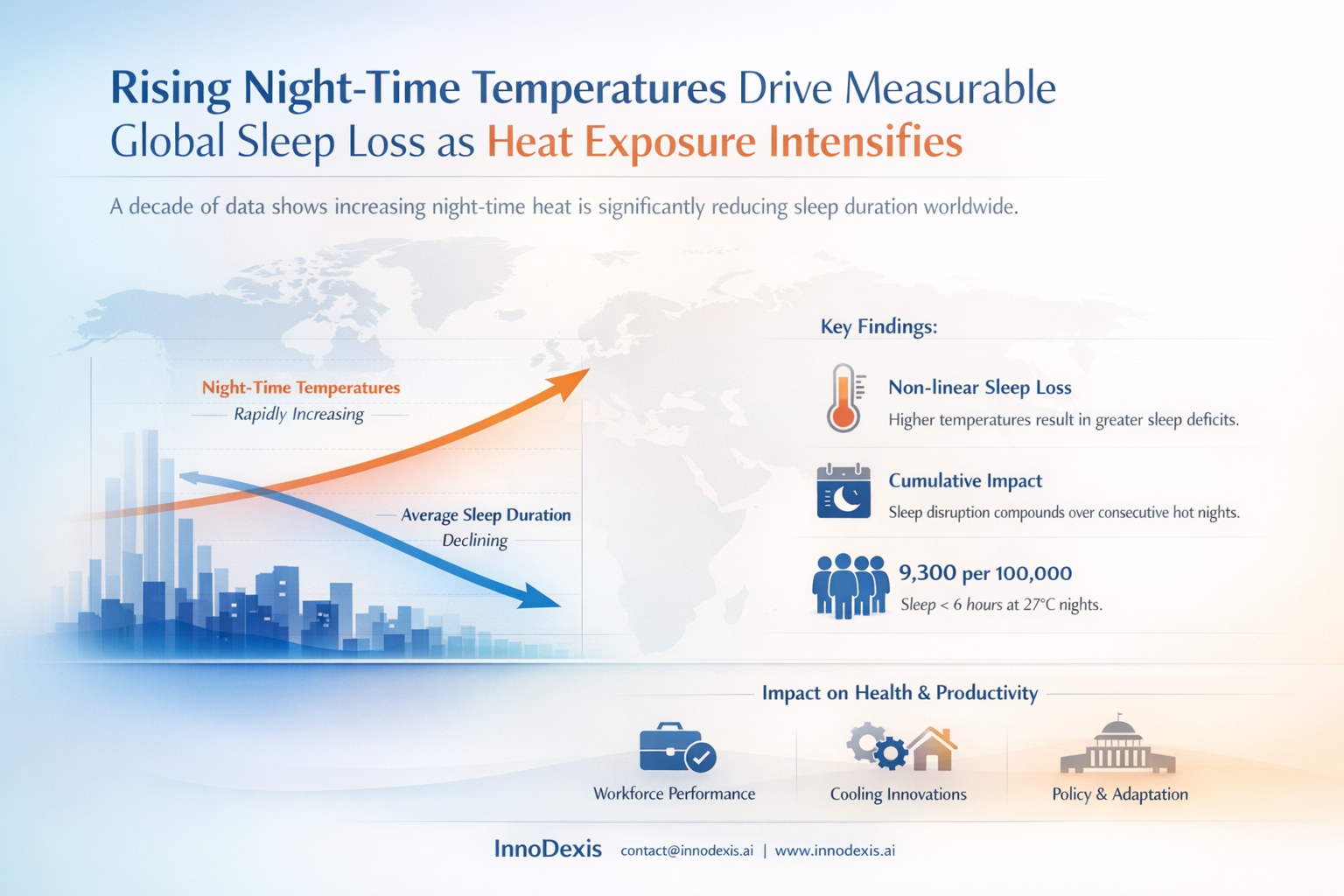
InnoDexis has published its latest Innovation Intelligence Report covering climate-linked human health impacts, analyzing longitudinal sleep and temperature data across global populations over a decade. The report reveals that rising night-time temperatures are directly associated with measurable reductions in sleep duration, with effects intensifying non-linearly as temperatures increase. As nights warm faster than days, the findings indicate that climate change is increasingly influencing biological recovery cycles, positioning sleep disruption as a growing global health and performance concern.
Key Findings
Night-time temperatures are increasing at a faster rate than daytime temperatures, creating a disproportionate impact on human recovery cycles. This shift directly affects sleep quality, as the body’s ability to cool during rest periods becomes increasingly constrained.
The relationship between temperature and sleep loss is non-linear, with each incremental rise in night-time temperature producing a progressively larger reduction in sleep duration. This indicates that marginal increases in heat exposure can lead to disproportionately higher physiological strain.
Sleep disruption compounds across consecutive hot nights. Even when temperatures decline, the cumulative effect of prior exposure continues to reduce sleep duration, suggesting that recovery is not immediate and that heat stress has lingering impacts.
At approximately 27°C night-time temperatures, an additional 9,300 individuals per 100,000 experience sleep durations of less than six hours. This quantifies the population-scale impact of heat on insufficient sleep, linking temperature thresholds to measurable human outcomes.
The findings collectively indicate that sleep loss is not an isolated response to extreme heat events, but a systemic effect associated with gradual climatic shifts. As night-time warming continues, the frequency and intensity of sleep disruption are expected to increase across regions.
Strategic Insight and Trend Analysis
The data points to a structural shift in how climate change interacts with human physiology. Traditionally framed as an environmental or ecological challenge, rising temperatures are now directly influencing biological functions, particularly sleep, which is central to cognitive performance and long-term health.
The acceleration of night-time warming introduces a persistent constraint on recovery cycles. Unlike daytime heat exposure, which can be mitigated through behavioral adjustments, night-time heat directly interferes with the body’s thermoregulatory processes during sleep. This reduces the capacity for physiological restoration, creating a cumulative deficit over time.
The non-linear relationship between temperature and sleep loss suggests that incremental climate changes may produce disproportionate human impacts. This dynamic increases the urgency of addressing night-time heat exposure, as small increases in average temperatures can translate into significant population-level effects.
The compounding nature of sleep disruption across consecutive nights further indicates that the impact is not episodic but continuous. As a result, the burden of heat-related sleep loss is likely to accumulate in regions experiencing sustained temperature increases, reinforcing disparities in health and productivity outcomes.
Collectively, the findings position sleep disruption as a measurable interface between climate systems and human performance. This reframes climate impact from an external environmental issue to an internal physiological constraint embedded in daily life.
Global and Industry Implications
For corporates and R&D teams, reduced sleep quality at scale has implications for workforce productivity, cognitive performance, and operational risk. As sleep disruption becomes more widespread, organizations may need to incorporate environmental and occupational adjustments to maintain performance stability.
For investors and capital allocators, the findings indicate emerging demand for solutions in cooling technologies, adaptive housing design, and climate-responsive infrastructure. Sectors addressing thermal comfort and recovery environments may see increased relevance as heat-related physiological impacts intensify.
For policymakers and national innovation bodies, rising night-time temperatures highlight the need to integrate public health considerations into climate adaptation strategies. Urban planning, housing standards, and infrastructure design may increasingly be evaluated based on their ability to support human recovery and resilience.
InnoDexis Statement
“Rising night-time temperatures are transforming climate change into a direct physiological constraint, where the ability to recover through sleep becomes a measurable limiting factor for health, productivity, and long-term human performance,” noted InnoDexis in its latest intelligence report.
Conclusion
The analysis highlights a growing convergence between climate dynamics and human biological limits, with sleep emerging as a critical indicator of systemic stress. As night-time temperatures continue to rise, the ability to maintain consistent recovery cycles may become a defining factor in both public health and economic productivity. The findings suggest that future climate resilience strategies will need to extend beyond daytime mitigation to include night-time recovery conditions. The complete Climate and Sleep Impact Report is available to InnoDexis subscribers and enterprise clients.
About InnoDexis
InnoDexis is a global Innovation Intelligence platform that tracks, analyzes, and interprets breakthrough innovations, prototypes, and emerging technologies across industries and countries. Its intelligence helps corporates, investors, and policymakers understand the true structure and direction of global innovation. Learn more at innodexis.ai.