Real-Time Imaging Reveals How Lithium Metal Batteries Begin to Fail at the Nanoscale
Research from Korea Advanced Institute of Science and Technology identifies the precise formation dynamics of “dead lithium,” a major barrier to next-generation battery commercialization.
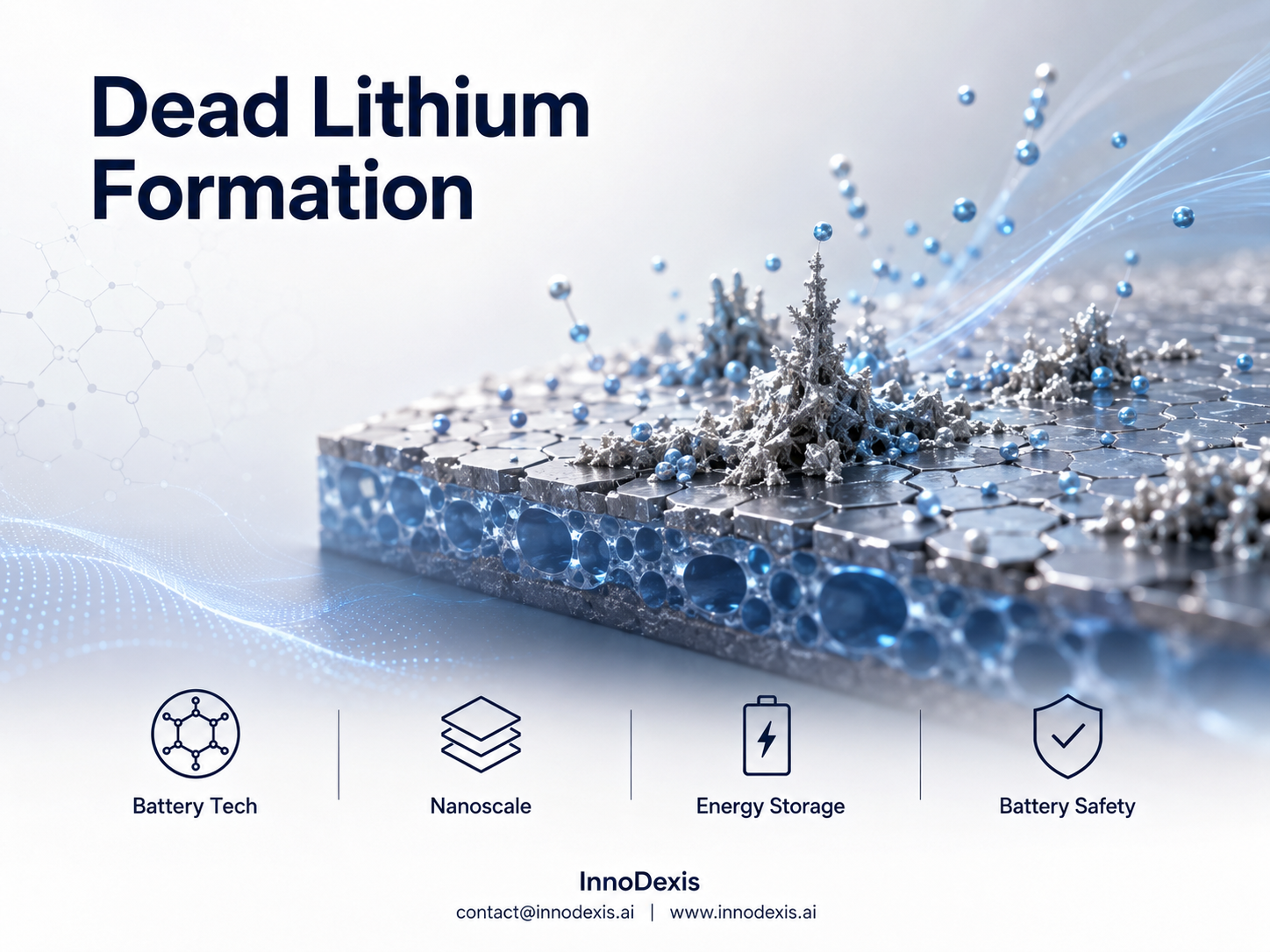
InnoDexis has published its latest Innovation Intelligence Report covering next-generation battery technologies, analyzing recent research conducted at Korea Advanced Institute of Science and Technology. The report reveals that researchers have directly observed, in real time, how “dead lithium” forms inside lithium metal batteries during charging cycles. Using nanoscale imaging techniques, the findings identify specific degradation mechanisms linked to instability and performance decline, providing new visibility into one of the most significant technical barriers limiting commercialization of advanced electric vehicle battery systems.
Key Findings
Researchers at Korea Advanced Institute of Science and Technology used in situ electrochemical atomic force microscopy (EC-AFM) imaging to observe lithium metal battery degradation in real time at the nanoscale. This approach enabled direct visualization of internal structural changes during battery operation rather than relying on post-cycle analysis.
The study identified irregular lithium stripping in porous regions as the primary mechanism responsible for the formation of “dead lithium.” These inactive lithium deposits reduce battery efficiency and contribute to rapid performance degradation over repeated charging cycles.
The findings also demonstrate that early lithium deposition morphology significantly influences long-term battery stability. Initial structural patterns formed during charging were shown to affect subsequent degradation behavior, suggesting that early-stage material organization plays a critical role in battery lifespan.
The ability to directly monitor degradation pathways provides a more precise understanding of failure dynamics in lithium metal batteries. Rather than inferring instability indirectly, researchers can now observe how structural changes emerge and evolve during operation.
The implications extend to battery safety, energy density, and charging performance. By identifying how and where degradation begins, the research may support improved engineering strategies for extending operational life and increasing reliability in next-generation battery systems.
Strategic Insight and Trend Analysis
The findings from Korea Advanced Institute of Science and Technology indicate a broader transition in battery innovation from material discovery toward failure-mechanism engineering. While lithium metal batteries have long been viewed as a pathway to higher energy density and extended electric vehicle range, commercialization has been constrained by instability during repeated charging cycles.
Direct nanoscale visualization changes how these limitations can be addressed. Traditional battery development has often depended on iterative optimization, where performance improvements are achieved through repeated testing and adjustment. The ability to observe degradation mechanisms in real time introduces a more targeted engineering framework focused on understanding the origins of failure during actual operating conditions.
The identification of irregular lithium stripping as a source of “dead lithium” suggests that microscopic structural behavior may be as important as chemical composition in determining battery performance. This reframes battery development as a problem involving both materials science and dynamic system behavior at the nanoscale.
The research also reflects increasing convergence between advanced imaging technologies and energy storage engineering. As visualization capabilities improve, battery innovation may become increasingly data-driven, enabling predictive modeling of degradation pathways before large-scale deployment.
Collectively, the findings suggest that future advances in energy storage may depend not only on discovering new chemistries, but on controlling how materials behave and deteriorate over time under real-world operational stress.
Global and Industry Implications
For corporates and R&D teams, the findings highlight the growing importance of nanoscale diagnostic capabilities in battery development. Integrating real-time imaging and degradation analysis into research workflows may accelerate optimization cycles and improve battery reliability.
For investors and capital allocators, the ability to directly observe failure mechanisms may reduce technical uncertainty surrounding lithium metal battery commercialization. Companies developing advanced battery diagnostics, materials engineering, and degradation-control technologies could gain strategic relevance within the electric mobility ecosystem.
For policymakers and national innovation bodies, the research reinforces the importance of supporting next-generation energy storage infrastructure and advanced materials science. Improvements in battery stability and lifespan are likely to remain central to electric vehicle adoption, energy transition goals, and supply chain competitiveness.
InnoDexis Statement
“The ability to directly visualize lithium degradation mechanisms in real time represents a structural shift in battery engineering, enabling next-generation energy storage systems to be optimized through failure analysis rather than iterative trial-and-error development,” noted InnoDexis in its latest intelligence report.
Conclusion
The research conducted at Korea Advanced Institute of Science and Technology provides new insight into how lithium metal batteries degrade at the nanoscale during operation. By identifying the mechanisms responsible for “dead lithium” formation, the findings establish a clearer pathway for improving battery stability, safety, and lifespan. As electric vehicle adoption and energy storage demands continue to increase globally, understanding microscopic failure dynamics may become a defining factor in the commercialization of next-generation battery technologies. The complete Next-Generation Battery Innovation Intelligence Report is available to InnoDexis subscribers and enterprise clients.
About InnoDexis
InnoDexis is a global Innovation Intelligence platform that tracks, analyzes, and interprets breakthrough innovations, prototypes, and emerging technologies across industries and countries. Its intelligence helps corporates, investors, and policymakers understand the true structure and direction of global innovation. Learn more at innodexis.ai.