Real-Time AI Video Generation Advances as Interactive Control Replaces Iterative Prompting
Adobe Research’s MotionStream system signals a shift from prompt-based video generation to continuous, real-time creative direction.
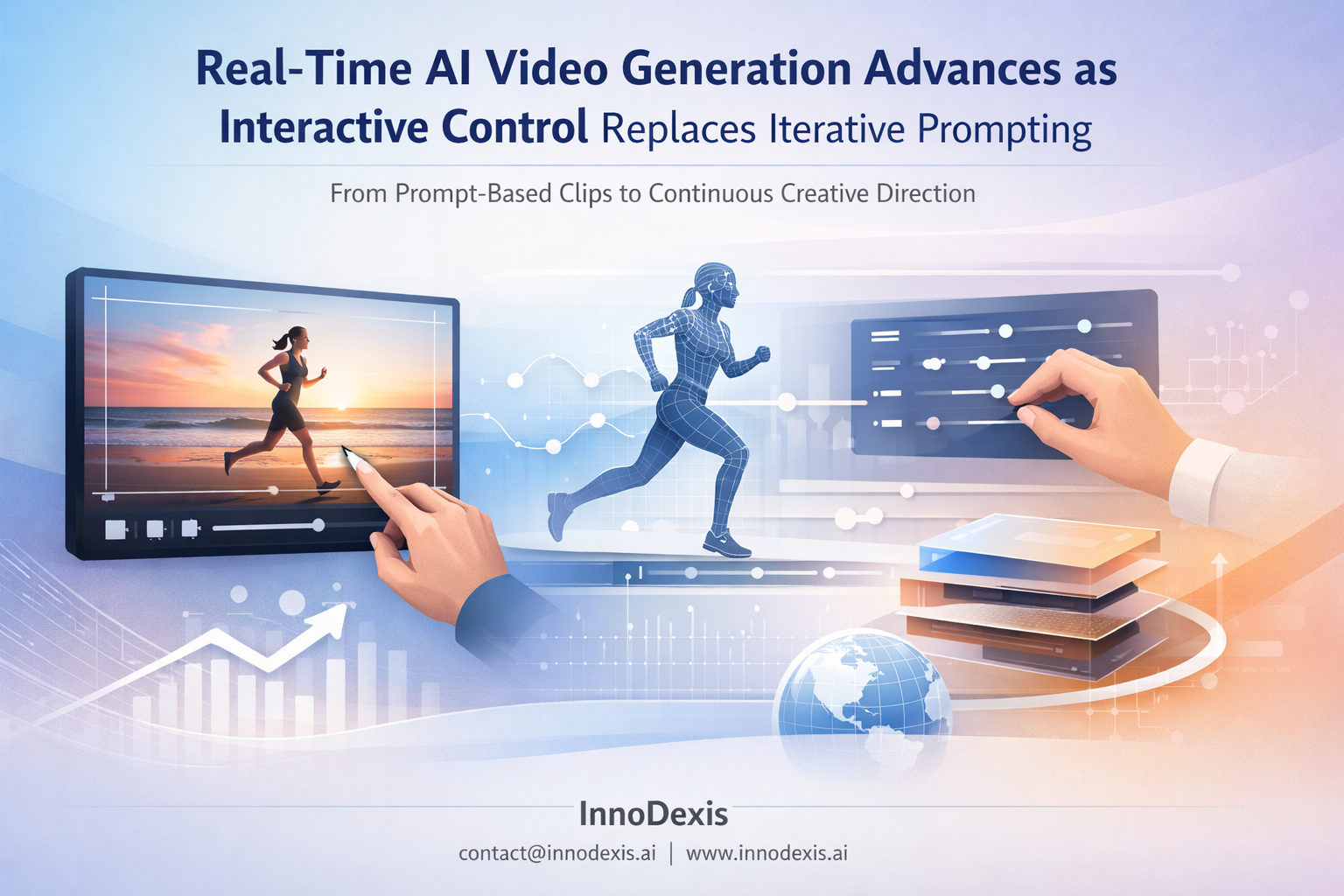
InnoDexis has published its latest Innovation Intelligence Report covering generative AI video systems, analyzing emerging real-time interaction models in AI-driven media during early 2026. The report reveals that advancements in autoregressive video generation now enable real-time, interactive control of AI-generated scenes, eliminating traditional latency constraints. With systems such as MotionStream demonstrating frame-by-frame generation with immediate feedback, the findings indicate a transition from iterative prompting workflows to continuous creative direction environments.
Key Findings
A real-time AI video system developed by Adobe Research enables interactive control over generated video content as it is being created. This represents a departure from traditional workflows where users generate discrete clips and iterate through multiple cycles to achieve desired outputs.
The system is built on autoregressive video generation, producing content frame-by-frame in real time. This architecture allows continuous rendering rather than batch-based generation, aligning output more closely with live input.
Users can manipulate motion, camera angles, and objects dynamically through cursor-based inputs and interface controls such as sliders. This introduces a direct interaction layer between creator and system, reducing dependence on static text prompts.
The system provides instant visual feedback with no observable latency between input and output. This eliminates delays that have historically constrained generative media workflows and introduces a continuous feedback loop.
Embedded physics realism, including natural motion behavior and fluid dynamics, is integrated into the generated video. This enhances the consistency and plausibility of outputs, particularly in dynamic or motion-heavy scenes.
Strategic Insight and Trend Analysis
The emergence of real-time, interactive AI video systems reflects a broader shift in generative media from discrete generation toward continuous control environments. Traditional prompt-based systems operate through sequential iteration, requiring users to generate, evaluate, and refine outputs across multiple cycles. The MotionStream approach collapses this process into a single, uninterrupted interaction loop.
Latency has historically functioned as a structural limitation in generative media systems. Delays between input and output introduce friction in creative workflows, constraining experimentation and slowing production timelines. The removal of this latency transforms the interaction model, enabling immediate adjustment and refinement as content is generated.
This transition suggests that generative AI is evolving from a tool that executes instructions to a system that responds dynamically to user direction. The distinction is operational: instead of defining outcomes in advance through prompts, users guide outcomes in real time through continuous input.
The shift from prompt-based rendering to real-time creative direction also indicates a change in required skill sets. Prompt engineering, which focuses on input optimization, may become less central as direct manipulation interfaces gain prominence. In its place, the ability to steer systems dynamically—adjusting motion, framing, and composition in real time—becomes more relevant.
Global and Industry Implications
For corporates and creative production teams, real-time AI video systems introduce the potential to compress ideation, editing, and production into a unified workflow. This could reduce production timelines and enable more iterative experimentation within shorter cycles.
For investors and capital allocators, the transition toward interactive generative systems highlights a new category of creative infrastructure. Platforms that enable real-time control may represent differentiated value compared to traditional generative models focused solely on output quality.
For policymakers and digital media regulators, the increasing realism and immediacy of AI-generated video may require updated frameworks around content authenticity, usage, and attribution. Real-time generation capabilities could accelerate both legitimate and unauthorized media production.
InnoDexis Statement
“The transition from prompt-based generation to real-time interaction represents a structural shift in how generative systems are used, moving from static instruction models toward continuous human-in-the-loop control,” noted InnoDexis in its latest intelligence report.
Conclusion
The development of real-time AI video systems signals a change in how generative media is created and controlled. By removing latency and enabling continuous interaction, these systems redefine workflows across creative and production environments. As the technology advances, the balance between automation and human direction will shape adoption across industries. The complete Real-Time AI Video Innovation Intelligence Report is available to InnoDexis subscribers and enterprise clients.
About InnoDexis
InnoDexis is a global Innovation Intelligence platform that tracks, analyzes, and interprets breakthrough innovations, prototypes, and emerging technologies across industries and countries. Its intelligence helps corporates, investors, and policymakers understand the true structure and direction of global innovation. Learn more at innodexis.ai.