Quantum Detection Advances as Semiconductor Device Enables Measurement of Individual Microwave Photons
A semiconductor-based architecture achieves up to 70% detection efficiency, addressing a long-standing limitation in quantum systems reliant on microwave photon measurement.
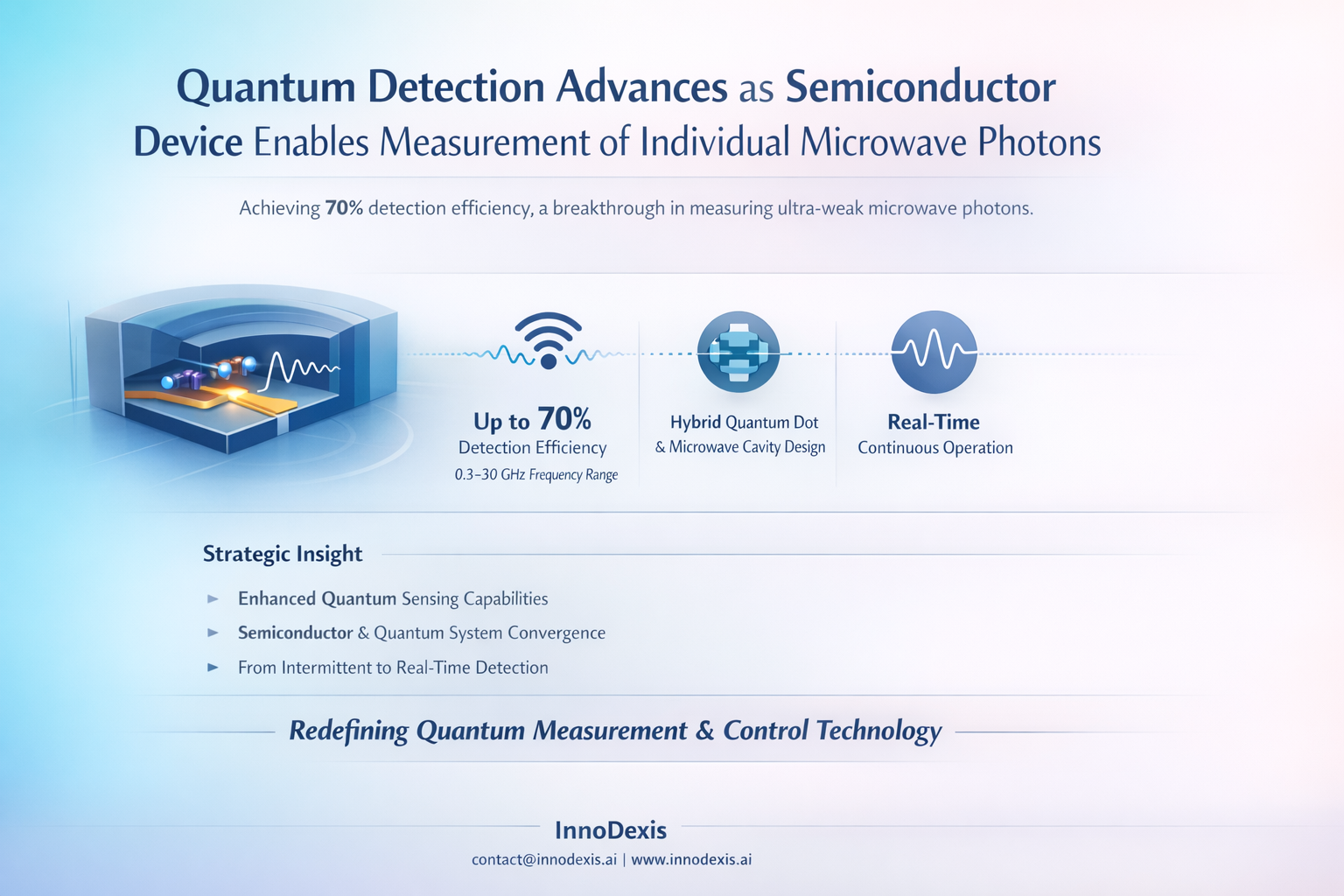
InnoDexis has published its latest Innovation Intelligence Report covering quantum sensing and semiconductor-based detection technologies, analyzing emerging breakthroughs in microwave photon measurement. The report highlights a development at the Swiss Federal Institute of Technology Lausanne, where researchers have demonstrated a semiconductor device capable of detecting individual microwave photons. The findings indicate that signals up to 100,000× weaker than visible light can now be measured, addressing a persistent constraint in quantum computing, sensing, and communication systems.
Key Findings
Researchers at the Swiss Federal Institute of Technology Lausanne have demonstrated the ability to detect individual microwave photons, representing a measurable advance in quantum sensing capability. Microwave photons, which carry significantly lower energy than visible light, have historically been difficult to observe with precision, limiting their practical use in quantum systems.
The device achieves detection efficiency of up to 70% across a frequency range of 0.3–30 GHz. This level of sensitivity represents a substantial improvement in measurement reliability, particularly for systems where weak signal detection is critical to operational performance.
The architecture integrates a double quantum dot with a microwave cavity, forming a hybrid semiconductor platform. This configuration enables interaction between microwave signals and electronic states, allowing previously undetectable photon events to be captured and processed.
The system operates continuously without requiring reset cycles, enabling real-time detection of microwave photons. Continuous operation addresses a key limitation in earlier detection methods, which often required intermittent measurement processes that constrained system scalability.
The device converts ultra-weak microwave photon signals into measurable electrical current. This signal translation mechanism allows integration with existing electronic systems, facilitating downstream processing and potential system-level applications.
Strategic Insight and Trend Analysis
The reported development indicates a shift in quantum technology progression from computational performance alone toward measurement and control capabilities. While advancements in qubit speed and coherence have historically defined progress, the ability to reliably detect and interpret quantum signals is emerging as a parallel requirement for system scalability.
Microwave photons serve as information carriers in multiple quantum architectures, including superconducting quantum systems. Their low energy profile has made detection inherently difficult, creating a persistent bottleneck in system performance. The ability to measure such signals with high efficiency introduces a new layer of operational visibility within quantum environments.
The integration of semiconductor components with quantum detection architectures suggests a convergence between traditional electronics and quantum systems. By enabling signal conversion into electrical current, the technology aligns quantum measurement processes with established semiconductor frameworks, potentially simplifying integration pathways.
The transition from intermittent to continuous detection further reflects a move toward real-time system operation. This capability may influence how quantum systems are monitored, controlled, and scaled, particularly in environments where uninterrupted signal tracking is required. Collectively, these developments indicate that detection technologies are becoming foundational components in the evolution of quantum infrastructure.
Global and Industry Implications
For corporates and R&D teams, the advancement introduces opportunities to integrate improved detection capabilities into quantum system design. Enhanced measurement reliability may support the development of more stable and scalable quantum devices across computing and sensing applications.
For investors and capital allocators, the findings highlight detection technologies as a distinct segment within quantum innovation. As system bottlenecks shift, enabling components such as sensing and measurement infrastructure may represent emerging areas of technical and commercial focus.
For policymakers and national innovation bodies, developments in quantum detection underscore the importance of supporting foundational technologies alongside computational advancements. Strengthening capabilities in measurement and control may influence national positioning in quantum technology ecosystems.
InnoDexis Statement
“The ability to reliably detect ultra-low-energy signals represents a structural shift in quantum system development, where measurement capabilities are increasingly central to unlocking scalable performance,” noted InnoDexis in its latest intelligence report.
Conclusion
The emergence of semiconductor-based microwave photon detection reflects a broader transition in quantum technology, where visibility into system behavior becomes as critical as computational advancement. As detection efficiency improves and integration with electronic systems becomes more feasible, the role of sensing technologies is expected to expand across quantum applications. Monitoring developments in detection architectures may provide early signals of progress in scalable quantum systems. The complete Quantum Sensing Innovation Intelligence Report is available to InnoDexis subscribers and enterprise clients.
About InnoDexis
InnoDexis is a global Innovation Intelligence platform that tracks, analyzes, and interprets breakthrough innovations, prototypes, and emerging technologies across industries and countries. Its intelligence helps corporates, investors, and policymakers understand the true structure and direction of global innovation. Learn more at innodexis.ai.