Physical AI Expands Across 32 Countries as Robotics Shifts Toward Infrastructure-Scale Deployment
A new InnoDexis intelligence report indicates that robotics is evolving from isolated automation systems into integrated, AI-driven operational infrastructure across industrial environments.
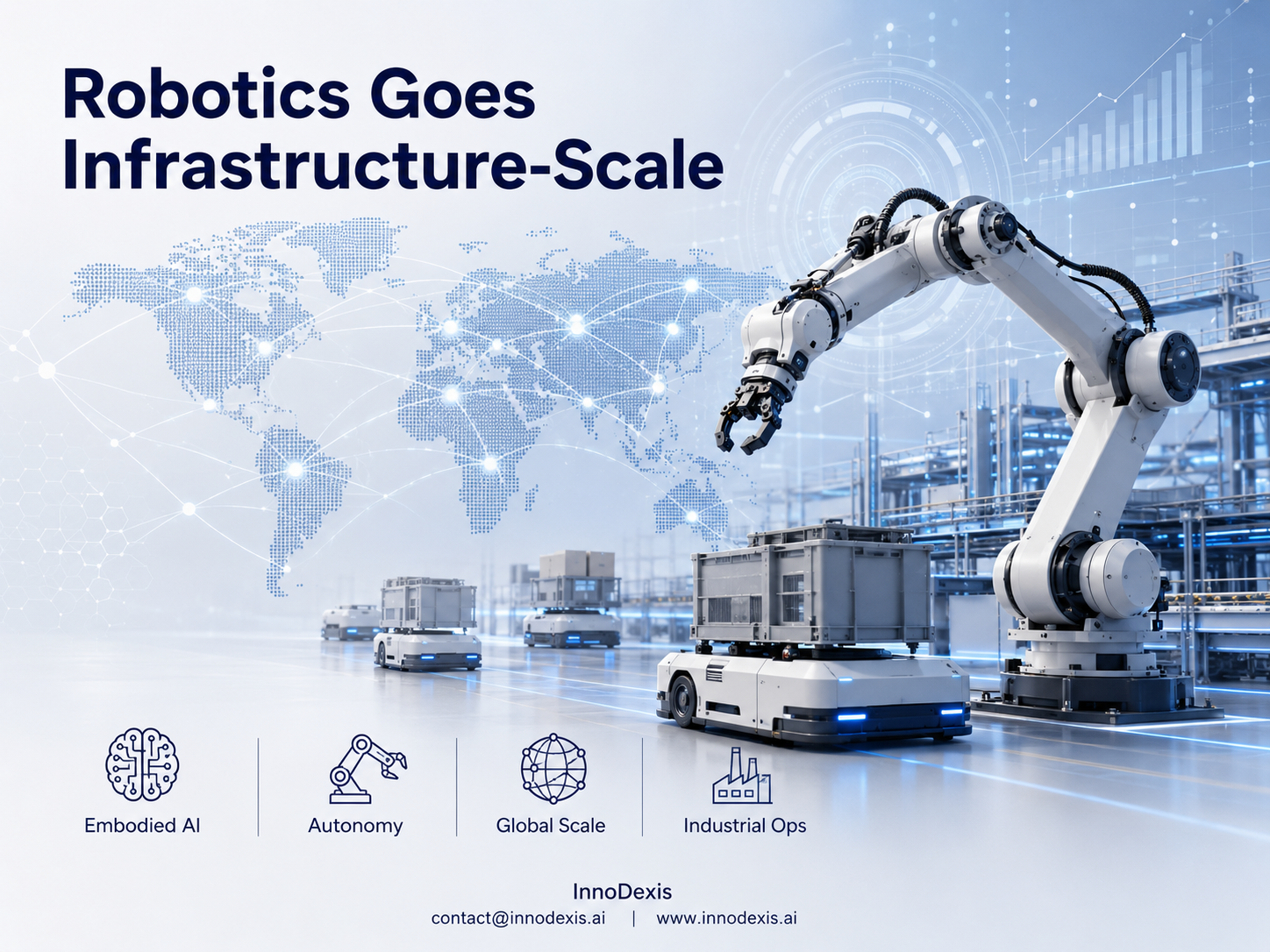
InnoDexis has published its latest Physical AI & Robotics Innovation Intelligence Report, analyzing 459 robotics innovations across 32 countries and 20 technology domains. The report reveals that robotics and embodied AI systems are increasingly transitioning from standalone automation tools into infrastructure-scale operational systems embedded within industrial environments. The findings indicate growing convergence between artificial intelligence, autonomous systems, and physical infrastructure, with developments spanning industrial robotics, logistics, firefighting systems, and low-cost robotic hardware.
Key Findings
The report tracked 459 robotics innovations across 32 countries and 20 domains, reflecting the expanding global scope of physical AI development. The distribution of innovation activity indicates increasing cross-sector integration of robotics technologies into manufacturing, logistics, healthcare, industrial automation, and emergency response systems.
Sereact secured $110 million to advance a robotics world model trained on more than one billion motion datapoints. The scale of the dataset highlights the growing importance of large-scale physical interaction data in training autonomous robotic systems capable of operating in dynamic environments.
Researchers at University of Oxford developed soft robotic actuators costing under $0.10 while demonstrating durability exceeding 100,000 operational cycles. The findings suggest that low-cost robotics components may become increasingly viable for scalable deployment across industrial and commercial systems.
Griffith University achieved a 99.67% success rate in autonomous multi-agent robotic firefighting trials. The results demonstrate increasing operational reliability in coordinated autonomous systems functioning under complex environmental conditions.
The report also identifies a broader transition in robotics architecture. Innovation activity is increasingly centered on interconnected operational environments rather than isolated robotic devices, indicating a movement toward infrastructure-level deployment models.
Strategic Insight and Trend Analysis
The findings suggest that physical AI is entering a systems-infrastructure phase comparable to earlier transitions observed in cloud computing and digital platforms. Rather than focusing solely on individual robots or isolated automation functions, innovation is increasingly directed toward creating interconnected physical operating environments powered by autonomous intelligence.
The scale and diversity of the 459 tracked innovations indicate that embodied AI is moving beyond experimentation into operational deployment across industrial systems. Developments in robotics world models, low-cost durable actuators, and coordinated autonomous agents collectively point toward infrastructure readiness rather than limited pilot-stage adoption.
The emergence of robotics world models trained on extensive motion datasets reflects a shift in how physical AI systems are developed. Similar to how large language models transformed software-based AI, large-scale motion and interaction datasets may become foundational for autonomous systems operating in physical environments. This transition positions data acquisition and real-world operational learning as strategic assets within robotics ecosystems.
At the same time, advances in low-cost robotic hardware suggest that deployment scalability may become economically feasible across broader industrial sectors. Combined with increasingly reliable autonomous coordination systems, these developments indicate that robotics may evolve into embedded industrial infrastructure rather than specialized automation tools.
The report points toward a structural transition in competitive dynamics. Future industrial advantage may increasingly depend not only on AI software capabilities, but on the ability to integrate intelligent autonomous systems into logistics networks, factories, ports, healthcare environments, and national infrastructure systems at scale.
Global and Industry Implications
For corporates and R&D teams, the findings indicate that robotics integration may increasingly become a core operational strategy rather than a specialized automation initiative. Organizations may need to develop infrastructure-level deployment capabilities that combine AI models, robotics hardware, and real-world operational systems.
For investors and capital allocators, the transition toward embodied AI infrastructure suggests expanding opportunities across robotics software, autonomous coordination systems, industrial deployment platforms, and physical AI data ecosystems. Scalability and operational reliability may become central evaluation metrics.
For policymakers and national innovation bodies, the emergence of physical AI infrastructure raises strategic considerations related to industrial competitiveness, workforce adaptation, and autonomous systems governance. National capabilities in robotics deployment and AI-enabled infrastructure may become increasingly linked to economic resilience and industrial sovereignty.
InnoDexis Statement
“The current trajectory of robotics innovation suggests that physical AI is evolving from isolated automation technologies into infrastructure-scale operational systems embedded across industrial environments,” noted InnoDexis in its latest intelligence report.
Conclusion
The Physical AI & Robotics Innovation Intelligence Report indicates that embodied AI systems are progressing toward large-scale operational deployment across industries and national infrastructure environments. As robotics platforms become increasingly data-driven, reliable, and economically scalable, the distinction between automation tools and industrial infrastructure may continue to narrow. Monitoring how autonomous systems are integrated into real-world operational environments will be critical to understanding the next phase of industrial transformation. The complete Physical AI & Robotics Innovation Intelligence Report is available to InnoDexis subscribers and enterprise clients.
About InnoDexis
InnoDexis is a global Innovation Intelligence platform that tracks, analyzes, and interprets breakthrough innovations, prototypes, and emerging technologies across industries and countries. Its intelligence helps corporates, investors, and policymakers understand the true structure and direction of global innovation. Learn more at innodexis.ai.