Pediatric Spine Surgery Advances as Real-Time 3D Imaging Enables 300 Precision-Guided Procedures
A milestone of 300 scoliosis surgeries highlights the integration of intraoperative imaging and navigation, improving precision, reducing radiation exposure, and reshaping surgical consistency.
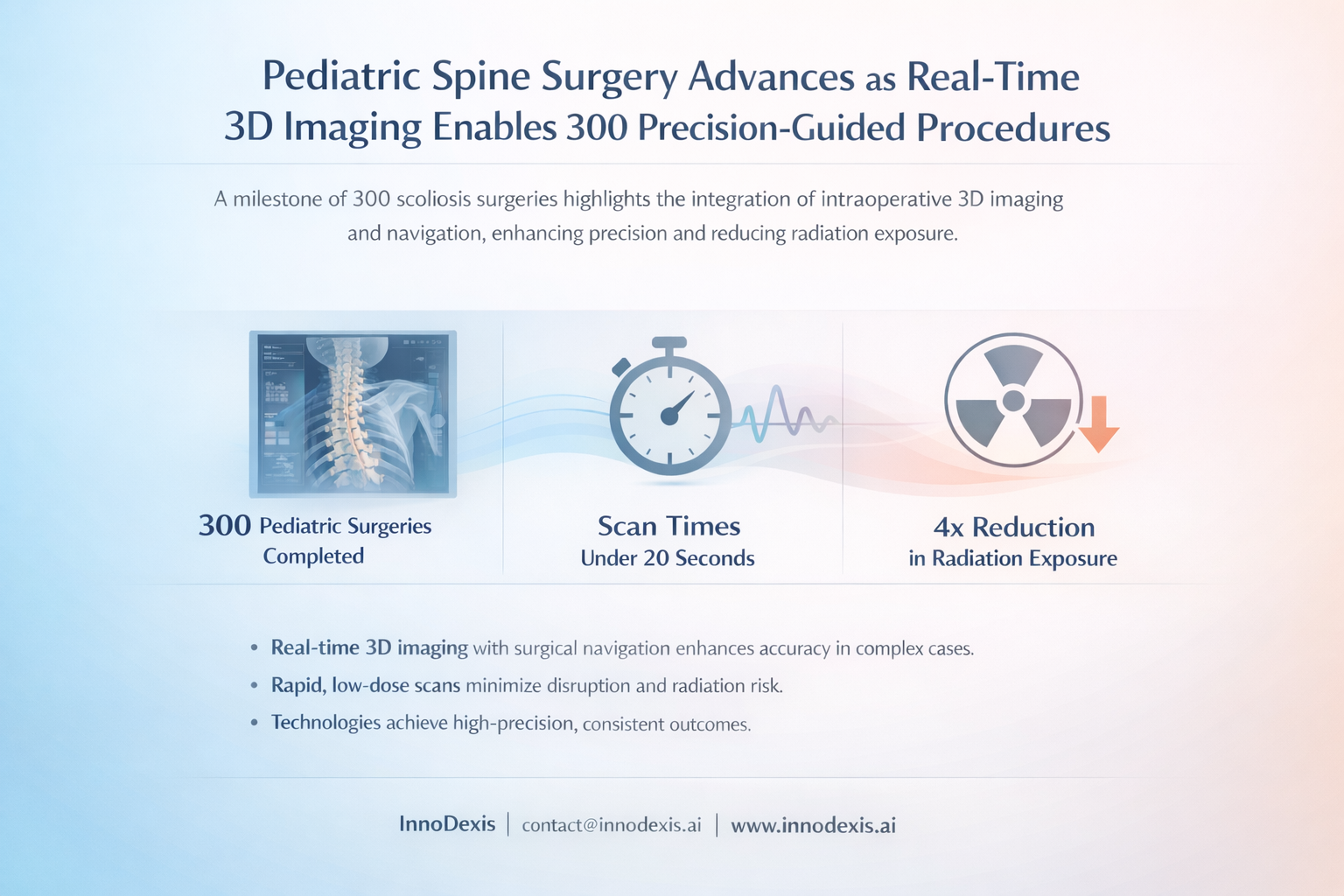
InnoDexis has published its latest Innovation Intelligence Report covering precision surgical technologies in pediatric care, analyzing clinical advancements in intraoperative imaging and navigation systems. The report highlights a milestone of 300 pediatric scoliosis surgeries conducted using real-time 3D imaging and navigation at Assistance Publique - Hôpitaux de Paris, specifically at Hôpital Armand-Trousseau. The report reveals that the integration of rapid imaging, reduced radiation exposure, and navigation-guided execution is contributing to measurable improvements in surgical precision and procedural consistency.
Key Findings
A total of 300 pediatric spine surgeries have been completed using intraoperative 3D imaging and navigation, marking a significant clinical adoption milestone. This volume demonstrates the repeatability and operational integration of advanced imaging technologies within a real-world hospital setting.
Real-time 3D imaging has been successfully combined with surgical navigation systems during procedures. This integration enables surgeons to visualize anatomical structures dynamically, supporting precise decision-making during complex pediatric spine interventions.
Scan times during surgery have been reduced to under 20 seconds, allowing imaging to be performed without significant disruption to surgical workflow. This rapid imaging capability supports continuous intraoperative feedback while maintaining procedural efficiency.
Radiation exposure has been reduced by approximately fourfold compared to older imaging techniques. This reduction is particularly significant in pediatric cases, where minimizing radiation exposure is a critical clinical priority.
High-precision placement of pedicle screws has been achieved in complex pediatric cases. The combination of imaging and navigation enhances accuracy in anatomically challenging scenarios, where margins for error are limited.
Strategic Insight and Trend Analysis
The data reflects a broader shift from skill-dependent surgical execution toward technology-augmented precision. The integration of real-time imaging and navigation systems into operating rooms indicates that surgical accuracy is increasingly being engineered through system-level enhancements rather than relying solely on individual expertise.
The ability to perform rapid intraoperative scans, combined with reduced radiation exposure, suggests that imaging is transitioning from a diagnostic support tool to a continuous procedural component. This evolution enables surgeons to validate and adjust interventions in real time, reducing uncertainty during complex procedures.
The milestone of 300 procedures demonstrates that these technologies are not limited to experimental or pilot settings but are being embedded into routine clinical workflows. This level of adoption indicates operational maturity and suggests that similar systems may scale across other surgical domains.
The observed improvements in precision and safety point toward a structural trend in which surgical outcomes are increasingly standardized through technology integration. As navigation and imaging systems become more widely implemented, variability in surgical performance may decrease, particularly in high-risk and anatomically complex cases.
Global and Industry Implications
For corporates and R&D teams, the findings highlight opportunities in developing integrated surgical ecosystems that combine imaging, navigation, and procedural tools. The demonstrated clinical adoption suggests demand for systems that enhance precision while maintaining workflow efficiency.
For investors and capital allocators, the data indicates a maturing segment within medical technology focused on intraoperative intelligence. The presence of measurable clinical benefits and repeatable use cases suggests potential for scalable deployment across healthcare systems.
For policymakers and national healthcare bodies, the reduction in radiation exposure and improvement in surgical precision align with patient safety priorities. The adoption of such technologies may influence future standards of care and investment in advanced surgical infrastructure.
InnoDexis Statement
“The integration of real-time imaging and navigation into surgical workflows reflects a structural shift toward engineered precision, where consistency and safety are increasingly defined by technology-enabled systems rather than individual variability,” noted InnoDexis in its latest intelligence report.
Conclusion
The achievement of 300 pediatric spine surgeries using intraoperative imaging and navigation signals a transition in how surgical precision is delivered. With reduced radiation exposure, rapid imaging capabilities, and enhanced accuracy in complex cases, these systems are reshaping procedural standards. As healthcare systems continue to adopt integrated surgical technologies, the focus is likely to shift toward scalable precision and consistent outcomes across institutions. The complete Pediatric Surgical Imaging Innovation Intelligence Report is available to InnoDexis subscribers and enterprise clients.
About InnoDexis
InnoDexis is a global Innovation Intelligence platform that tracks, analyzes, and interprets breakthrough innovations, prototypes, and emerging technologies across industries and countries. Its intelligence helps corporates, investors, and policymakers understand the true structure and direction of global innovation. Learn more at innodexis.ai.