New Geological Evidence Suggests Cascadia and San Andreas Fault Systems May Trigger Synchronized Mega-Earthquakes
Deep-sea sediment analysis indicates that major fault systems along the U.S. West Coast may have ruptured together multiple times, challenging conventional seismic risk models.
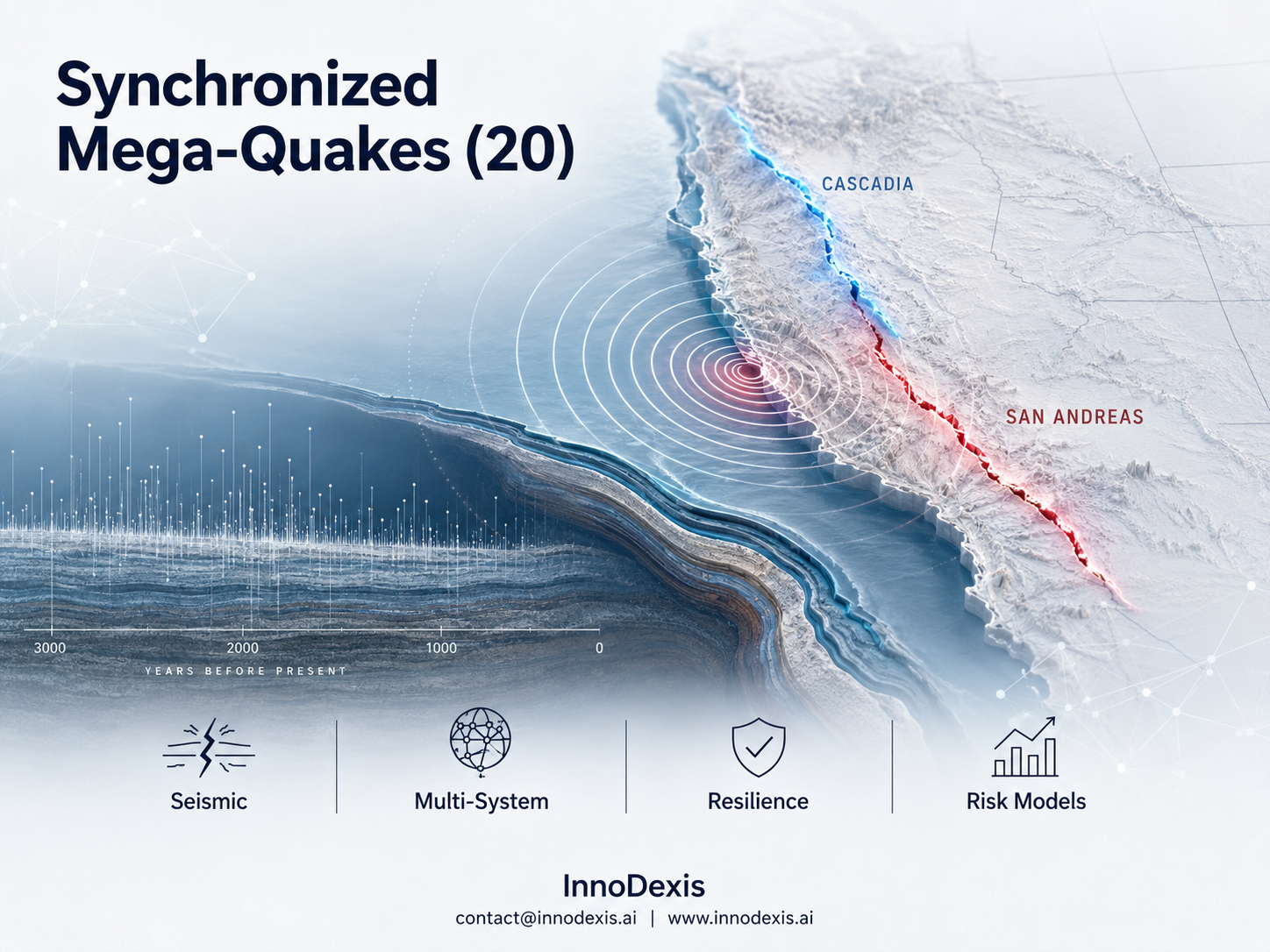
InnoDexis has published its latest Innovation Intelligence Report covering seismic risk and geological modeling, analyzing new research led by Oregon State University on the Cascadia and San Andreas fault systems. The report reveals that deep-sea sediment records preserving nearly 3,100 years of seismic history contain evidence suggesting that major fault systems may have ruptured in synchronized events multiple times over the past several thousand years. The findings point toward a potential shift from isolated earthquake risk assessment to multi-system cascading disaster modeling.
Key Findings
Researchers analyzed deep-sea sediment cores containing approximately 3,100 years of preserved seismic history. These geological records provide long-term evidence of earthquake activity patterns across major fault systems along the United States West Coast.
The study identified possible earthquake “doublets” involving both the Cascadia and San Andreas fault systems. The findings suggest that large-scale ruptures may not always occur independently, as commonly assumed in many current disaster planning frameworks.
Evidence from the sediment analysis indicates that synchronized seismic events may have occurred at least three times within a 1,500-year period. This pattern introduces the possibility that correlated mega-earthquakes represent a recurring structural risk rather than isolated anomalies.
Researchers identified the most recent suspected synchronized rupture as occurring around the year 1700. This timing aligns with historical evidence associated with significant seismic activity in the Pacific Northwest region.
The findings challenge conventional fault-based risk models that evaluate major earthquakes as separate regional events. The possibility of synchronized ruptures across multiple fault systems introduces broader implications for infrastructure resilience, emergency response coordination, and long-duration recovery planning.
Strategic Insight and Trend Analysis
The research indicates a potential transition in seismic risk assessment from isolated event modeling toward interconnected systems analysis. Traditional disaster planning approaches generally evaluate fault systems independently, focusing on localized impact zones and regional response capabilities. However, the identification of synchronized rupture patterns suggests that multiple large-scale fault systems may interact in ways that amplify systemic risk.
This shift has implications beyond geology. Simultaneous mega-earthquakes affecting the Cascadia and San Andreas systems could trigger cascading disruptions across energy infrastructure, transportation corridors, logistics networks, communications systems, and emergency response operations across multiple regions at once. The scale and coordination requirements associated with such events differ substantially from single-fault disaster scenarios.
The increasing role of deep-sea geological records also reflects a broader evolution in predictive and resilience modeling. Sediment archives are no longer functioning solely as historical datasets; they are becoming operational tools for understanding correlated risk patterns over long timescales. This approach expands the role of geological intelligence in national preparedness planning.
The findings further reinforce the growing importance of multi-system risk frameworks in an environment shaped by infrastructure density, population concentration, and interconnected supply networks. As disaster modeling evolves, understanding the interaction between multiple hazards may become as important as forecasting individual events themselves.
Global and Industry Implications
For corporates and infrastructure operators, the findings suggest that resilience planning may need to expand beyond localized disaster scenarios. Energy systems, logistics networks, telecommunications infrastructure, and supply chains could face simultaneous disruptions across multiple regions in the event of synchronized seismic activity.
For investors and capital allocators, the research highlights the importance of evaluating correlated infrastructure and climate-related risks. Long-duration systemic disruptions may increasingly influence investment decisions in utilities, transportation, insurance, and critical infrastructure sectors.
For policymakers and national resilience bodies, the possibility of synchronized fault ruptures introduces new preparedness challenges. Emergency response systems designed for isolated regional events may require restructuring to address simultaneous, multi-region crises affecting infrastructure, healthcare systems, and resource distribution networks.
InnoDexis Statement
“The findings suggest that future resilience planning may need to account for correlated seismic events capable of triggering cascading infrastructure and operational disruptions across multiple regions simultaneously,” noted InnoDexis in its latest intelligence report.
Conclusion
The research led by Oregon State University indicates that seismic risk along the United States West Coast may involve more interconnected dynamics than previously modeled. The identification of potential synchronized mega-earthquakes across major fault systems highlights the growing importance of multi-system disaster frameworks and long-term geological intelligence. As infrastructure interdependence and population density continue to increase, preparedness strategies may increasingly depend on understanding cascading risks rather than isolated events alone. The complete Seismic Risk Innovation Intelligence Report is available to InnoDexis subscribers and enterprise clients.
About InnoDexis
InnoDexis is a global Innovation Intelligence platform that tracks, analyzes, and interprets breakthrough innovations, prototypes, and emerging technologies across industries and countries. Its intelligence helps corporates, investors, and policymakers understand the true structure and direction of global innovation. Learn more at innodexis.ai.