Neurotechnology and AI Converge to Enable Circuit-Level Intervention in Parkinson’s Disease
Emerging clinical and engineering approaches indicate a shift from symptom management toward real-time modulation and early detection of neurological dysfunction.
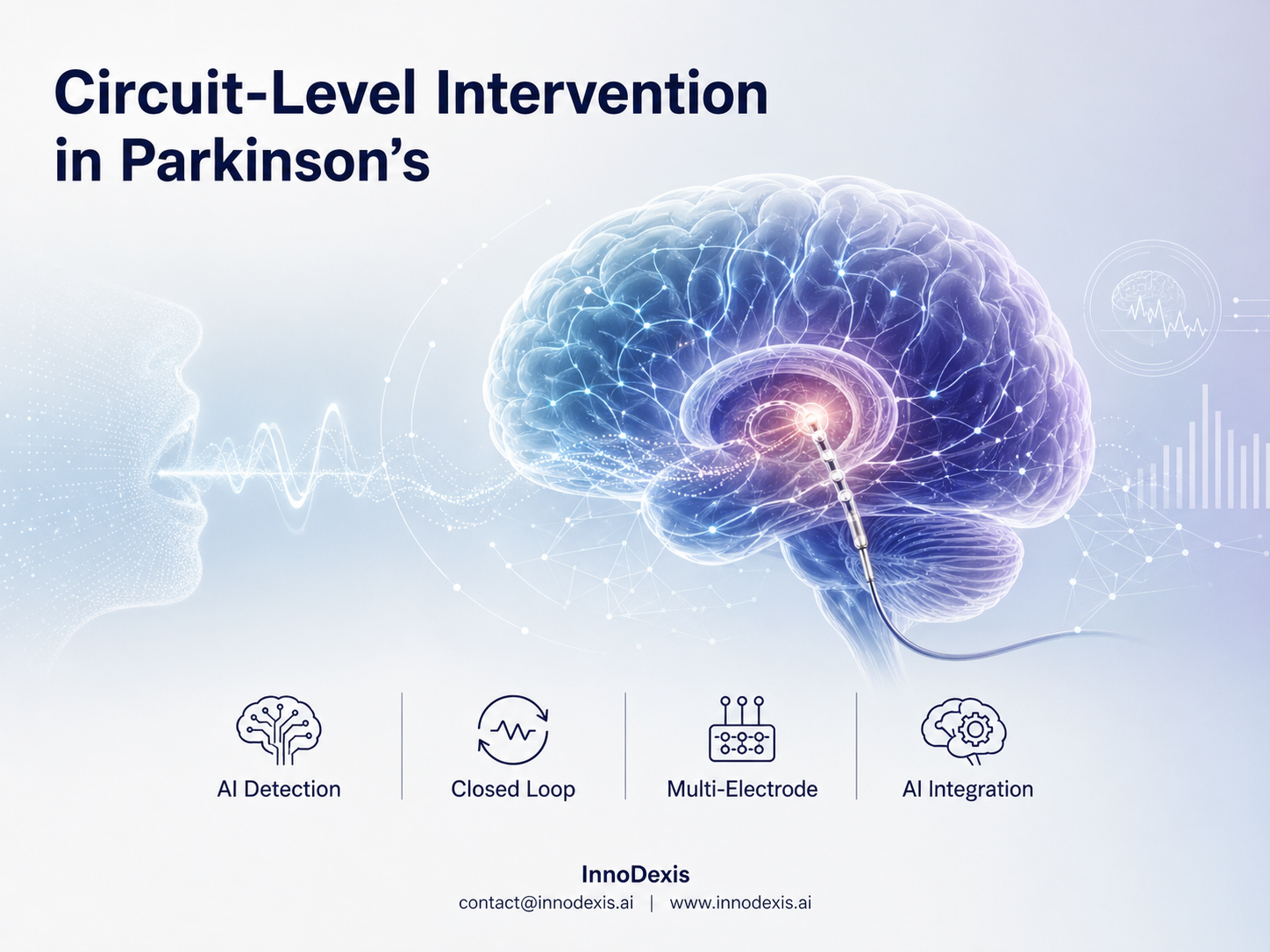
InnoDexis has published its latest Innovation Intelligence Report covering Parkinson’s disease innovation, analyzing a set of clinical and research developments emerging from Mayo Clinic. The report reveals that treatment approaches are increasingly focused on intervening directly in neural circuits rather than managing symptoms alone. Advances in artificial intelligence, neuromodulation, and bioengineering are contributing to a model where early detection and adaptive intervention may alter disease progression.
Key Findings
Recent developments in Parkinson’s research at Mayo Clinic indicate a transition toward targeting the neural pathways underlying the disease. This shift reflects a broader effort to move beyond symptom-focused treatment and address the biological systems driving neurological decline.
Artificial intelligence is being applied to enable earlier detection of Parkinson’s disease through voice analysis. AI-powered systems can identify subtle speech pattern changes, positioning this approach as a potential tool for continuous, noninvasive monitoring and early-stage diagnosis.
Closed-loop neuromodulation technologies are advancing toward real-time adaptability. These systems respond dynamically to brain signals, adjusting stimulation based on patient-specific neural activity, which may improve therapeutic precision compared to fixed stimulation approaches.
Multi-electrode implant systems are being designed to address multiple symptoms within a single procedure. By targeting different neural regions simultaneously, these devices aim to provide more comprehensive symptom management through integrated intervention strategies.
The BIONIC model represents a convergence of artificial intelligence, neurology, and bioengineering into a unified development pipeline. This integrated approach reflects a shift toward combining computational and clinical capabilities to design and deliver next-generation neurological therapies.
Strategic Insight and Trend Analysis
The developments observed in Parkinson’s disease research suggest a structural shift in neurology from reactive treatment models to system-level intervention strategies. Rather than focusing on alleviating visible symptoms, emerging approaches aim to identify and modulate the neural circuits responsible for disease progression.
The integration of AI-driven diagnostics with adaptive neuromodulation systems indicates the formation of a continuous feedback loop between detection and intervention. This model enables treatment to be adjusted in real time based on evolving neural signals, moving away from static therapeutic protocols.
The application of engineering principles to neurological disorders is becoming increasingly evident. Multi-electrode implants and closed-loop systems reflect a design-oriented approach to treatment, where the brain is engaged as a dynamic system that can be monitored, interpreted, and adjusted through technological intervention.
Early detection capabilities, particularly those enabled by AI-based voice analysis, further reinforce this transition. Identifying neurological changes before full symptom onset introduces the possibility of intervening at earlier stages of disease development, potentially influencing long-term outcomes.
Collectively, these trends indicate that neurology is evolving toward an integrated model combining diagnostics, real-time data processing, and targeted intervention. The convergence of these capabilities suggests that future neurological care may be defined by continuous monitoring and adaptive treatment rather than episodic clinical response.
Global and Industry Implications
For corporates and R&D teams, the findings highlight the importance of integrating artificial intelligence, neurotechnology, and medical device development into unified innovation strategies. Companies may need to develop cross-disciplinary capabilities to design systems that combine detection, monitoring, and intervention.
For investors and capital allocators, the shift toward adaptive and system-level neurological treatments suggests emerging opportunities in platforms that integrate AI with medical hardware. Technologies enabling early detection and real-time intervention may represent new categories of investment within neurotechnology.
For policymakers and national innovation bodies, these developments underscore the need for regulatory frameworks that can evaluate integrated AI-medical systems and adaptive therapeutic devices. Supporting translational pathways for such technologies may be critical to enabling their clinical adoption.
InnoDexis Statement
The convergence of AI, neuromodulation, and bioengineering in Parkinson’s research indicates a transition toward continuous, system-level intervention, where neurological treatment is defined by real-time adaptation rather than episodic care,” noted InnoDexis in its latest intelligence report.
Conclusion
The evolving landscape of Parkinson’s disease research reflects a shift toward circuit-level understanding and intervention. As AI-driven detection tools and adaptive neuromodulation systems continue to develop, the boundary between diagnosis and treatment may become increasingly integrated. These changes suggest that neurological care could move toward continuous monitoring and real-time response frameworks. The complete Parkinson’s Disease Innovation Intelligence Report is available to InnoDexis subscribers and enterprise clients.
About InnoDexis
InnoDexis is a global Innovation Intelligence platform that tracks, analyzes, and interprets breakthrough innovations, prototypes, and emerging technologies across industries and countries. Its intelligence helps corporates, investors, and policymakers understand the true structure and direction of global innovation. Learn more at innodexis.ai.