MIT Astronomers Identify New Class of Astrophysical Object in Early Universe Using James Webb Space Telescope
A black hole of approximately 100,000 solar masses enshrouded in a dense hydrogen cocoon has been identified as a candidate explanation for the widely observed but previously unclassified little red dots appearing across deep-space JWST imagery.
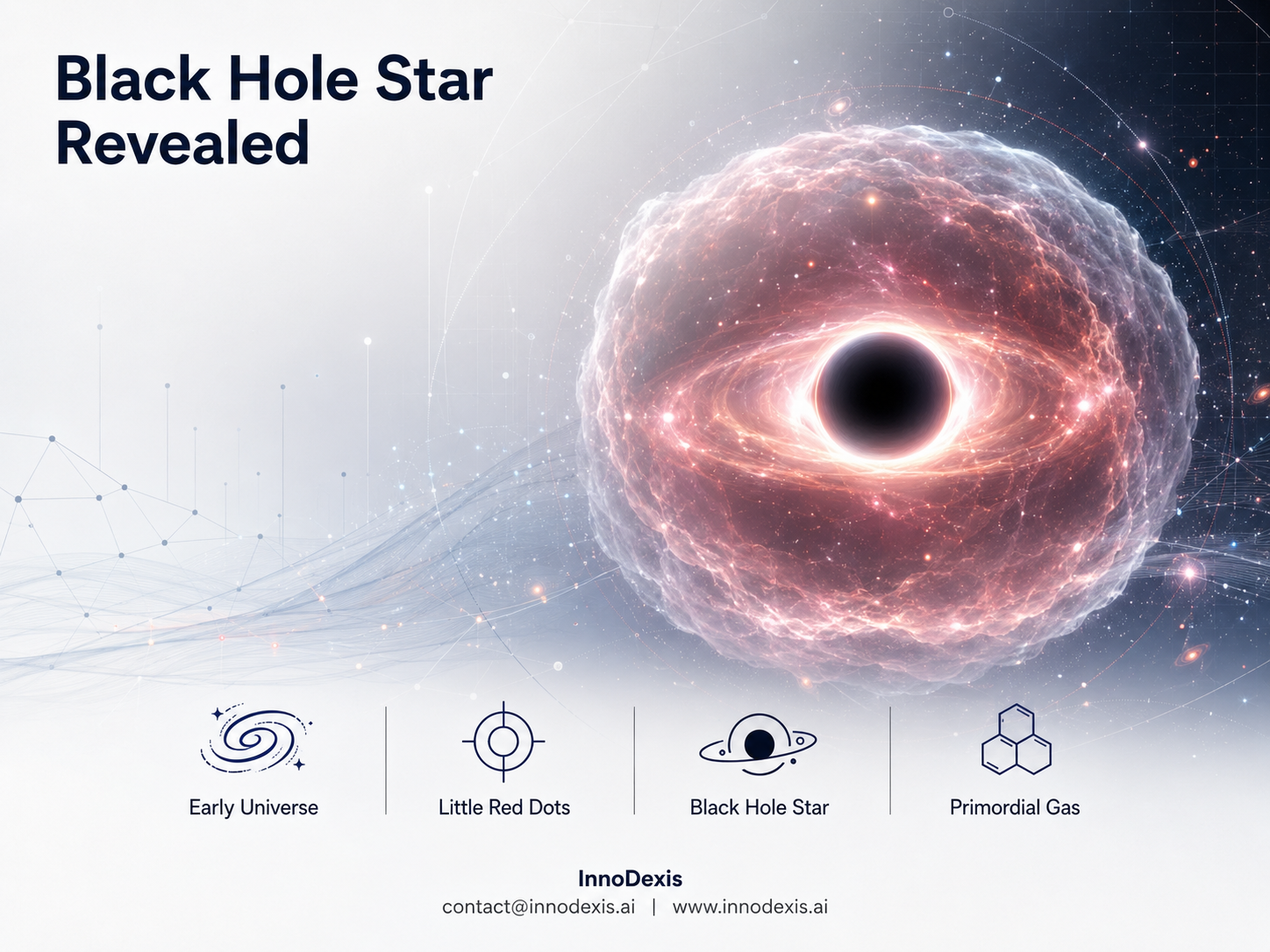
InnoDexis has published its latest Innovation Intelligence Report covering astrophysics and early-universe science, analyzing a high-significance discovery by astronomers at the Massachusetts Institute of Technology using NASA's James Webb Space Telescope. The report reveals that researchers have identified MoM-BH-1* — a previously unclassified astrophysical object comprising a central black hole of approximately 100,000 solar masses surrounded by a dense hydrogen envelope roughly the size of our solar system — introducing a candidate new object class that may account for the persistent little red dots observed across nearly every deep-space JWST image since the telescope's deployment.
Key Findings
MoM-BH-1* is estimated to contain a central black hole of approximately 100,000 solar masses surrounded by a star-sized hydrogen envelope. This configuration — a nascent black hole enshrouded in dense gas — does not correspond to any previously catalogued astrophysical source, positioning it as a candidate member of a new object class that the dataset terms a black hole star.
The object emits 100 billion times more energy than any known star can physically produce. This energy output rules out conventional stellar sources as an explanation for the object and its observational signature, establishing a luminosity threshold that places MoM-BH-1* outside the boundaries of any known stellar or conventional black hole system category.
The deepest Balmer break ever observed was recorded from MoM-BH-1*, directly ruling out ordinary stellar sources as the origin of the emission. The Balmer break measurement is a key diagnostic tool in astrophysics for distinguishing the nature of light-emitting objects, and its unprecedented depth in this case provides the observational basis for rejecting known source classifications.
The light emitted by MoM-BH-1* is composed almost entirely of hydrogen and helium, with virtually no metals detected. This elemental composition is consistent with matter from the earliest cosmic epoch, before stellar nucleosynthesis had produced heavier elements at scale — providing a direct observational link between the object and the conditions of the early universe.
The discovery introduces a third category of luminous astrophysical object alongside stars and conventional black hole systems. The dataset notes that the absence of such objects in the present-day universe suggests the conditions that produced them were unique to the earliest cosmic epoch, raising the question of what their disappearance reveals about the transition from the early cosmos to the universe observed today.
Strategic Insight and Trend Analysis
The strategic significance of this discovery operates on two distinct levels. The first is observational resolution: the little red dots appearing across nearly every deep-space JWST image have represented one of the most debated unresolved questions of the telescope's era. MoM-BH-1* provides the most coherent single explanation yet advanced for these objects, shifting the scientific question from classification — what are these objects — to origin and disappearance — how did they form and why are they absent today.
The second level is conceptual. The introduction of a third category of luminous astrophysical object alongside stars and conventional black hole systems is not an incremental finding within an existing framework. It proposes a structural addition to the taxonomy of objects that populate the universe — a category of object with a distinct formation pathway, a distinct observational signature, and a distinct lifecycle confined to the earliest cosmic epoch. If confirmed as a class through further observation, black hole stars would require integration into models of early-universe structure formation, black hole seeding, and cosmic chemical evolution.
The dataset signals that this confirmation process is the immediate next scientific priority. The transition from a single identified object to a confirmed class depends on whether the observational properties of MoM-BH-1* — its luminosity, Balmer break depth, elemental composition, and energy output — are reproducible across other little red dot candidates in the JWST archive. The scale of that archive, spanning nearly every deep-space JWST image, means the candidate pool for follow-up investigation is large.
The disappearance of black hole stars from the present-day universe introduces a further research dimension: the conditions of the early cosmos that enabled their formation, and the processes by which those conditions ended, become directly relevant to understanding the structure of the universe observed today.
Global and Industry Implications
For corporates and R&D teams in aerospace, telescope instrumentation, and deep-space observational technology, the discovery demonstrates the continued scientific return on investment in next-generation space telescope infrastructure. The identification of MoM-BH-1* was made possible by JWST's observational capabilities, and the follow-up confirmation programme will similarly depend on continued access to that infrastructure.
For investors and capital allocators, the finding reinforces the long-term scientific productivity of space science investment. While the discovery itself is foundational rather than commercially proximate, the dataset of unresolved JWST observations it draws from — the little red dot archive — represents a substantial and growing resource for future high-significance astrophysical discoveries, each of which generates institutional and reputational value for the organisations involved.
For policymakers and national innovation bodies, the MIT-led discovery underscores the strategic value of sustained national investment in fundamental space science. Discoveries of this category — introducing new object classes, resolving persistent observational anomalies — are not predictable in advance but emerge from sustained, well-resourced observational programmes supported by public funding infrastructure.
InnoDexis Statement
"The identification of MoM-BH-1* shifts the scientific question from classifying an anomaly to understanding a potentially distinct astrophysical epoch — one defined by object classes that formed under early-universe conditions and have since disappeared entirely," noted InnoDexis in its latest intelligence report.
Conclusion
The identification of MoM-BH-1* marks a transition point in JWST-era astrophysics — from cataloguing unresolved anomalies to proposing and testing new object class frameworks. As follow-up observations determine whether the properties of MoM-BH-1* are reproducible across the broader population of little red dots, the scientific community will move closer to resolving one of the telescope's most persistent open questions. InnoDexis will continue to monitor developments in early-universe astrophysics, JWST observational science, and the confirmation status of black hole stars as a recognised object class. The complete Early Universe Astrophysics Innovation Intelligence Report is available to InnoDexis subscribers and enterprise clients.
About InnoDexis
InnoDexis is a global Innovation Intelligence platform that tracks, analyzes, and interprets breakthrough innovations, prototypes, and emerging technologies across industries and countries. Its intelligence helps corporates, investors, and policymakers understand the true structure and direction of global innovation. Learn more at innodexis.ai.