Michigan State University Advances Autonomous Vehicle Deployment Through Interdisciplinary Framework Spanning AI Safety, Infrastructure Simulation, and Legal Ethics
MSU researchers have developed an interdisciplinary autonomous vehicle framework that treats safety as a hard engineering requirement, simulates city-scale deployment using Chicago's road network, and proposes informational freedom of movement as a foundational governance principle.
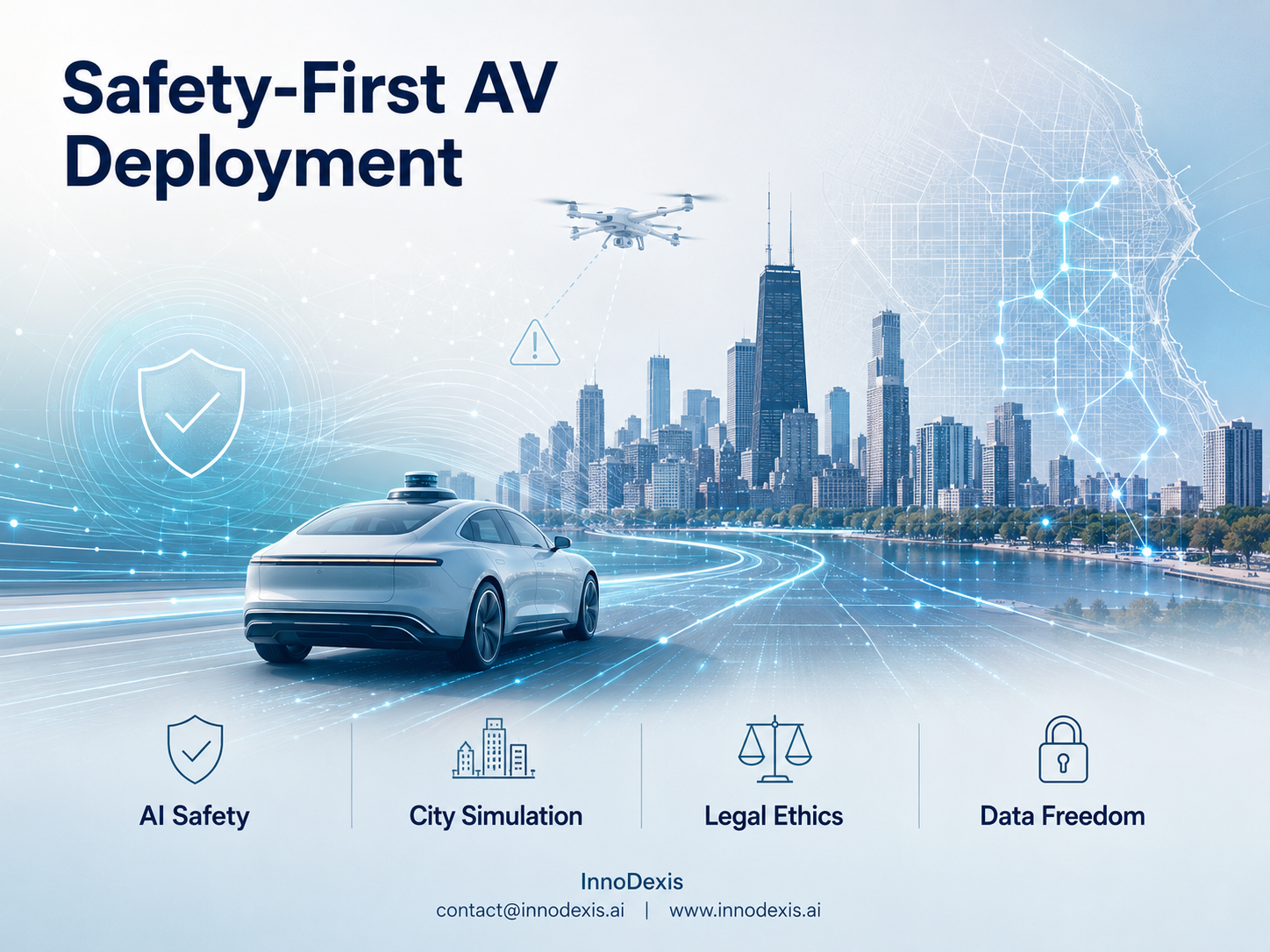
InnoDexis has published its latest Innovation Intelligence Report covering autonomous mobility research, analyzing a high-significance interdisciplinary innovation from the United States. The report reveals that researchers at Michigan State University have developed a comprehensive autonomous vehicle framework spanning vehicle connectivity, AI decision-making, infrastructure simulation, and legal ethics — addressing the full AV deployment stack from vehicle control to governance. The research positions legal and ethical frameworks as deployment prerequisites rather than afterthoughts, marking a structural shift in how autonomous mobility development is being approached at the institutional level.
Key Findings
A new AV decision-making method developed by the MSU team treats safety as a hard requirement rather than a weighted preference within a cost-optimisation function. This distinction is significant: conventional AI decision-making frameworks balance safety against other variables, meaning safety can in principle be traded off under certain conditions. The MSU approach removes this trade-off by establishing safety as a non-negotiable constraint, directly addressing one of the most persistent governance concerns surrounding AI-controlled vehicle systems.
MSU drone control systems demonstrate the capacity to detect actuator failures mid-flight and self-correct in real time. This capability extends the interdisciplinary framework beyond ground-based autonomous vehicles into aerial mobility systems, establishing a shared technical foundation for fault-tolerant autonomous control across multiple vehicle classes. Real-time self-correction under component failure conditions is a critical safety threshold for any autonomous system operating in public airspace or road infrastructure.
A city-scale simulation modelled on Chicago's road network has been developed to test autonomous vehicle strategies before real-world deployment. This infrastructure simulation capability addresses a fundamental challenge in AV development: the impossibility of safely testing complex urban deployment scenarios at full scale without first validating them in a controlled environment. The Chicago network model provides a high-fidelity testbed for evaluating AV behaviour across the range of conditions present in a major metropolitan road system.
The research proposes informational freedom of movement as a core principle for AV governance and legal frameworks. This proposal responds directly to the data collection reality of autonomous vehicle systems: AVs continuously gather data through cameras, sensors, biometric monitoring, and GPS, generating detailed records of how individuals move, associate, and conduct their daily lives. The proposal frames data autonomy not as a privacy add-on but as a structural governance question that must be addressed before widespread AV deployment.
Strategic Insight and Trend Analysis
The dominant trend emerging from the MSU research programme is a structural reframing of what autonomous vehicle development requires — moving from engineering-led development to interdisciplinary development in which safety science, legal frameworks, and ethical governance are treated as co-equal components of the deployment stack.
This reframing reflects a maturation in how the AV field understands its own challenges. The technical performance of autonomous systems — sensor accuracy, path planning, obstacle detection — has advanced substantially over the past decade. What has not kept pace is the governance infrastructure required to deploy these systems within societies that have established legal rights around movement, privacy, and data ownership. The MSU framework directly addresses this gap by treating the deployment stack as spanning not just vehicle control and infrastructure integration but workforce training and legal frameworks simultaneously.
The informational freedom of movement proposal carries particular strategic weight. Autonomous vehicles are not merely transportation systems — they are continuous data collection systems that generate granular records of individual behaviour at scale. As AV deployment expands, the aggregate data produced will constitute one of the most detailed surveillance infrastructures ever created, built into public road systems under the framing of transportation improvement. The MSU proposal that this data dimension requires a foundational governance principle — rather than case-by-case regulatory responses — reflects a structurally important shift in how researchers are framing the problem.
The city-scale Chicago simulation and the hard-constraint safety decision-making methodology together demonstrate that the MSU framework is not purely theoretical. Each component addresses a specific, identified gap in the current AV development landscape, producing tools and frameworks that are directly applicable to real deployment decisions.
Global and Industry Implications
For corporates and R&D teams, the MSU interdisciplinary framework signals that AV development programmes built exclusively around engineering performance metrics are increasingly incomplete. Organisations developing or deploying autonomous vehicle systems will need to integrate legal and ethical frameworks into their development cycles — not as compliance exercises but as technical prerequisites that determine whether deployment is feasible in a given regulatory environment.
For investors and capital allocators, the research highlights a growing secondary investment opportunity in AV governance infrastructure — simulation platforms, legal framework development, safety validation systems, and data governance tools — that sits alongside the primary vehicle hardware and software investment thesis. As regulatory scrutiny of AV data collection practices intensifies, companies with robust governance frameworks embedded in their development process will carry lower regulatory risk profiles.
For policymakers and national innovation bodies, the informational freedom of movement proposal represents a concrete starting point for AV data governance legislation. The finding that AVs generate continuous records of movement, association, and behaviour through cameras, sensors, biometric monitoring, and GPS provides the factual foundation for regulatory frameworks that address data autonomy as a structural issue rather than an incidental privacy concern.
InnoDexis Statement
"MSU's autonomous vehicle research reframes the deployment challenge by establishing that legal and ethical frameworks are not downstream of engineering — they are structural prerequisites without which technically capable AV systems cannot be responsibly deployed at scale," noted InnoDexis in its latest intelligence report.
Conclusion
As autonomous vehicle deployment moves from controlled pilots toward urban-scale integration, the governance gap between technical capability and regulatory readiness will become the defining constraint on the pace of adoption. MSU's interdisciplinary framework — combining hard-constraint safety decision-making, city-scale infrastructure simulation, drone fault tolerance, and legal governance principles — provides a model for how research institutions can contribute to closing that gap. InnoDexis will continue to monitor developments in autonomous mobility governance, AV safety frameworks, and the emergence of data rights principles in transportation regulation. The complete Autonomous Mobility Innovation Intelligence Report is available to InnoDexis subscribers and enterprise clients.
About InnoDexis
InnoDexis is a global Innovation Intelligence platform that tracks, analyzes, and interprets breakthrough innovations, prototypes, and emerging technologies across industries and countries. Its intelligence helps corporates, investors, and policymakers understand the true structure and direction of global innovation. Learn more at innodexis.ai.