Mars’s Gravitational Influence Identified as a Factor in Long-Term Earth Climate Cycles
New simulations indicate that Mars contributes to variations in Earth’s orbital patterns, challenging assumptions about planetary influence on climate cycles.
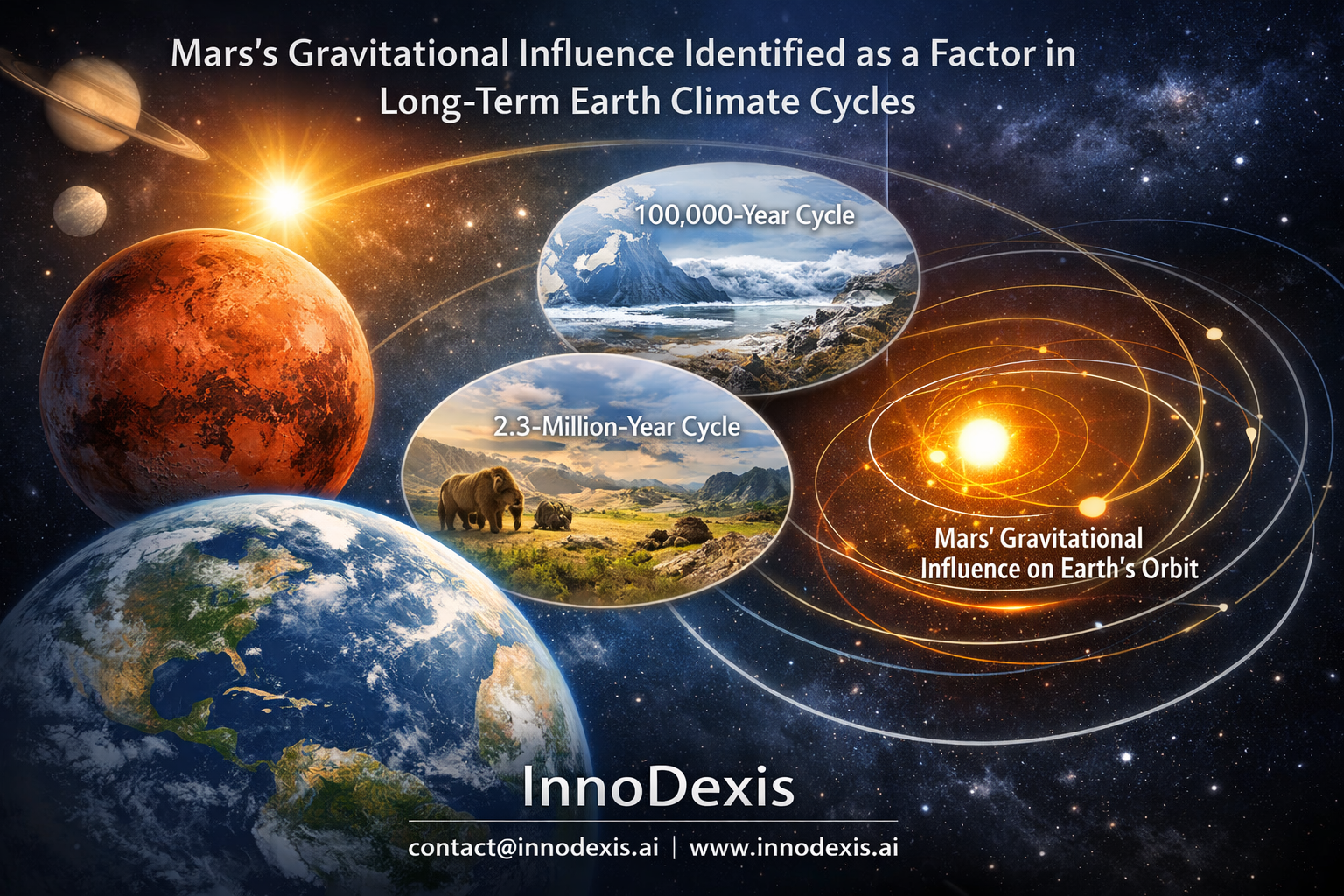
InnoDexis has published its latest Innovation Intelligence Report covering planetary dynamics and long-term climate variability, analyzing recent simulation-based research on gravitational interactions within the solar system. The report reveals that Mars, despite its relatively small size, contributes to variations in key Milankovitch cycles, including the 100,000-year and 2.3-million-year patterns associated with major climate shifts on Earth. The findings suggest that planetary interactions beyond large bodies such as Jupiter may play a role in shaping Earth’s long-term climate behavior.
Key Findings
Recent simulation studies indicate that Mars exerts a measurable gravitational influence on Earth’s orbital dynamics. Although significantly smaller than major planets like Jupiter, Mars contributes to subtle variations in Earth’s trajectory over extended time scales.
The research identifies Mars as a contributing factor in variations of key Milankovitch cycles, including the ~100,000-year and ~2.3-million-year periodic patterns. These cycles are historically associated with ice ages and large-scale climate transitions.
The findings challenge the long-standing assumption that only large planets exert meaningful influence on Earth’s orbital behavior. Instead, the simulations demonstrate that smaller planetary bodies can contribute to orbital variability when observed over geological timescales.
The study highlights the cumulative nature of gravitational effects. Even relatively small forces, when applied consistently over millions of years, can influence planetary motion and contribute to long-term system-level changes.
The results suggest that planetary systems may be more dynamically interconnected than previously assumed. Interactions between multiple bodies, rather than isolated influences, appear to shape orbital patterns that are linked to climate variability.
Strategic Insight and Trend Analysis
The identification of Mars as a contributing factor in Earth’s orbital dynamics reflects a broader shift in understanding complex planetary systems. Traditional models have emphasized the dominant role of large bodies such as Jupiter in shaping orbital stability and long-term cycles. However, the new findings indicate that smaller planets may also play a role when interactions are evaluated across extended timescales.
This perspective introduces a more distributed model of gravitational influence within the solar system. Rather than relying on a few dominant drivers, orbital behavior may emerge from the combined effects of multiple interacting bodies. Such a framework aligns with broader trends in complex systems science, where cumulative interactions produce outcomes not attributable to a single source.
The implications extend to the interpretation of Milankovitch cycles themselves. While these cycles have been widely used to explain periodic climate changes on Earth, the underlying drivers may be more complex than previously modeled. If multiple planetary interactions contribute to orbital variations, then climate patterns linked to these cycles may reflect a more intricate set of influences.
The research also underscores the importance of simulation-based approaches in astrophysics and Earth science. Advanced computational models allow scientists to analyze long-term interactions that cannot be observed directly, enabling new insights into how planetary systems evolve and interact over millions of years.
Global and Industry Implications
For corporates and R&D teams working in climate science, geospatial analytics, and Earth system modeling, the findings suggest that orbital dynamics may require more comprehensive modeling approaches. Incorporating multi-planet interactions could improve long-term climate projections and scenario planning.
For investors and capital allocators, the research highlights the growing intersection between astrophysics, climate science, and computational modeling. Technologies that enhance simulation capabilities or improve long-term predictive modeling may see increasing relevance across climate and space-related sectors.
For policymakers and national innovation bodies, the findings indicate that understanding climate systems may extend beyond atmospheric and terrestrial factors. Incorporating orbital and planetary dynamics into climate frameworks could support more robust long-term environmental planning and research initiatives.
InnoDexis Statement
“The findings suggest that long-term climate variability may be influenced by a broader set of planetary interactions, indicating that Earth’s climate system is embedded within a more interconnected orbital framework,” noted InnoDexis in its latest intelligence report.
Conclusion
The identification of Mars as a contributing factor in Earth’s long-term climate cycles introduces a new dimension to the study of planetary influence on climate systems. By demonstrating that smaller gravitational forces can accumulate over time to shape orbital behavior, the research expands current understanding of how Milankovitch cycles may be influenced. As climate modeling continues to evolve, integrating multi-body planetary dynamics may provide a more comprehensive view of long-term climate variability. The complete Planetary Climate Dynamics Intelligence Report is available to InnoDexis subscribers and enterprise clients.
About InnoDexis
InnoDexis is a global Innovation Intelligence platform that tracks, analyzes, and interprets breakthrough innovations, prototypes, and emerging technologies across industries and countries. Its intelligence helps corporates, investors, and policymakers understand the true structure and direction of global innovation. Learn more at innodexis.ai.