Live Conflict Environments Reshape R&D Models as Field-Integrated Innovation Accelerates
A four-week, multi-time-zone innovation sprint demonstrates how real-time operational conditions are compressing the distance between problem identification and solution deployment.
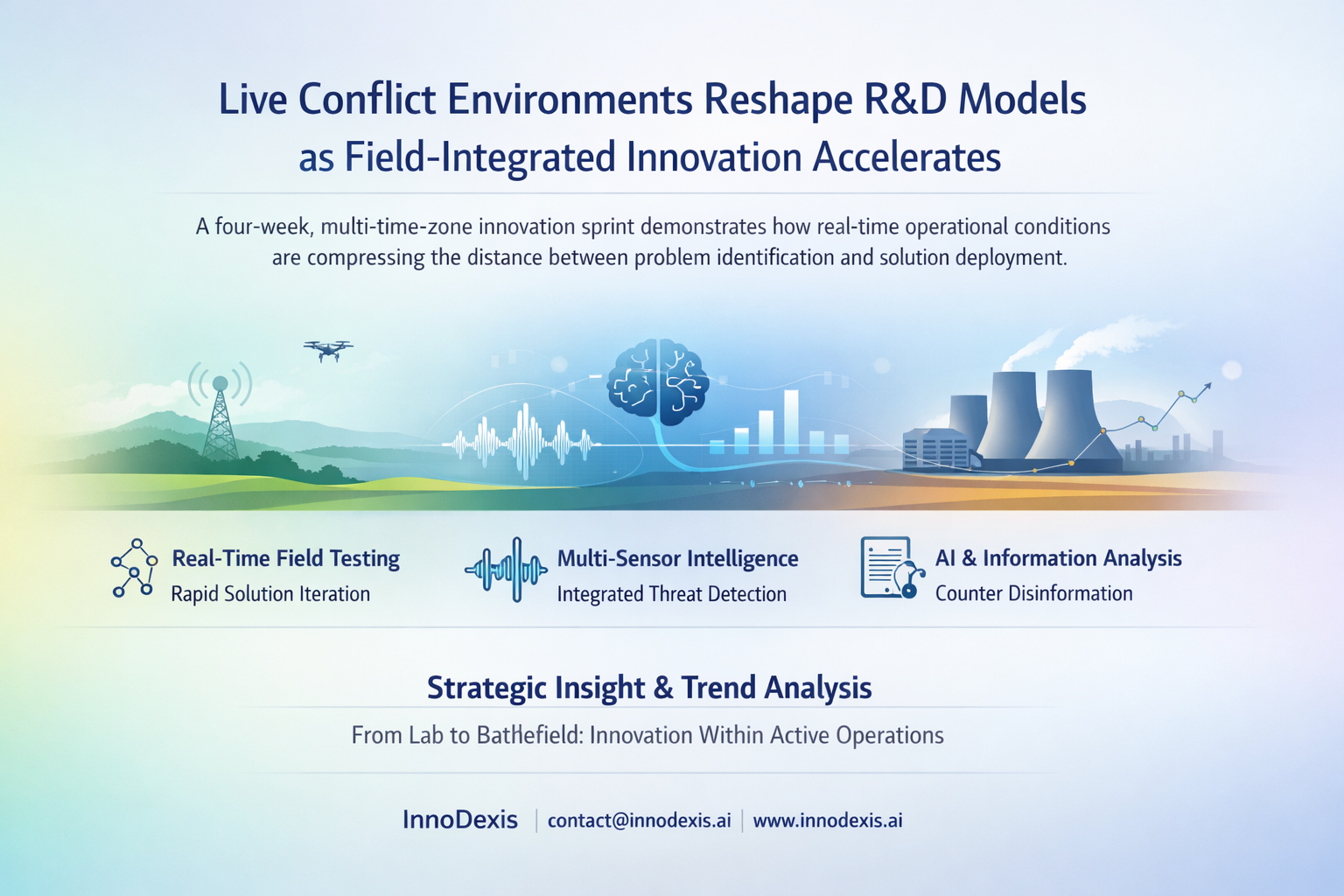
InnoDexis has published its latest Innovation Intelligence Report covering field-integrated research and development models, analyzing innovation activity conducted across seven time zones under live wartime conditions over a four-week period. The report reveals that innovation is increasingly occurring within active operational environments rather than controlled settings, enabling faster iteration cycles and immediate validation. This shift reflects a structural transition in how solutions are developed, tested, and refined in high-stakes contexts.
Key Findings
A four-week innovation sprint conducted across seven time zones demonstrates the emergence of distributed, real-time R&D models operating under live conflict conditions. Teams collaborated directly with field operators, enabling continuous feedback loops and reducing delays between problem identification and solution development.
Acoustic sensing systems were developed to detect critical shifts in nuclear reactor cooling mechanisms. These systems highlight the application of AI-driven signal monitoring in high-risk energy environments, where early detection of anomalies is essential for operational safety.
Hybrid audio and radio frequency detection systems were designed to identify hard-to-detect drones, including those controlled via fiber-optic communication. This reflects a growing focus on multi-signal intelligence approaches to address evolving threats in contested environments.
Real-time translation systems converted metal detector signals into visual cues to support safer de-mining operations. This development demonstrates the integration of AI-assisted interpretation tools to improve human decision-making in hazardous field conditions.
Large language model pipelines were deployed to intercept and analyze disinformation flows before they scale. This indicates the use of AI systems not only for physical threat detection but also for managing information integrity in dynamic environments.
Strategic Insight and Trend Analysis
The observed innovation model reflects a shift from sequential R&D processes toward continuous, field-integrated development. Rather than separating research, testing, and deployment into distinct phases, innovation is increasingly embedded within operational environments where feedback is immediate and iterative cycles are compressed.
The ability to co-develop solutions with end-users under live conditions introduces a structural change in validation processes. Solutions are no longer tested after development but are refined in parallel with deployment, enabling faster alignment with real-world requirements. This reduces the gap between theoretical performance and operational effectiveness.
The integration of multiple sensing modalities, such as acoustic, audio, and RF systems, alongside AI-driven interpretation tools, indicates a move toward layered intelligence systems. These systems are designed to function in complex, high-uncertainty environments where single-signal approaches may be insufficient.
The inclusion of large language models in managing disinformation highlights the expansion of AI applications beyond physical systems into cognitive and informational domains. This suggests that modern R&D environments are addressing both tangible and intangible threat vectors simultaneously.
Collectively, these developments point to a restructuring of innovation cycles. Speed is no longer solely an operational metric but a structural characteristic of the R&D process itself, driven by proximity to real-world conditions and continuous iteration.
Global and Industry Implications
For corporates and R&D teams, the findings indicate a shift toward integrating development processes within operational contexts. Organizations may need to redesign R&D frameworks to incorporate real-time feedback and reduce reliance on controlled testing environments.
For investors and capital allocators, the emergence of field-integrated innovation models suggests new criteria for evaluating technological maturity. Solutions developed and validated under live conditions may present different risk profiles compared to those tested in isolated environments.
For policymakers and national innovation bodies, the data highlights the importance of enabling flexible R&D environments that can operate under dynamic conditions. Supporting frameworks that allow rapid deployment and iterative testing may become increasingly relevant in sectors such as defense, energy, and critical infrastructure.
InnoDexis Statement
“The transition toward field-integrated R&D reflects a structural shift in how innovation is validated, where proximity to real-world conditions enables faster iteration and more adaptive solution development,” noted InnoDexis in its latest intelligence report.
Conclusion
The four-week, multi-time-zone innovation sprint demonstrates how R&D is evolving from controlled, sequential processes to continuous, real-time development embedded within operational environments. As technologies are increasingly designed, tested, and refined under live conditions, the boundaries between research and deployment continue to narrow. This shift introduces new considerations for risk assessment, validation, and scalability across industries. The complete Field-Integrated R&D Innovation Intelligence Report is available to InnoDexis subscribers and enterprise clients.
About InnoDexis
InnoDexis is a global Innovation Intelligence platform that tracks, analyzes, and interprets breakthrough innovations, prototypes, and emerging technologies across industries and countries. Its intelligence helps corporates, investors, and policymakers understand the true structure and direction of global innovation. Learn more at innodexis.ai.