Laser Manufacturing Advances Signal Industrial Pathway for Solid-State Batteries - Fraunhofer ILT Demonstrates Precision Production Methods
New laser-based processes for lithium metal handling and ceramic electrolyte fabrication highlight emerging manufacturing solutions for scaling solid-state battery production.
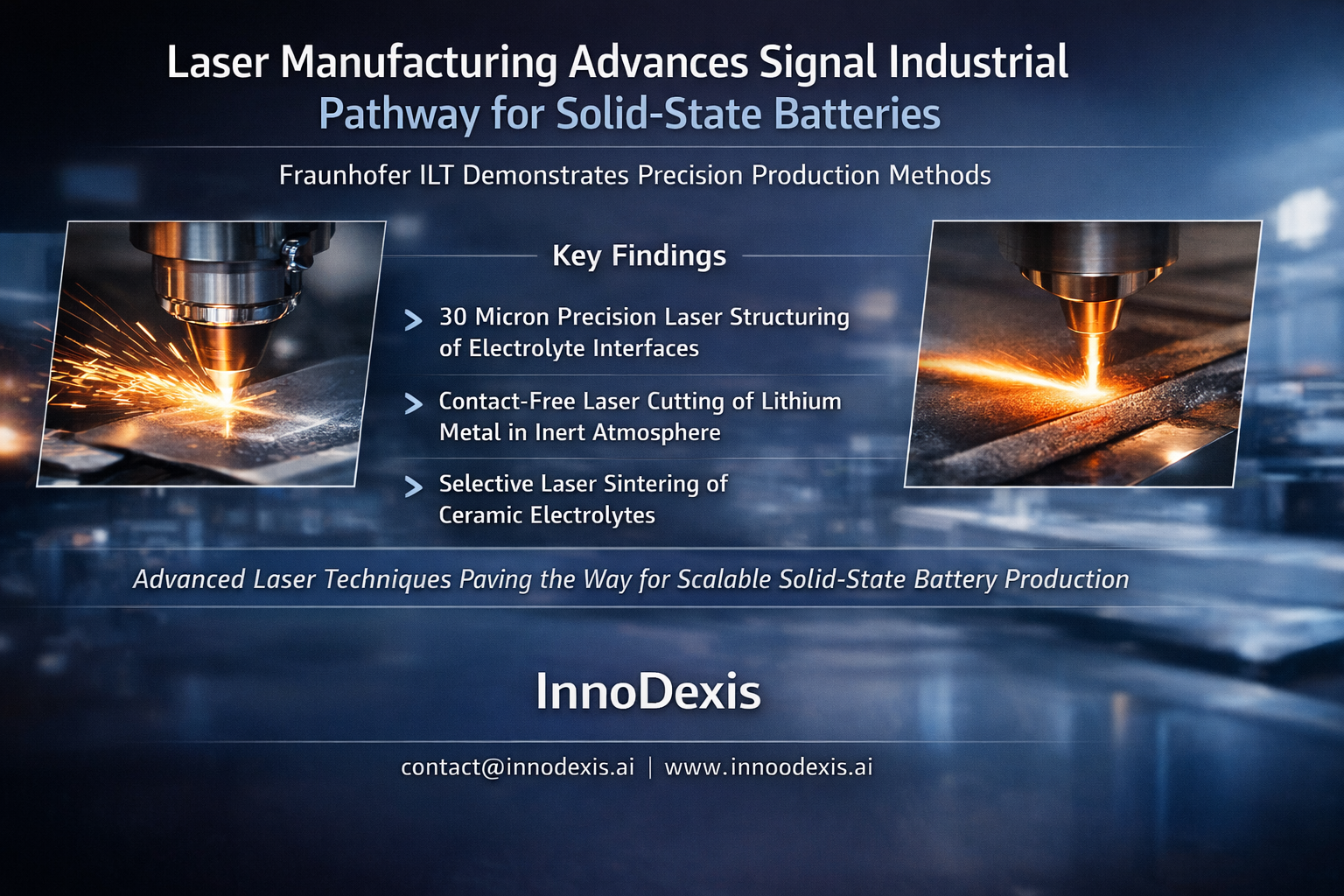
InnoDexis has published its latest Innovation Intelligence Report covering advanced battery manufacturing technologies, analyzing recent developments in solid-state battery production processes. The report reveals that researchers at the Fraunhofer Institute for Laser Technology in Germany are developing laser-based manufacturing methods designed to address one of the primary barriers in battery innovation: industrial-scale production of solid-state batteries. The initiative focuses on precision laser structuring, contact-free lithium metal processing, and selective laser sintering of oxide ceramic electrolytes—technologies that collectively aim to reduce production inefficiencies and enable scalable manufacturing.
Key Findings
Researchers at the Fraunhofer Institute for Laser Technology are developing laser-based manufacturing techniques designed to support industrial-scale production of solid-state batteries. These processes focus on addressing key manufacturing challenges related to precision structuring, material handling, and ceramic electrolyte fabrication.
One major advancement involves laser structuring of electrolyte–anode interfaces with approximately 30 micrometer precision. Accurate interface engineering is considered critical for improving electrochemical contact and overall battery performance in solid-state architectures.
A second development centers on contact-free cutting of lithium metal using laser systems operating in an argon environment with a dew point below –70°C. Lithium metal is highly reactive, and the controlled atmosphere combined with laser processing enables precise handling of the material during battery component fabrication.
Selective laser sintering is also being explored for oxide ceramic electrolytes. This technique allows localized heating and consolidation of ceramic materials, potentially enabling more controlled fabrication of solid-state electrolyte layers.
Manufacturing efficiency remains a major industrial constraint. During production ramp-up phases, reject rates in battery manufacturing can reach approximately 30%, underscoring the importance of improved process control and precision fabrication methods.
Lithium metal represents a key material opportunity within solid-state battery systems due to its specific capacity of 3860 mAh g⁻¹. Its electrochemical characteristics provide the potential for significantly higher energy density compared with conventional battery anode materials.
Strategic Insight and Trend Analysis
The emergence of laser-based battery manufacturing processes reflects a broader shift in energy storage innovation toward solving industrial scalability challenges rather than solely improving laboratory performance metrics. While solid-state battery chemistry has been extensively explored, manufacturing complexity has remained a central barrier to commercialization.
Precision engineering of the electrolyte–anode interface is particularly important in solid-state architectures because ion transport efficiency depends heavily on the quality and stability of this interface. Laser structuring techniques offer the potential for micron-level control, which could enable more consistent electrochemical performance across large production volumes.
Lithium metal handling represents another critical industrial challenge. The material’s reactivity requires controlled environmental conditions, and the development of contact-free laser cutting processes within inert atmospheres indicates progress toward integrating lithium metal into scalable production workflows.
Selective laser sintering of oxide ceramic electrolytes further highlights the potential of additive or localized manufacturing approaches in battery fabrication. Unlike traditional bulk processing methods, laser-based sintering enables targeted energy delivery, which may reduce thermal stress and improve structural consistency in electrolyte layers.
The combination of these technologies suggests that the next phase of solid-state battery development may depend less on new chemistries and more on manufacturing technologies capable of translating laboratory prototypes into industrially viable products.
Global and Industry Implications
For corporates and R&D teams in the battery and automotive sectors, advancements in laser-based battery manufacturing indicate potential pathways for addressing scale-up challenges. Precision structuring, lithium metal processing, and ceramic sintering technologies may influence how next-generation battery production lines are designed.
For investors and capital allocators, manufacturing technologies for solid-state batteries represent a critical segment of the broader energy storage value chain. Innovations that reduce production inefficiencies and reject rates may play a decisive role in determining which battery architectures achieve commercial viability.
For policymakers and national innovation bodies, developments at European research institutions demonstrate ongoing regional participation in advanced battery manufacturing capabilities. With no established industrial monopoly in solid-state battery production, manufacturing innovation may shape future competitive positioning in the global battery industry.
InnoDexis Statement
“Manufacturing innovation is emerging as the defining factor in the commercialization timeline for solid-state batteries, with precision fabrication technologies playing a critical role in translating laboratory chemistry into industrial production,” noted InnoDexis in its latest intelligence report.
Conclusion
Advances in laser-based manufacturing processes indicate growing progress toward industrial-scale solid-state battery production. Precision interface structuring, controlled lithium metal handling, and selective ceramic electrolyte sintering collectively address several of the core technical barriers associated with battery manufacturing. As the global energy storage sector continues to pursue higher energy density and safer battery architectures, the ability to scale production will likely determine the pace of adoption. The complete Solid-State Battery Manufacturing Innovation Intelligence Report is available to InnoDexis subscribers and enterprise clients.
About InnoDexis
InnoDexis is a global Innovation Intelligence platform that tracks, analyzes, and interprets breakthrough innovations, prototypes, and emerging technologies across industries and countries. Its intelligence helps corporates, investors, and policymakers understand the true structure and direction of global innovation. Learn more at innodexis.ai.