Johns Hopkins Medicine Unveils Whole-Brain Maps of Over 10 Million Myelin Cells Per Mouse, Revealing Regional Disparities and Disease-Linked Damage
High-resolution cellular mapping identifies threefold oligodendrocyte concentration differences across brain regions and documents myelin damage adjacent to amyloid-beta plaques.
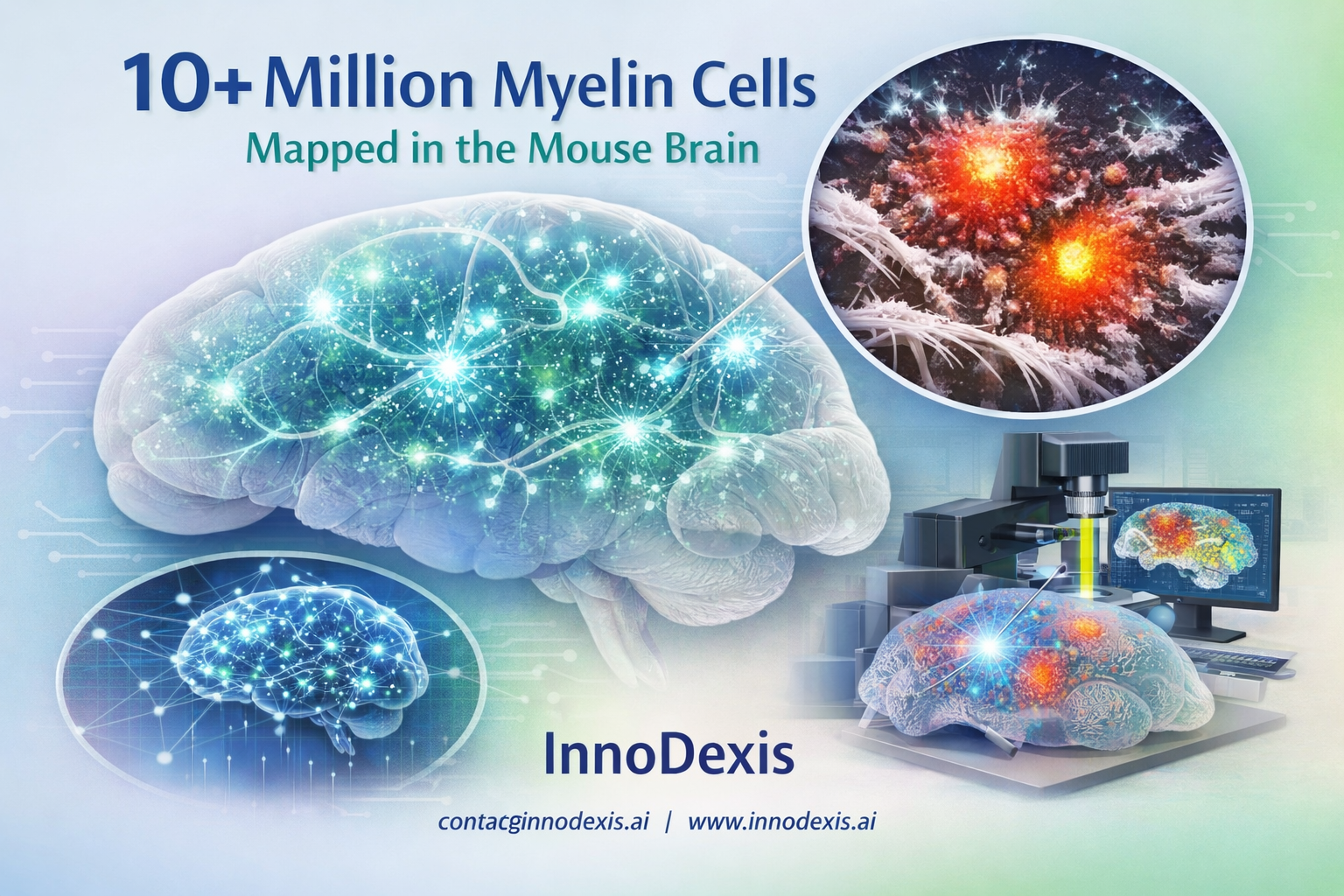
InnoDexis has published its latest Innovation Intelligence coverage of large-scale neurocellular mapping, analyzing a newly released whole-brain dataset from the United States during February 2026. The report reveals that researchers at Johns Hopkins Medicine successfully mapped more than 10 million oligodendrocytes per mouse brain, generating high-resolution, brain-wide cellular reconstructions. Published in Cell, the work documents significant regional variation in myelin-forming cells and identifies myelin damage in proximity to amyloid-beta plaques, providing new structural insight relevant to multiple sclerosis and Alzheimer’s disease research.
KEY FINDINGS
Researchers reconstructed whole-brain maps containing more than 10 million oligodendrocytes per mouse brain. The scale of mapping represents comprehensive cellular coverage across brain regions, enabling quantitative comparisons of myelin-forming cells at a level of resolution not previously available in earlier mapping efforts.
Sensory input regions were found to contain three times more oligodendrocytes than the primary motor cortex. This quantified disparity highlights substantial regional specialization in myelin distribution, suggesting that myelination density correlates with functional circuitry demands.
Myelin damage was observed near both dense core and diffuse amyloid-beta plaques. The spatial association between plaque presence and oligodendrocyte disruption provides structural evidence linking neurodegenerative pathology with myelin integrity across affected brain areas.
Oligodendrocyte formation was shown to vary significantly across brain regions and throughout the lifespan. The findings indicate that myelin-producing cell development is not uniform, but instead dynamically regulated by both anatomical location and age.
The maps provide higher resolution and broader gray matter coverage than previous brain-wide cellular maps. This expanded coverage enhances the ability to assess cellular distribution patterns beyond white matter-dominant analyses.
The dataset has been made freely available to researchers. Open accessibility enables broader validation, comparative analysis, and downstream application across neuroscience laboratories and translational research programs.
STRATEGIC INSIGHT AND TREND ANALYSIS
Collectively, the findings indicate a shift toward quantitative, whole-brain cellular cartography powered by integrated imaging and computational systems. By combining tissue clearing, light-sheet microscopy, and AI-based machine learning, researchers reconstructed brain-wide cellular maps at scale. The integration of imaging and computational analytics reflects a broader structural trend in neuroscience: the convergence of biological experimentation with artificial intelligence-driven reconstruction and pattern detection.
The identification of a threefold oligodendrocyte concentration difference between sensory regions and the primary motor cortex underscores the importance of region-specific myelination patterns. Rather than treating myelin distribution as homogeneous, the dataset reinforces the concept of anatomical and functional specialization at the cellular level.
The documented proximity of myelin damage to amyloid-beta plaques introduces structural evidence relevant to neurodegenerative disease models. The spatial relationship between plaque pathology and oligodendrocyte disruption may influence how researchers frame mechanistic studies in Alzheimer’s disease.
Finally, lifespan-dependent variability in oligodendrocyte formation suggests that temporal dynamics are integral to understanding myelin biology. This reinforces the value of whole-brain longitudinal or age-stratified mapping efforts as a foundation for disease modeling and therapeutic strategy development.
GLOBAL AND INDUSTRY IMPLICATIONS
For corporates and R&D teams, the availability of high-resolution, brain-wide cellular maps enables more precise targeting of myelin-related therapeutic programs. Companies focused on multiple sclerosis and neurodegeneration may integrate region-specific myelination data into preclinical modeling and drug development pipelines.
For investors and capital allocators, the study signals continued advancement in AI-integrated biomedical imaging platforms. Technologies combining tissue clearing, light-sheet microscopy, and machine learning reconstruction may represent a growing infrastructure layer within neurotechnology and life sciences research ecosystems.
For policymakers and national innovation bodies, the open release of large-scale cellular datasets supports collaborative scientific infrastructure. Publicly accessible brain-wide maps can accelerate international research coordination and improve reproducibility across neuroscience institutions.
INNODEXIS STATEMENT
“Large-scale cellular cartography is redefining how neurological structure is quantified, moving from regional sampling toward whole-brain, AI-integrated reconstruction,” noted InnoDexis in its latest intelligence report.
CONCLUSION
The mapping of more than 10 million oligodendrocytes per mouse brain represents a measurable advance in whole-brain cellular reconstruction. As imaging, tissue processing, and machine learning pipelines continue to converge, quantitative neuroanatomy is likely to become increasingly data-dense and computationally integrated. Future research will determine how such structural maps inform disease modeling, therapeutic targeting, and longitudinal brain studies. InnoDexis will continue monitoring developments in large-scale neurocellular mapping and AI-enabled biomedical imaging. The complete Innovation Intelligence coverage is available to InnoDexis subscribers and enterprise clients.
ABOUT INNODEXIS
InnoDexis is a global Innovation Intelligence platform that tracks, analyzes, and interprets breakthrough innovations, prototypes, and emerging technologies across industries and countries. Its intelligence helps corporates, investors, and policymakers understand the true structure and direction of global innovation. Learn more at innodexis.ai.