India Secures Dual Patents for Sunlight-Powered Nano-Reactor Targeting Persistent Wastewater Pollutants
An Indian-developed, sunlight-driven nano-reactor designed to dismantle pharmaceutical waste and industrial contaminants has received patents in India and the United Kingdom, signaling a scalable shift toward low-energy wastewater treatment.
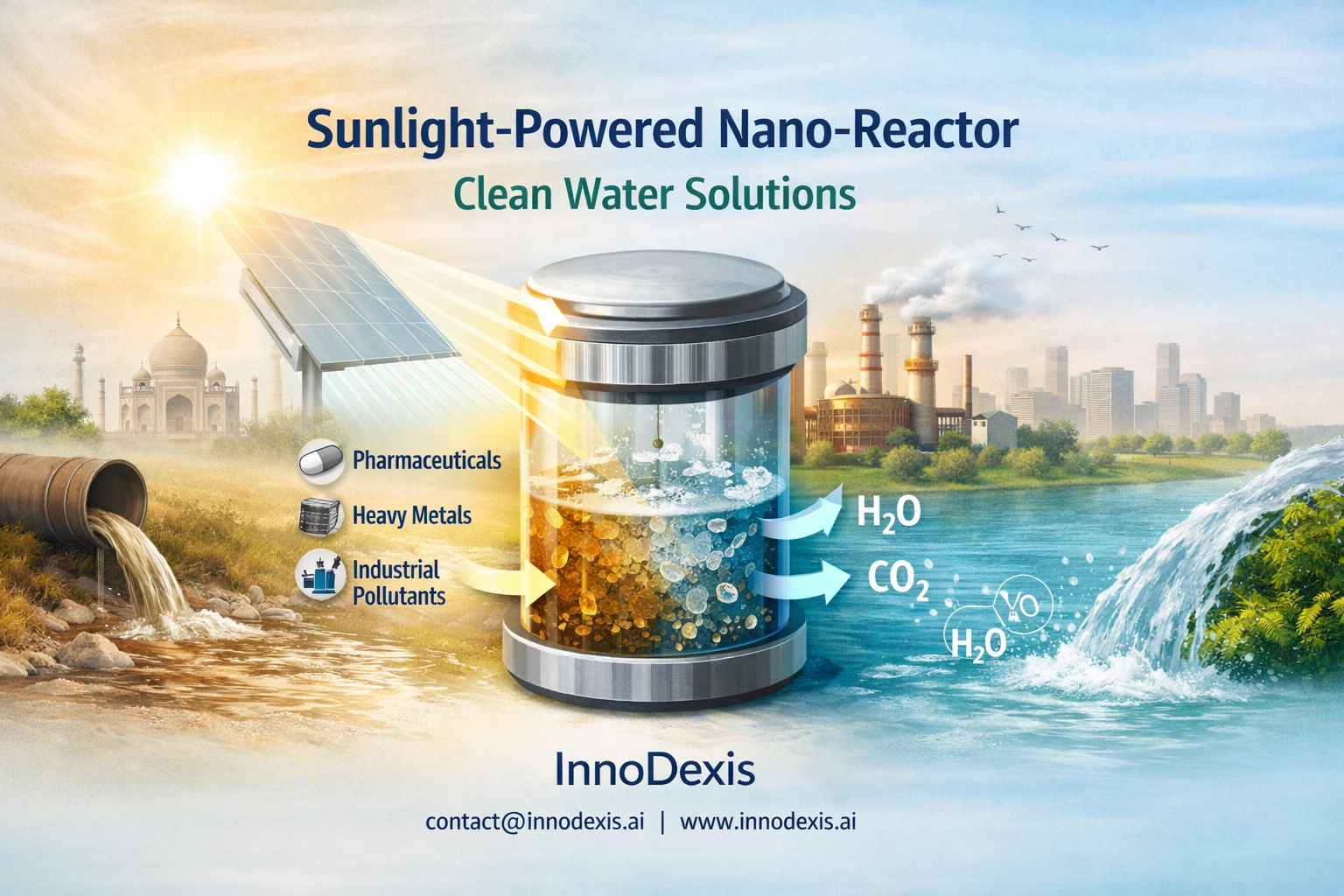
InnoDexis has published its latest Innovation Intelligence Report covering advanced wastewater treatment technologies, analyzing one patented nano-reactor innovation developed in India with patent protection secured in two countries during the current patent cycle. The report reveals that a sunlight-powered nano-reactor, developed by Indian research institutions, can dismantle hazardous pharmaceutical and industrial pollutants that conventional wastewater treatment systems routinely fail to remove, while operating without external electricity or chemical inputs.
KEY FINDINGS
The nano-reactor operates exclusively on sunlight as its energy source. Unlike conventional wastewater treatment systems that depend on grid electricity and chemical reagents, this device functions under normal temperature and pressure conditions, eliminating the need for additional energy infrastructure. This significantly reduces operational complexity and long-term energy dependency.
The system targets persistent contaminants that escape existing wastewater treatment processes. Pharmaceutical residues, industrial chemicals, pesticides, dyes, and heavy metals—commonly detected in rivers and groundwater—are identified as primary pollutant categories addressed by the device. These contaminants are often resistant to standard biological and chemical treatment methods.
The technology generates no harmful by-products during operation. Instead of transferring pollutants from one medium to another, the nano-reactor converts complex organic contaminants into harmless substances such as water and carbon dioxide. This eliminates secondary pollution risks that are often associated with chemical treatment processes.
Operational costs are minimal. Because the system relies solely on sunlight and does not require continuous chemical inputs or energy-intensive conditions, it presents a low-cost treatment pathway. This is particularly relevant for regions where wastewater treatment facilities face financial and energy constraints.
The innovation has been granted patents in both India and the United Kingdom. Dual patent protection indicates both domestic validation and international applicability, positioning the technology for broader deployment beyond its country of origin.
STRATEGIC INSIGHT AND TREND ANALYSIS
The development of a sunlight-powered nano-reactor reflects a broader structural shift in water treatment innovation toward energy-neutral and low-infrastructure solutions. Traditional wastewater treatment systems are capital-intensive and frequently fail to address emerging contaminants, particularly pharmaceutical residues and industrial chemicals. This innovation directly targets that performance gap.
A defining trend identified in the report is the integration of nanotechnology with renewable energy inputs to create decentralized treatment capabilities. By eliminating dependence on electricity and harsh chemical reagents, the device aligns with a growing emphasis on sustainable and climate-compatible infrastructure. This approach reduces lifecycle costs while also lowering environmental risk.
The conversion of complex pollutants into water and carbon dioxide signals a transition from pollutant containment to pollutant transformation. Rather than filtering or diluting contaminants, the nano-reactor chemically dismantles them under ambient conditions. This represents a functional rethinking of treatment design principles.
The joint development model—bringing together the Inter-University Accelerator Centre, University of Allahabad, and Central Institute of Tibetan Studies—also highlights the increasing role of collaborative, publicly supported research ecosystems in advancing applied clean technologies. Developed under the Make in India initiative, the project underscores a policy-backed push toward indigenous clean-tech capability.
Collectively, the data suggests that wastewater treatment innovation is entering a phase where energy efficiency, environmental neutrality, and cost accessibility are becoming central design criteria rather than secondary considerations.
GLOBAL AND INDUSTRY IMPLICATIONS
For corporates and R&D teams, the nano-reactor presents a pathway to integrate low-energy pollutant degradation into existing wastewater infrastructure. Industrial operators facing regulatory scrutiny over pharmaceutical and chemical discharge may find such modular, sunlight-driven systems relevant for compliance and sustainability targets.
For investors and capital allocators, the dual patent status in India and the United Kingdom signals potential for cross-border commercialization. Technologies that reduce energy dependency while addressing persistent contaminants align with long-term environmental infrastructure investment themes.
For policymakers and national innovation bodies, the device demonstrates the feasibility of domestically developed, export-ready environmental technologies. As access to clean water remains a pressing challenge in metropolitan and industrial regions, scalable, low-cost treatment systems could influence future wastewater standards and funding priorities.
INNODEXIS STATEMENT
“Water treatment innovation is shifting from energy-intensive containment models toward sunlight-driven pollutant transformation systems,” noted InnoDexis in its latest intelligence report.
CONCLUSION
The sunlight-powered nano-reactor represents a targeted response to one of the most persistent gaps in wastewater treatment: the removal of complex pharmaceutical and industrial contaminants under low-energy conditions. With patent protection secured in two jurisdictions and demonstrated environmental compatibility, the technology signals a practical pathway toward decentralized, sustainable treatment systems. Future monitoring will focus on pilot deployments, industrial integration, and cross-border adoption. The complete Sunlight-Powered Nano-Reactor Innovation Intelligence Report is available to InnoDexis subscribers and enterprise clients.
ABOUT INNODEXIS
InnoDexis is a global Innovation Intelligence platform that tracks, analyzes, and interprets breakthrough innovations, prototypes, and emerging technologies across industries and countries. Its intelligence helps corporates, investors, and policymakers understand the true structure and direction of global innovation. Learn more at innodexis.ai.