Hybrid Bioprinting System Achieves Capillary-Scale Vascular Networks with Living Cells for the First Time
A collaboration between the University of Notre Dame and Harvard Medical School has produced vascular networks with capillaries under 10 micrometers in diameter a resolution threshold with living cell compatibility not previously achieved in bioprinting.
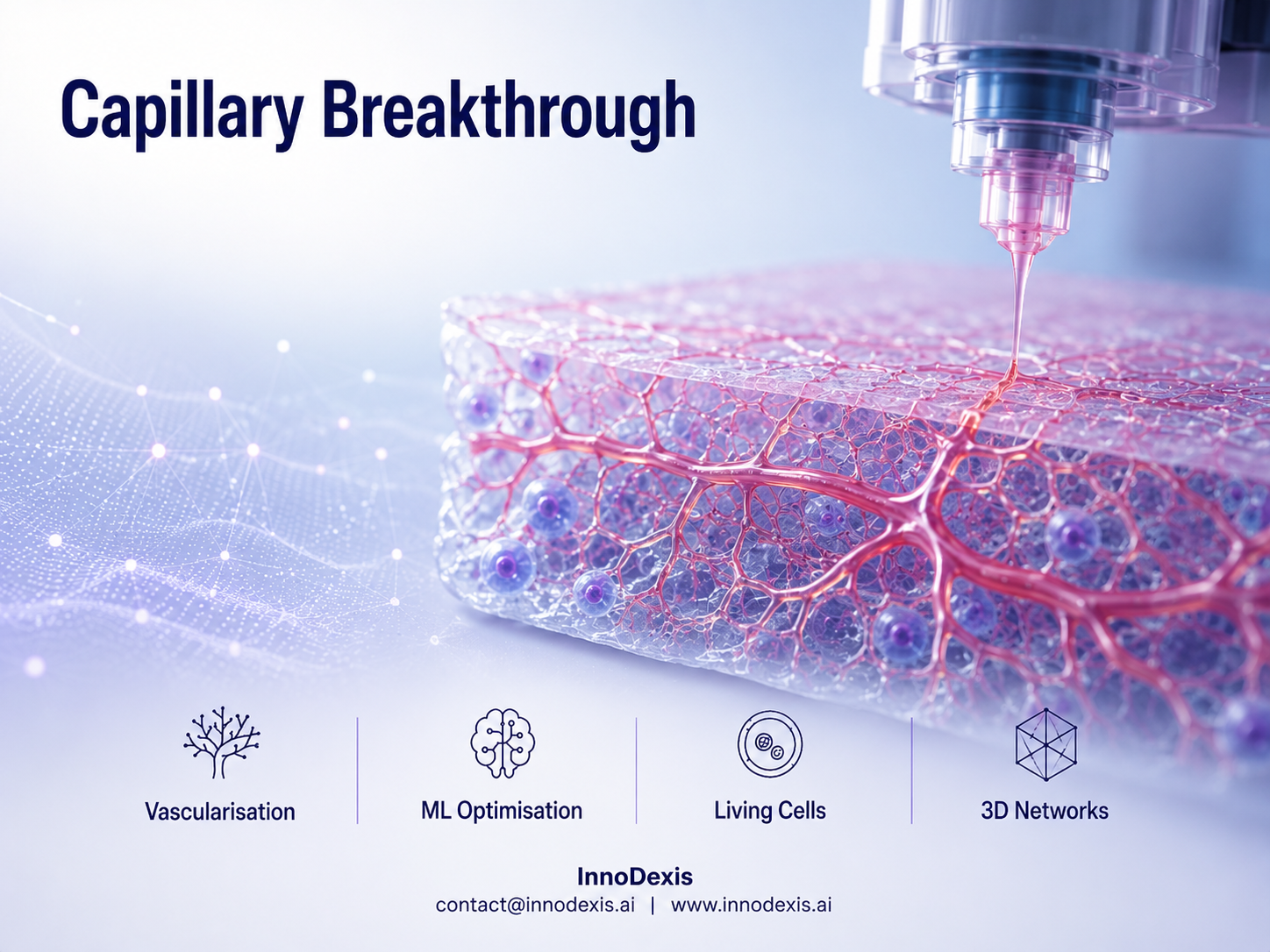
InnoDexis has published its latest Innovation Intelligence Report covering bioprinting and regenerative medicine, analyzing a high-significance innovation from the United States developed through a collaboration between the University of Notre Dame and Harvard Medical School. The report reveals that researchers led by Yanliang Zhang have developed a hybrid bioprinting technique that combines extrusion printing, aerosol jet printing, and a machine learning optimisation framework to fabricate vascular networks at capillary-scale resolution — producing living channels under 10 micrometers in diameter that successfully replicated natural capillary barrier function when seeded with endothelial cells.
Key Findings
The hybrid system achieved capillary printing at fewer than 10 micrometers in diameter — smaller than the finest human hair — establishing a resolution threshold that has not previously been reached in combination with living cell compatibility. This dual achievement is the defining technical advance: prior bioprinting approaches could approach this scale or support living cells, but not both simultaneously within a single fabricated vascular system.
Vascular networks were fabricated across one, two, and three dimensions, demonstrating that the hybrid approach can produce hierarchical structures rather than simple linear channels. The capacity to engineer vascular architecture across multiple dimensions is a prerequisite for organ-level tissue complexity, where blood vessel networks must navigate three-dimensional biological structures to deliver oxygen and nutrients to cells throughout a tissue mass.
A machine learning optimisation framework replaced conventional trial-and-error methods for printing parameter selection. This methodological shift is significant beyond this specific application: embedding ML optimisation within the fabrication process transforms parameter tuning from a manual, time-intensive bottleneck into a systematic, scalable process — a change that could accelerate bioprinting development timelines across multiple tissue engineering applications.
Printed channels seeded with endothelial cells successfully replicated natural capillary barrier function. This biological validation is critical: achieving the correct physical dimensions is necessary but insufficient without demonstrating that the printed structures support the cellular behaviour required for functional tissue. The endothelial cell integration result confirms that the fabricated capillaries are not merely structural mimics but biologically active channels.
The clinical context underpinning the significance of this advance is substantial. Over 100,000 people currently await organ transplants in the United States, with a new candidate added every 10 minutes. The inability to fabricate capillary-scale vascular networks has been a primary barrier preventing lab-grown organ fabrication from progressing beyond surface-layer tissue structures — making this advance directly relevant to one of the most persistent unmet needs in medicine.
Strategic Insight and Trend Analysis
The strategic significance of this innovation is that it reframes organ fabrication from a biological aspiration into an engineering problem with a visible solution pathway. The capillary gap — the inability to fabricate blood vessels small enough to oxygenate and nourish cells beyond the outer layers of a tissue construct — has been the defining structural limitation of bioprinting for organ engineering. Closing that gap, even at early prototype stage, changes the nature of the challenge that remains.
What this dataset signals is a convergence of three previously separate technical capabilities: precision fabrication at sub-10-micrometer resolution, living cell compatibility within the fabrication process, and ML-driven parameter optimisation that makes the system reproducible and scalable. Each capability alone has precedent. Their integration within a single hybrid system producing biologically validated capillary structures is the advance that distinguishes this work from incremental progress.
The three-dimensional hierarchical vascular network fabrication is the component most directly relevant to organ-level engineering. Organs are not flat structures — they require vascular networks that branch, navigate, and deliver function throughout a volumetric mass of tissue. Demonstrating fabrication across one, two, and three dimensions within this system indicates that the architectural complexity required for organ-scale structures is within the scope of the approach, rather than a separate problem requiring a different solution.
The embedding of ML optimisation within the fabrication workflow also signals a broader trend: the systematic integration of computational methods into bioprinting processes, reducing reliance on manual expertise and making high-precision fabrication more accessible and reproducible across research environments.
Global and Industry Implications
For corporates and R&D teams in biotechnology and pharmaceutical research, the hybrid bioprinting system represents a foundational capability advance for tissue engineering programmes. Organisations developing organoids, drug testing platforms, and tissue models now have a demonstrated pathway to capillary-scale vascularisation with living cell integration — a capability that directly improves the biological fidelity of fabricated tissue constructs used in preclinical research.
For investors and capital allocators, the advance signals that organ engineering is transitioning from a long-horizon aspiration toward a staged engineering problem with identifiable milestones. The combination of academic leadership from the University of Notre Dame and Harvard Medical School, ML integration, and biological validation of endothelial function provides a credible technical foundation for monitoring commercialisation activity in this space.
For policymakers and national innovation bodies, the scale of unmet clinical need — over 100,000 people awaiting organ transplants in the US alone — reinforces the strategic value of sustained public investment in regenerative medicine and bioprinting research infrastructure. Advances of this nature require long development timelines and benefit from coordinated funding across basic science, engineering, and translational research programmes.
InnoDexis Statement
"The fabrication of living capillary-scale vascular networks reframes organ engineering as a structured technical challenge — the integration of ML optimisation and multi-dimensional vascular fabrication within a single system marks a transition from aspiration to engineered pathway," noted InnoDexis in its latest intelligence report.
Conclusion
The fabrication of sub-10-micrometer capillaries with living endothelial cell integration and multi-dimensional hierarchical architecture marks a measurable advance in the structural capabilities of bioprinting. As the field moves toward organ-level complexity, the next thresholds — sustained cell viability at scale, immune compatibility, and integration with host vasculature — will define the pace of translation from laboratory construct to transplantable tissue. InnoDexis will continue to track developments in bioprinting, vascular tissue engineering, and the convergence of machine learning with biological fabrication. The complete Bioprinting and Vascular Engineering Innovation Intelligence Report is available to InnoDexis subscribers and enterprise clients.
About InnoDexis
InnoDexis is a global Innovation Intelligence platform that tracks, analyzes, and interprets breakthrough innovations, prototypes, and emerging technologies across industries and countries. Its intelligence helps corporates, investors, and policymakers understand the true structure and direction of global innovation. Learn more at innodexis.ai.