Heavy-Duty Electric Trucks Demonstrate Bidirectional Grid Integration as Fleets Emerge as Energy Assets
A Fraunhofer-led project shows trucks storing and returning electricity to the grid, signaling a shift from transport-only assets to participants in energy markets.
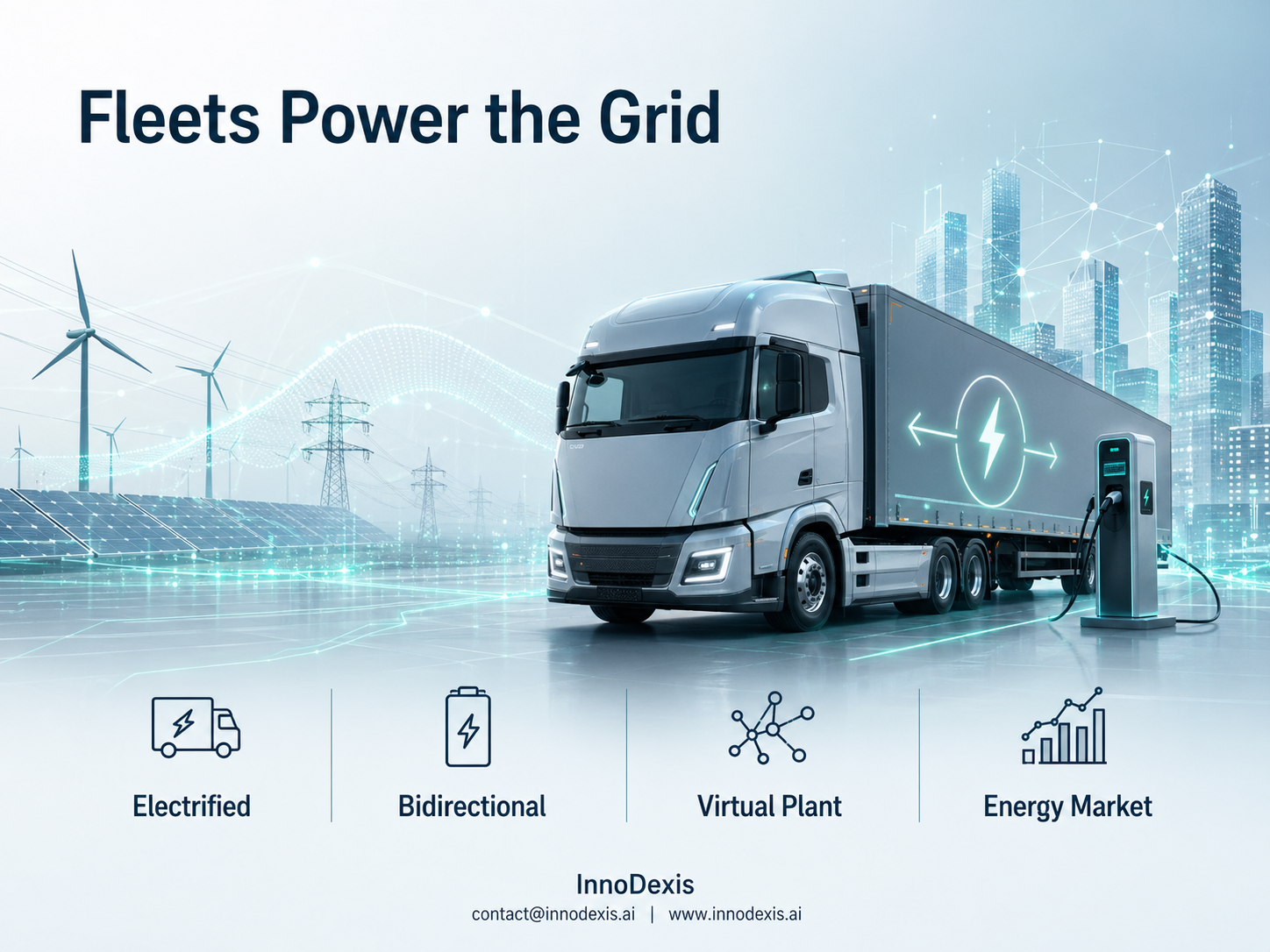
InnoDexis has published its latest Innovation Intelligence Report covering energy and mobility systems, analyzing recent demonstrations of bidirectional charging in heavy-duty electric trucks led by Fraunhofer Institute for Energy Economics and Energy System Technology. The report reveals that electric logistics fleets are beginning to function as distributed energy assets, capable of storing electricity and feeding it back into the grid. The findings indicate a convergence of transport electrification, grid infrastructure, and energy market participation within a unified operating model.
Key Findings
A real-world demonstration has validated bidirectional charging capabilities in heavy-duty electric trucks. This marks a transition from theoretical or pilot-stage concepts to operational proof, showing that large commercial vehicles can both consume and supply electricity within grid-connected systems.
Electric trucks are capable of storing energy and returning it to the grid during periods of demand. This capability positions fleets as distributed storage resources, contributing to grid stability while extending the functional role of vehicles beyond transportation.
Integration with virtual power plants enables coordinated participation in energy systems. By connecting fleets to aggregated energy platforms, trucks can be managed collectively, allowing synchronized charging and discharging aligned with grid requirements and market signals.
Fleet-level aggregation introduces flexibility at scale. Multiple vehicles operating as a coordinated unit can provide measurable grid services, including load balancing and peak shaving, enhancing the operational value of electrified logistics networks.
The convergence of transport and energy systems is evident in the integration of vehicles, grid infrastructure, and trading mechanisms. This alignment indicates a structural shift toward interconnected systems where mobility assets participate directly in energy distribution and exchange.
Strategic Insight and Trend Analysis
The findings point to a broader transition in how electrified transport assets are defined and utilized. Heavy-duty electric trucks are no longer limited to their primary function of goods movement; they are evolving into dynamic components of energy infrastructure. This shift reflects the increasing interdependence between mobility systems and electricity networks, particularly in regions with growing renewable energy penetration.
Bidirectional charging introduces a new operational layer in fleet management, where decisions are influenced not only by logistics requirements but also by energy pricing, grid demand, and storage capacity. This creates a multi-variable system in which transport efficiency and energy optimization are interconnected.
The integration with virtual power plants further reinforces this transition by enabling fleets to operate within aggregated energy ecosystems. Instead of acting as isolated assets, vehicles become nodes within coordinated networks that respond to real-time conditions. This model aligns with the broader evolution of decentralized energy systems, where distributed resources contribute to grid resilience.
Importantly, the value proposition of electrification expands beyond emissions reduction. While decarbonization remains a primary driver, the ability to store and trade energy introduces new economic dimensions. Fleets may generate additional value through participation in energy markets, shifting their role from cost centers to potential revenue-generating assets.
Global and Industry Implications
For corporates and logistics operators, the findings indicate a need to rethink fleet strategies in the context of energy participation. Electrified fleets may require integration with energy management systems, enabling operators to optimize both transport and electricity-related value streams.
For investors and capital allocators, the convergence of mobility and energy systems suggests emerging opportunities in platforms that enable aggregation, trading, and coordination of distributed assets. Infrastructure supporting bidirectional charging and virtual power plant integration may represent areas of increasing relevance.
For policymakers and national innovation bodies, the demonstration highlights the importance of regulatory frameworks that support bidirectional energy flows and market participation by non-traditional assets. Enabling standards and incentives may be required to accelerate adoption and ensure grid compatibility.
InnoDexis Statement
“The integration of heavy-duty electric fleets into grid and market systems indicates that electrification is evolving from a transport transition into a broader energy systems transformation,” noted InnoDexis in its latest intelligence report.
Conclusion
The demonstration led by Fraunhofer Institute for Energy Economics and Energy System Technology reflects a structural shift in the role of electric vehicles within energy ecosystems. As fleets gain the ability to store, distribute, and trade electricity, their function extends into grid support and market participation. Monitoring how these capabilities scale across regions and integrate with existing infrastructure will be critical in understanding the next phase of energy and mobility convergence. The complete Energy and Mobility Innovation Intelligence Report is available to InnoDexis subscribers and enterprise clients.
About InnoDexis
InnoDexis is a global Innovation Intelligence platform that tracks, analyzes, and interprets breakthrough innovations, prototypes, and emerging technologies across industries and countries. Its intelligence helps corporates, investors, and policymakers understand the true structure and direction of global innovation. Learn more at innodexis.ai.