Global Warming Rate Accelerates to 0.35°C per Decade in Recent Years
A new climate analysis indicates that the pace of global warming itself is increasing, potentially accelerating the timeline for reaching critical temperature thresholds.
InnoDexis has published its latest Innovation Intelligence analysis covering climate science trends, examining global temperature dynamics based on findings from the Potsdam Institute for Climate Impact Research. The analysis evaluates temperature data across five major global datasets and assesses long-term warming patterns by removing short-term natural influences such as El Niño cycles, volcanic activity, and solar variability. The report reveals that the rate of global warming has increased significantly in the past decade compared with previous decades, suggesting that temperature change is not only continuing but accelerating.
Key Findings
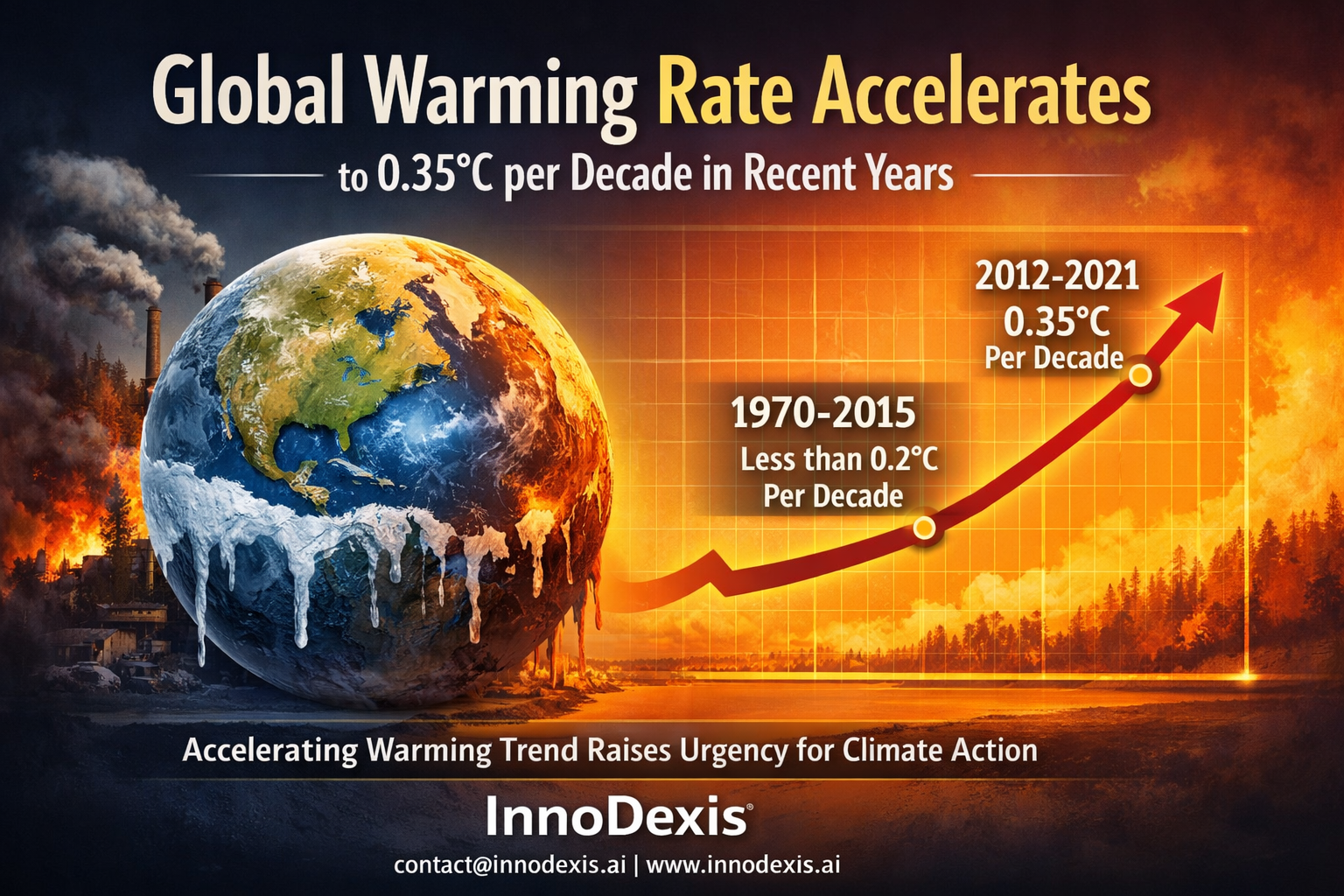
A comprehensive review of global temperature datasets indicates that the long-term warming trend has shifted noticeably in recent years. Analysis of data from NASA, NOAA, HadCRUT, Berkeley Earth, and ERA5 reveals that global temperatures between 1970 and 2015 increased at a rate of less than 0.2°C per decade. This period reflects the baseline warming trend used in many climate projections and policy frameworks.
However, the most recent decade shows a substantially higher warming rate. The analysis estimates that temperatures have increased at approximately 0.35°C per decade during the past ten years. This change suggests that the underlying climate system may be responding more rapidly to greenhouse gas concentrations than previously assumed in many long-term projections.
To isolate the structural warming signal, researchers removed short-term natural influences from the temperature record. Factors such as El Niño events, volcanic eruptions, and solar variability can temporarily amplify or suppress global temperatures. By adjusting for these influences, the study focused on the persistent warming trend associated with long-term climate forcing.
The statistical analysis indicates a high level of confidence in the observed acceleration. Researchers estimate that the likelihood of the accelerated warming trend being a random fluctuation is less than 2%, corresponding to a statistical certainty exceeding 98%.
One of the most significant implications of the findings concerns the global temperature targets established under the Paris Agreement. If the accelerated warming rate continues, the threshold of 1.5°C above pre-industrial levels could be crossed before 2030. Such a scenario would compress the timeframe available for governments and industries to implement emissions reductions and climate mitigation strategies.
Strategic Insight and Trend Analysis
The data indicates that the climate system may be entering a phase where warming trends are not only persistent but dynamically changing. Many existing climate projections assume that the rate of warming remains relatively stable over time. Under that assumption, policymakers and industries can rely on gradual warming curves when designing long-term adaptation and mitigation strategies.
An acceleration in the warming rate challenges this assumption. If the pace of temperature increase itself changes, projections based on earlier trends may underestimate the speed at which climate thresholds could be reached. This introduces additional uncertainty into climate modeling and increases the urgency of monitoring real-time environmental signals.
From a scientific perspective, the analysis demonstrates the importance of separating long-term climate forcing from short-term variability. Events such as El Niño cycles can produce temporary temperature spikes that may obscure underlying structural trends. By removing these natural fluctuations, the study provides a clearer view of the persistent warming signal linked to greenhouse gas emissions.
The emerging pattern also highlights the importance of continuously updating climate models with current observational data. Historical trends remain valuable for understanding climate dynamics, but the possibility of accelerating warming suggests that future climate behavior may diverge from earlier projections.
Global and Industry Implications
For corporates and R&D teams, accelerated warming trends may influence long-term planning in sectors such as energy, infrastructure, and environmental technologies. Faster temperature increases could intensify demand for solutions related to carbon capture, climate resilience infrastructure, and renewable energy systems.
For investors and capital allocators, the shift in warming dynamics may reinforce the strategic importance of climate technologies and sustainability-focused innovation. Technologies addressing energy transition, emissions monitoring, and climate adaptation may experience increased investment attention as policy and market responses accelerate.
For policymakers and national planning bodies, the potential for earlier temperature thresholds introduces new challenges for climate policy timelines. Infrastructure planning, emissions reduction pathways, and climate adaptation strategies may require reassessment if warming trajectories continue to change.
InnoDexis Statement
“Signals indicating shifts in the pace of global warming highlight the importance of continuously monitoring climate trends and integrating new data into long-term policy and investment decisions,” noted InnoDexis in its latest intelligence analysis.
Conclusion
The emerging evidence that global warming rates may be accelerating underscores the need for continuous observation and reassessment of climate projections. While long-term temperature increases have been well documented, changes in the rate of warming introduce additional complexity into forecasting future climate conditions.
For governments, industries, and researchers, the implications extend beyond environmental monitoring to strategic planning for energy systems, infrastructure resilience, and economic development. As climate dynamics evolve, real-time intelligence and analytical platforms will play an increasingly important role in identifying emerging signals and interpreting their implications.
The complete Climate Science Innovation Intelligence analysis is available to InnoDexis subscribers and enterprise clients.
About Innodexis
InnoDexis is a global Innovation Intelligence platform that tracks, analyzes, and interprets breakthrough innovations, prototypes, and emerging technologies across industries and countries. Its intelligence helps corporates, investors, and policymakers understand the true structure and direction of global innovation. Learn more at innodexis.ai.