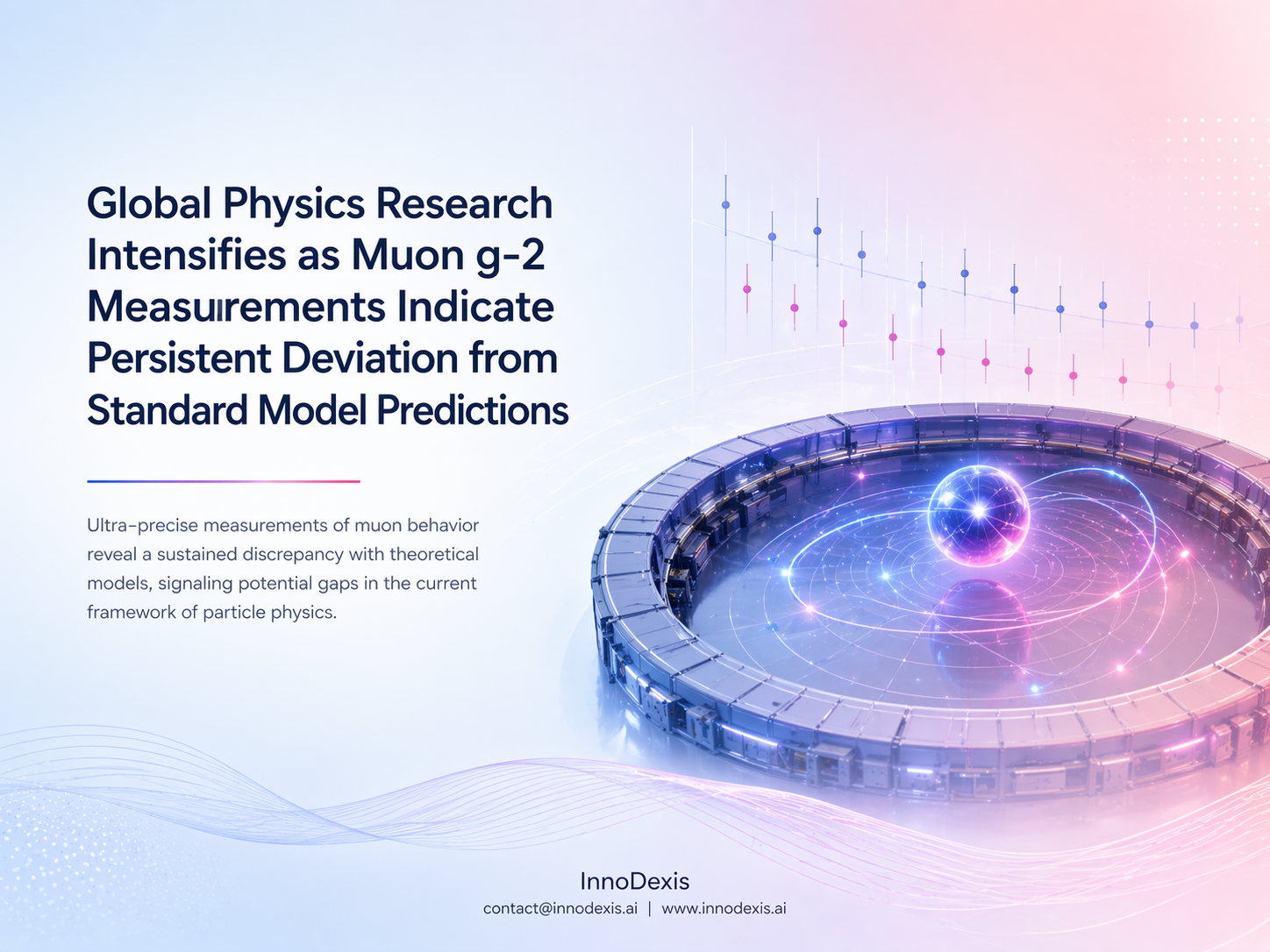
Global Physics Research Intensifies as Muon g-2 Measurements Indicate Persistent Deviation from Standard Model Predictions
Ultra-precise measurements of muon behavior reveal a sustained discrepancy with theoretical models, signaling potential gaps in the current framework of particle physics.
InnoDexis has published its latest Innovation Intelligence Report covering particle physics research, analyzing experimental advancements across leading laboratories including CERN, Fermi National Accelerator Laboratory, and Brookhaven National Laboratory over multiple decades. The report reveals that the most recent results from the Muon g-2 experiment provide the most precise measurement to date of muon behavior in magnetic fields, while continuing to show a measurable deviation from predictions defined by the Standard Model.
Key Findings
The Muon g-2 experiment represents a multi-decade scientific effort involving multiple leading research institutions. Initial measurements conducted at Brookhaven National Laboratory have been extended and refined through subsequent experimental work at Fermi National Accelerator Laboratory, with collaborative contributions from CERN and global partners. This continuity reflects long-term investment in precision physics experimentation.
The experiment achieved the most accurate measurement to date of muon precession, often described as the “wobble” of muons in a controlled magnetic storage ring. This level of precision is the result of incremental improvements in instrumentation, calibration, and data analysis, enabling detection of extremely small variations in particle behavior.
Experimental results consistently indicate a deviation between observed muon behavior and predictions derived from the Standard Model. This discrepancy has persisted across multiple experimental runs and refinements, suggesting that the divergence is not attributable to isolated measurement error.
A growing gap is observed between empirical data and computational theoretical models. While theoretical predictions have been refined using increasingly sophisticated calculations, the experimental measurements continue to indicate a measurable difference, highlighting tension between observed and predicted values.
The findings position precision measurement as a critical tool in advancing fundamental physics. Rather than relying solely on higher-energy experiments, the Muon g-2 results demonstrate that small-scale anomalies detected through high-precision instrumentation can reveal structural inconsistencies in established theoretical frameworks.
Strategic Insight and Trend Analysis
The Muon g-2 results indicate a broader shift in how fundamental physics discoveries may emerge. Historically, progress in particle physics has often been associated with increasing experimental scale, particularly through higher-energy particle collisions. However, the current findings suggest that precision-based experimentation is becoming an equally significant pathway for discovery.
The persistent deviation from Standard Model predictions introduces the possibility that existing theoretical frameworks may be incomplete. While the magnitude of the discrepancy remains small in absolute terms, its consistency across multiple measurements increases its relevance at a structural level. This indicates that even minor anomalies can carry implications that extend beyond incremental theoretical adjustments.
The divergence between experimental results and computational models also highlights limitations in current theoretical approaches. As models become more complex, aligning them with empirical observations becomes increasingly challenging. This dynamic suggests a phase in which theory and experimentation are no longer converging at the same rate, creating a gap that may require new conceptual approaches.
Collectively, the findings point toward a transition from refinement-driven research to framework-challenging investigation. The focus is shifting from validating existing models to testing their boundaries, with precision measurements serving as a primary mechanism for identifying inconsistencies.
Global and Industry Implications
For corporates and R&D teams, particularly those engaged in advanced instrumentation and measurement technologies, the findings highlight the increasing importance of precision engineering. High-accuracy detection systems and data analysis capabilities are becoming central to enabling next-generation scientific discovery.
For investors and capital allocators, the results indicate that value creation in deep science domains may increasingly emerge from long-term, high-precision research rather than short-cycle experimental scaling. This may influence funding strategies toward enabling infrastructure that supports sustained measurement accuracy.
For policymakers and national innovation bodies, the multi-institutional and multi-decade nature of the Muon g-2 experiment underscores the importance of sustained public investment in fundamental science. Continued support for collaborative research ecosystems may be critical in advancing discoveries that challenge existing scientific frameworks.
InnoDexis Statement
“The persistence of deviation between experimental measurement and theoretical prediction suggests that precision physics is entering a phase where small anomalies may redefine foundational assumptions within established scientific models,” noted InnoDexis in its latest intelligence report.
Conclusion
The Muon g-2 experiment represents a significant development in the ongoing evaluation of fundamental physics theories. While the observed discrepancy remains under continued investigation, its persistence across high-precision measurements positions it as a key signal to monitor. As scientific inquiry increasingly balances scale with precision, the ability to detect and interpret small deviations may shape the next phase of discovery. The complete Muon g-2 Innovation Intelligence Report is available to InnoDexis subscribers and enterprise clients.
About InnoDexis
InnoDexis is a global Innovation Intelligence platform that tracks, analyzes, and interprets breakthrough innovations, prototypes, and emerging technologies across industries and countries. Its intelligence helps corporates, investors, and policymakers understand the true structure and direction of global innovation. Learn more at innodexis.ai.