Germany Leads Global Space Innovation as Quantum Communications and Earth Intelligence Convergence Accelerates
109 innovations across 20 countries reveal that space systems are advancing through simultaneous multi-domain convergence, led by quantum-secured communications and Earth observation infrastructure.
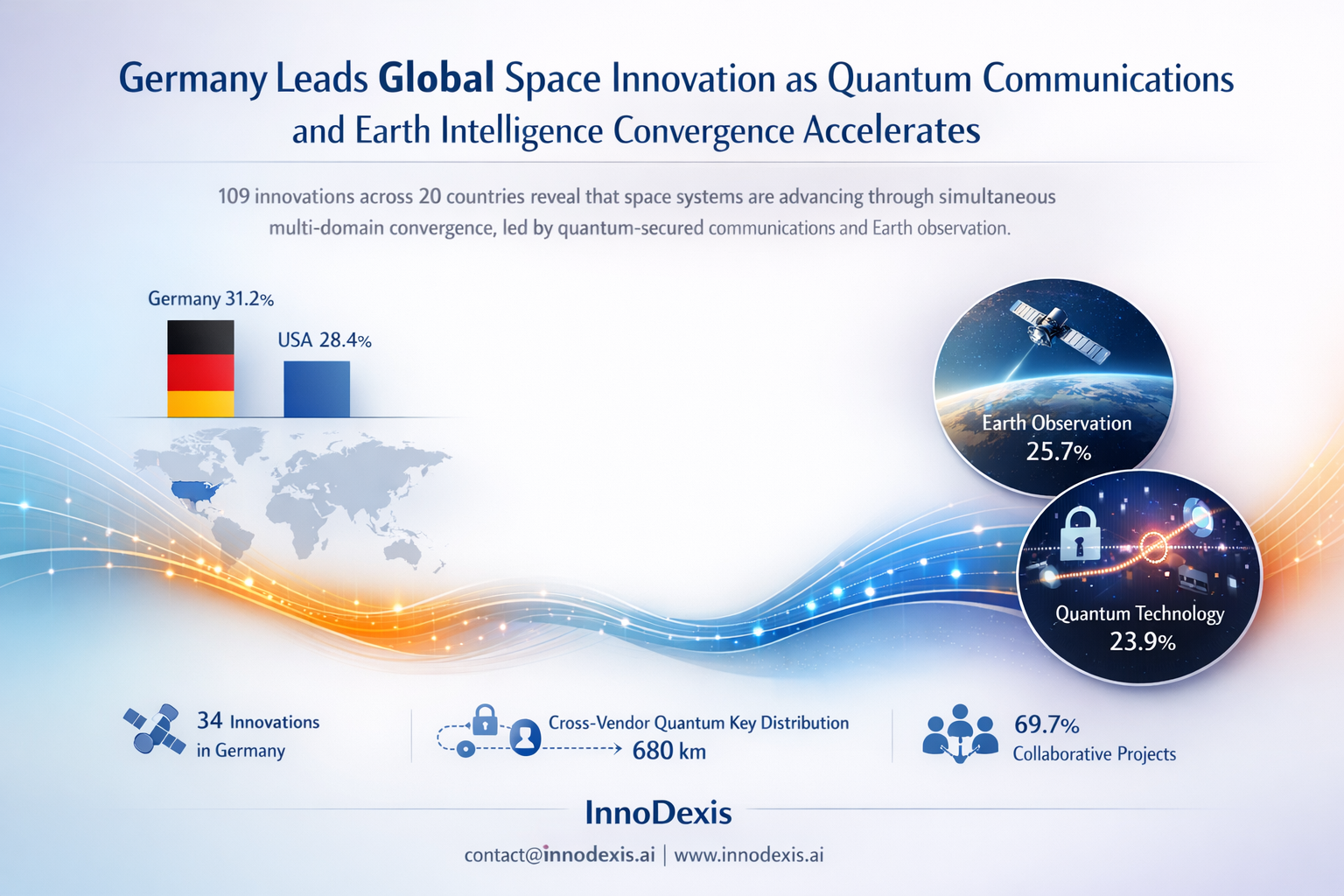
InnoDexis has published its latest Innovation Intelligence Report covering space and aerospace technology, analyzing 109 innovations across 20 countries during January to March 2026. The report reveals that space innovation has reached a structural inflection point, where multiple technology domains—including quantum communications, Earth observation, and AI-enabled satellite systems—are advancing simultaneously. This convergence is redefining space systems from isolated missions into integrated intelligence infrastructure spanning sensing, communication, and computation layers.
KEY FINDINGS
Earth Observation & Remote Sensing and Space Communications & Quantum Technology have emerged as the two dominant technology segments, accounting for approximately 25.7% and 23.9% of total innovations respectively. Together, they represent nearly half of all activity, indicating that the primary focus of space innovation is shifting toward intelligence generation and secure data transmission rather than standalone hardware systems.
Germany leads global space innovation with 34 innovations (31.2%), followed by the United States with 31 (28.4%). Combined, the Germany–United States axis accounts for 65 innovations, or 59.6% of total output, demonstrating structural dominance across research, engineering, and mission deployment capabilities.
Quantum communications has reached a critical development threshold, with multiple independent breakthroughs achieved within a single quarter. These include cross-vendor quantum key distribution at 680 km (TRL 7), device-independent QKD at 100 km, and advances in free-space and chip-integrated quantum systems, collectively indicating that the technology has moved beyond feasibility toward early deployment readiness.
CubeSat and miniaturisation technologies have achieved operational maturity, with missions delivering over 11 billion atmospheric observations using sensors at one-hundredth the size of traditional systems, and nanosatellites demonstrating more than 25 months of mission heritage at TRL 9. These developments confirm the viability of distributed, low-cost satellite architectures.
Government funding supports 48.6% of all innovations, while explicit venture capital participation appears in only 1% of records. This distribution highlights a structural imbalance where early-stage research is well-funded, but commercial scaling and private capital engagement remain limited across the space innovation ecosystem.
Collaborative R&D is a defining feature of the ecosystem, with 69.7% of innovations involving multi-institutional partnerships. These include consortium-based models, multi-country programmes, and mission-linked collaborations, demonstrating that large-scale coordination is central to advancing complex space technologies.
STRATEGIC INSIGHT AND TREND ANALYSIS
The Q1 2026 dataset indicates a clear transition from isolated technological advancements to system-level convergence across the space ecosystem. The most significant trend is the integration of sensing, communication, and computation into unified orbital intelligence systems.
Earth observation and space communications are advancing in parallel, forming the foundation of a new space-based information infrastructure. This convergence is reinforced by simultaneous breakthroughs in quantum communications, onboard AI processing, and miniaturised sensing platforms, all occurring within the same time window.
Quantum communications represents the most pronounced inflection point. Multiple independent milestones—including distance records, device-independent security models, and operational network demonstrations—have been achieved concurrently, shifting the competitive landscape from fundamental research to standardisation and deployment.
At the same time, the emergence of onboard AI satellites marks a structural shift in how space data is processed and delivered. Systems capable of performing analysis directly in orbit reduce latency and bandwidth constraints while enabling real-time decision-making capabilities.
The dataset also shows that innovation is occurring simultaneously across every layer of the space system, including propulsion, in-space services, and exploration technologies. This simultaneity indicates that the space sector is entering a phase of architectural transformation, where multiple enabling technologies are maturing together rather than sequentially.
GLOBAL AND INDUSTRY IMPLICATIONS
For corporates and R&D teams, the findings indicate that future competitiveness will depend on integrating capabilities across multiple domains, particularly combining sensing technologies with secure communications and onboard processing. Organisations must prioritise system-level architectures rather than standalone product development.
For investors and capital allocators, the report highlights a clear commercialisation gap. While technologies such as quantum communications and CubeSat systems have reached advanced maturity levels, limited venture capital participation suggests significant opportunities in scaling and infrastructure deployment.
For policymakers and national innovation bodies, the data underscores the importance of coordinated national strategies. Countries leading in innovation demonstrate strong alignment between research institutions, funding mechanisms, and industrial partnerships, which is critical for translating technological capability into strategic advantage.
INNODEXIS STATEMENT
“The space innovation landscape is transitioning from mission-centric development to integrated intelligence systems where sensing, communication, and computation converge into a unified infrastructure layer,” noted InnoDexis in its latest intelligence report.
CONCLUSION
The Q1 2026 space innovation landscape reflects a system-wide transformation driven by convergence across multiple technology domains. Advances in quantum communications, Earth observation, and AI-enabled satellites are collectively redefining the structure of space systems and their role in global infrastructure.
Looking ahead, key developments to monitor include quantum communication standardisation, commercial deployment of onboard AI satellite systems, expansion of CubeSat constellations, and the evolution of on-orbit servicing and resource utilisation technologies. The complete Space Innovation Landscape 2026 report is available to InnoDexis subscribers and enterprise clients.
ABOUT INNODEXIS
InnoDexis is a global Innovation Intelligence platform that tracks, analyzes, and interprets breakthrough innovations, prototypes, and emerging technologies across industries and countries. Its intelligence helps corporates, investors, and policymakers understand the true structure and direction of global innovation. Learn more at innodexis.ai.