Germany Expands Shared Deep-Tech Infrastructure as Photonics and AI Converge Across Energy and Virology Research
New initiatives in artificial photosynthesis and AI-supported virus intelligence suggest scientific infrastructure is increasingly evolving into a shared technology layer spanning multiple industries.
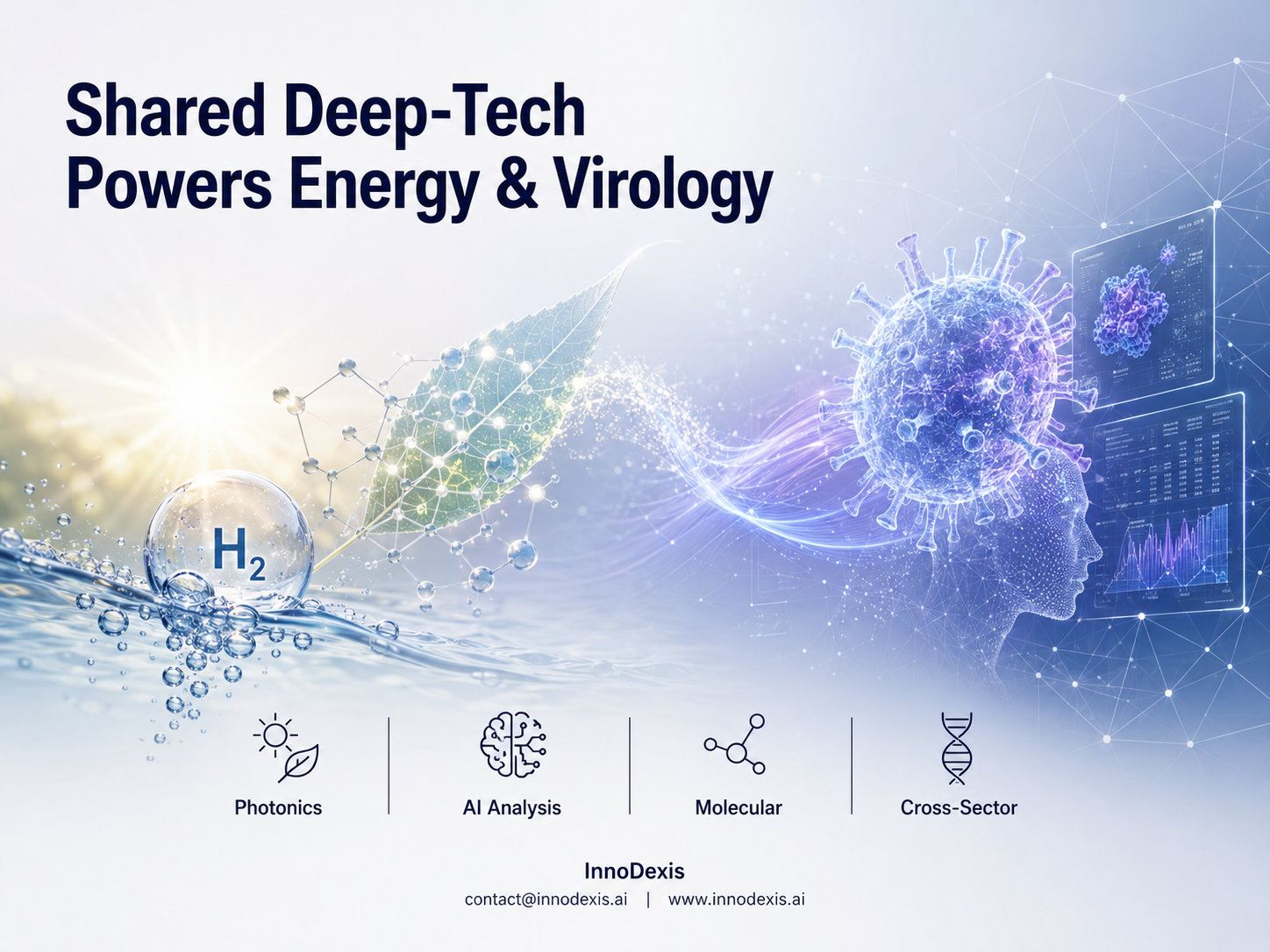
InnoDexis has published its latest Innovation Intelligence Report covering converging developments in photonics, computational biology, and molecular-scale scientific systems. The report analyzes emerging cross-disciplinary research initiatives centered on energy innovation, virology, and AI-supported scientific infrastructure. The findings reveal that researchers at Friedrich Schiller University Jena are advancing parallel programs in sunlight-driven hydrogen production and AI-enabled virus analysis, both built on overlapping capabilities in photonics, molecular observation, and computational modeling. The developments indicate that foundational deep-tech systems may increasingly support innovation simultaneously across energy, healthcare, biotechnology, and advanced scientific research domains.
Key Findings
The report identifies the continued expansion of Germany’s “CATALIGHT” program as a major signal in the development of artificial photosynthesis systems for green hydrogen production. Supported through extended funding from the German Research Foundation (DFG), the initiative focuses on using sunlight-driven catalytic reactions to split water into hydrogen and oxygen. Researchers are working to coordinate interconnected reaction pathways capable of enabling more efficient hydrogen generation through light-controlled chemical processes.
A second major finding involves the establishment of the “VirusREvolution” center, which is developing AI-supported photonic tools for advanced virus analysis. The initiative combines photonics, bioinformatics, microbiology, virology, and computational biology capabilities to study viral structures and interactions with greater analytical precision. Initial model systems include SARS-CoV-2 and bacteriophage N4, providing test environments for next-generation analytical methods.
The report also highlights the increasing overlap between energy research and biological intelligence systems. Although artificial photosynthesis and virus analysis operate in different application domains, both rely heavily on molecular-scale sensing, high-precision observation, and computational modeling. This convergence suggests that the same enabling infrastructure may increasingly support innovation across multiple scientific sectors simultaneously.
Another significant finding concerns the growing role of photonics as a foundational scientific capability. Light-based analytical and control systems are emerging as essential tools not only in advanced materials and communications research, but also in healthcare diagnostics, biological analysis, and energy conversion systems. The findings indicate that photonics is evolving from a specialized field into a broader enabling layer for scientific and industrial innovation.
The report further identifies the importance of interdisciplinary integration within modern research ecosystems. The combination of chemistry, computational biology, microbiology, photonics, and AI-supported analysis reflects a broader shift toward platform-oriented scientific development models capable of addressing multiple technological domains through shared infrastructure.
Strategic Insight and Trend Analysis
The broader trend emerging from these developments is the transformation of scientific infrastructure into reusable, cross-sector technology platforms. Historically, major research initiatives were often organized around isolated industrial or scientific objectives. The current shift suggests that foundational capabilities such as photonics, AI-assisted modeling, molecular sensing, and high-resolution computational analysis are becoming increasingly transferable across industries.
The parallel development of artificial photosynthesis and AI-enabled virus intelligence demonstrates how the same core technical systems can support fundamentally different application areas. In both cases, researchers are attempting to observe, control, and model molecular interactions with high precision. This convergence indicates that future innovation ecosystems may depend less on isolated scientific silos and more on shared deep-tech infrastructure capable of enabling multiple sectors simultaneously.
Photonics appears to be playing a particularly important role in this transition. Light-based systems are increasingly functioning as operational tools for manipulating chemical reactions, detecting biological activity, and generating high-resolution analytical data. Combined with advances in computational biology and AI-assisted interpretation, these systems are creating new pathways for integrated scientific research environments.
The findings also suggest a structural change in how governments and research institutions may approach long-term investment strategies. Rather than funding narrowly defined technologies, institutions may increasingly prioritize platform technologies capable of generating downstream innovation across energy, healthcare, biotechnology, environmental science, and advanced manufacturing.
Collectively, the developments point toward an emerging scientific model where innovation capacity is determined not only by individual discoveries, but by the flexibility and interoperability of shared research infrastructure.
Global and Industry Implications
For corporates and R&D teams, the findings highlight the growing importance of platform-based scientific capabilities that can be deployed across multiple business domains. Organizations operating in healthcare, energy, biotechnology, and advanced materials may increasingly compete through integrated research ecosystems rather than isolated product development programs.
For investors and capital allocators, the report signals rising strategic relevance for enabling technologies such as photonics, AI-supported scientific computing, and molecular-scale sensing infrastructure. Companies and institutions developing reusable deep-tech platforms may become increasingly important within long-term innovation portfolios spanning multiple sectors.
For policymakers and national innovation bodies, the developments reinforce the importance of supporting interdisciplinary scientific ecosystems capable of driving broad economic and technological impact. Countries investing in shared research infrastructure may strengthen their ability to generate cross-sector innovation in energy resilience, healthcare preparedness, and advanced industrial technologies.
InnoDexis Statement
“The convergence of photonics, computational biology, and molecular-scale analysis suggests that future scientific competitiveness may increasingly depend on shared deep-tech infrastructure rather than isolated sector-specific innovation programs,” noted InnoDexis in its latest intelligence report.
Conclusion
The initiatives emerging from Friedrich Schiller University Jena reflect a broader transformation in how advanced scientific systems are being developed and deployed. As photonics, AI-supported analysis, and molecular-scale modeling become increasingly interconnected, the same foundational technologies may support innovation simultaneously across energy, healthcare, biotechnology, and computational science. This convergence could reshape future research priorities, investment strategies, and national innovation frameworks. InnoDexis will continue tracking developments in platform-based scientific infrastructure and cross-sector deep-tech systems shaping the next phase of global innovation. The complete Photonics, Artificial Photosynthesis, and AI-Enabled Virology Intelligence Report is available to InnoDexis subscribers and enterprise clients.
About InnoDexis
InnoDexis is a global Innovation Intelligence platform that tracks, analyzes, and interprets breakthrough innovations, prototypes, and emerging technologies across industries and countries. Its intelligence helps corporates, investors, and policymakers understand the true structure and direction of global innovation. Learn more at innodexis.ai.