Germany Accounts for 23.4% of Global AI Innovation Output in February 2026 as United States and Germany Together Generate 57%
A concentrated surge in AI innovation activity across two countries defined the global landscape during a 19-day February intelligence window.
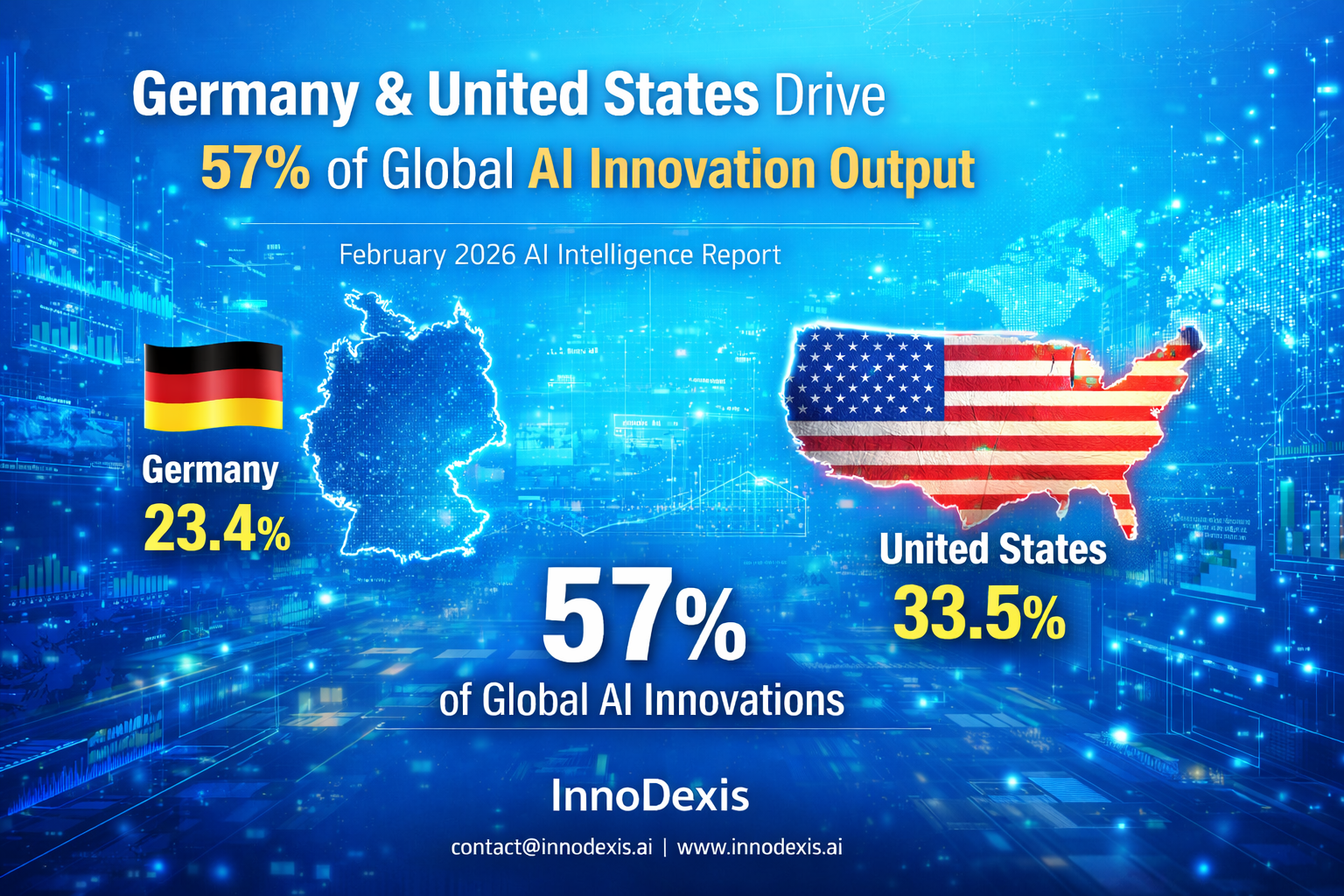
InnoDexis has published its latest Innovation Intelligence Report covering artificial intelligence innovation activity, analyzing AI developments across multiple countries during a 19-day period in February 2026. The report reveals that Germany generated 125 AI innovations during the period, accounting for 23.4% of total global output tracked, while the United States produced 179 innovations, representing 33.5%. Together, the two countries contributed 57% of all AI innovation activity identified in the dataset, highlighting a pronounced geographic concentration in near-term AI development momentum.
Key Findings
Germany recorded 125 AI innovations within 19 days, representing 23.4% of total global AI innovation output captured during the reporting period. This volume places Germany as the second-largest contributor in the dataset and signals sustained institutional and industrial AI activity at scale within a compressed timeframe.
The United States produced 179 AI innovations during the same 19-day window, accounting for 33.5% of total tracked output. This positions the United States as the single largest contributor in the dataset, maintaining quantitative leadership in overall AI innovation activity.
Combined, Germany and the United States generated 57% of all AI innovations recorded in the analysis period. This level of concentration indicates that more than half of documented AI innovation output originated from just two countries, underscoring geographic clustering within the current AI landscape.
China accounted for 12 AI innovations in the dataset, representing 2.2% of total global output during the observed period. The tracked activity reflects early-stage strategic positioning in battery machine learning applications, genomics-focused AI systems, and materials science-driven artificial intelligence development.
The 19-day observation window provides a near real-time view of AI innovation velocity, revealing measurable disparities in output distribution across major technology-producing economies.
Strategic Insight & Trend Analysis
The February 2026 data indicates that global AI innovation activity remains highly concentrated within a limited number of national ecosystems. With 57% of total output originating from Germany and the United States alone, the dataset points to a structural consolidation of innovation throughput in established AI economies during the measured period.
Germany’s 23.4% share within a compressed 19-day window suggests institutional density and coordinated AI research execution across industrial, academic, and applied domains. The scale of recorded output indicates that Germany’s AI ecosystem is operating at sustained volume rather than episodic announcement cycles. This reflects consistent innovation reporting and deployment signals rather than isolated breakthroughs.
The United States’ 33.5% share reinforces its quantitative leadership in AI innovation production. However, the narrowing differential between the United States and Germany in the dataset indicates that European AI output, at least during the observed period, is approaching comparable levels of intensity in documented innovation events.
China’s 2.2% share within this specific window does not indicate capability constraints but instead suggests strategic positioning in selected subdomains such as battery machine learning, genomics AI, and materials science applications. These areas often represent longer-horizon research cycles rather than rapid commercialization-driven outputs.
Collectively, the data reflects a global AI landscape characterized by output concentration, regional specialization, and evolving strategic positioning rather than evenly distributed innovation activity.
Global & Industry Implications
For corporates and R&D teams, the concentration of 57% of global AI innovation output in two countries signals where partnership, scouting, and competitive benchmarking efforts may yield the highest near-term visibility. Germany’s sustained activity volume suggests that European AI ecosystems require structured engagement strategies rather than peripheral monitoring.
For investors and capital allocators, the output distribution highlights geographic clustering risk and opportunity. The relative proximity of Germany’s share to that of the United States suggests that European AI pipelines may warrant deeper diligence within early-stage and applied research segments.
For policymakers and national innovation bodies, the dataset underscores the importance of measurable output velocity. Countries contributing marginal shares within the reporting window may need to evaluate institutional coordination, reporting transparency, and domain prioritization strategies to enhance global AI visibility and competitiveness.
InnoDexis Statement
“The February dataset demonstrates that AI innovation output is structurally concentrated, with measurable density in a small number of national ecosystems,” noted InnoDexis in its latest intelligence report.
Conclusion
The February 2026 intelligence window presents a snapshot of AI innovation concentration at scale. With 57% of recorded output originating from Germany and the United States, the data indicates a geographically consolidated phase of AI development momentum. At the same time, early-stage strategic positioning in select domains suggests that the distribution of AI leadership may evolve over the next five years. Continued monitoring of output velocity, domain specialization, and geographic shifts will be essential for industry and policy stakeholders. The complete February 2026 AI Innovation Intelligence Report is available to InnoDexis subscribers and enterprise clients.
About InnoDexis
InnoDexis is a global Innovation Intelligence platform that tracks, analyzes, and interprets breakthrough innovations, prototypes, and emerging technologies across industries and countries. Its intelligence helps corporates, investors, and policymakers understand the true structure and direction of global innovation. Learn more at innodexis.ai.