Genetic Regulator Identified as Central Switch in Immune Cell Development
Research from the University of Liège reveals MafB as a conserved genetic regulator controlling macrophage maturation and immune system function.
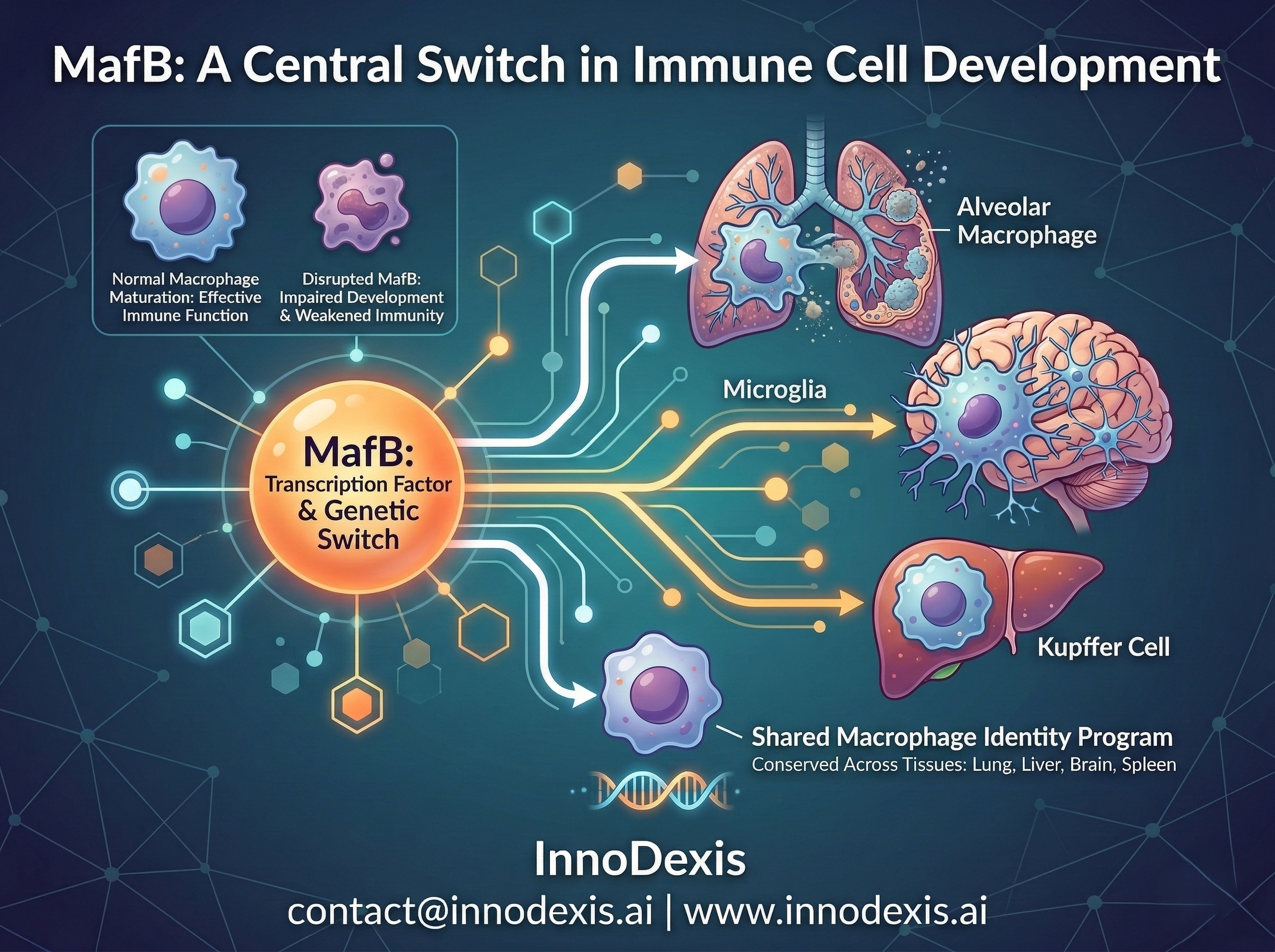
InnoDexis has published its latest Innovation Intelligence analysis covering advances in immunology and genetic regulation, examining a discovery from researchers at the University of Liège in Belgium. The research identifies the transcription factor MafB as a key genetic regulator controlling the development and function of macrophages—immune cells responsible for clearing damaged tissue, fighting infections, and maintaining physiological balance across organs. The findings show that MafB orchestrates a shared genetic program that defines macrophage identity across different tissues, providing insight into how immune cells maintain consistent functionality while adapting to diverse biological environments.
Key Findings
The research identifies MafB as a central transcription factor regulating macrophage maturation. Macrophages serve as the immune system’s primary “clean-up” cells, removing dead or damaged cells, combating pathogens, and maintaining tissue stability. The study demonstrates that MafB functions as a genetic switch that directs how these immune cells develop and perform their essential biological roles.
Another significant finding is that macrophages across different organs share a consistent genetic identity governed by MafB. Although macrophages adapt to local tissue environments in organs such as the lungs, spleen, intestines, and kidneys, they maintain a stable core identity through a MafB-driven regulatory program. This suggests that immune cell specialization occurs on top of a conserved genetic framework rather than replacing it.
The research also shows that disruption of MafB impairs macrophage maturation and compromises immune system function. When the transcription factor is absent or altered, macrophages fail to develop normally, which can affect their ability to maintain tissue health and regulate immune responses.
Importantly, the study demonstrates that this genetic regulatory mechanism is highly conserved across species. The MafB-controlled program appears consistently in both mice and humans and extends across vertebrates, indicating that this biological pathway plays a fundamental role in immune system evolution and function.
Strategic Insight and Trend Analysis
The discovery reflects a broader shift in biomedical research toward understanding the genetic regulatory networks that govern immune cell behavior. Rather than focusing solely on individual genes or immune pathways, scientists are increasingly identifying transcription factors that act as master regulators controlling entire cellular programs.
MafB appears to operate as such a regulator for macrophages. By coordinating gene expression patterns that determine immune cell identity and maturation, it provides a molecular framework explaining how macrophages maintain stability across tissues while adapting to different physiological contexts.
This insight is particularly significant because macrophages participate in numerous biological processes beyond infection control. They are involved in wound healing, tissue regeneration, metabolic regulation, and inflammation management. Disruption of macrophage behavior has been linked to chronic diseases including fibrosis, metabolic disorders, autoimmune conditions, and persistent inflammatory diseases.
Identifying a central regulatory mechanism such as MafB therefore offers a new conceptual model for therapeutic intervention. Instead of targeting individual inflammatory molecules or downstream pathways, future therapies could potentially modulate the upstream genetic programs controlling immune cell development.
The evolutionary conservation of the MafB pathway further strengthens its biological significance. Mechanisms preserved across species often represent fundamental biological processes that remain stable through millions of years of evolution. Such conservation suggests that MafB plays a critical structural role in immune system organization.
Global and Industry Implications
For pharmaceutical companies and biotechnology developers, the MafB regulatory pathway may represent a potential therapeutic target for immune-related diseases. Modulating the activity of this transcription factor or related pathways could provide new approaches to restoring healthy immune cell function in chronic inflammatory conditions.
For medical researchers and healthcare innovators, the findings highlight the importance of genetic regulation in immune system behavior. Understanding how macrophage identity is programmed at the genetic level could support the development of more precise therapies aimed at correcting immune dysfunction rather than broadly suppressing immune responses.
For policymakers and public health institutions, discoveries that clarify immune system regulation contribute to long-term strategies for addressing chronic diseases. Conditions linked to immune imbalance—including metabolic disorders, fibrosis, and inflammatory diseases—represent a growing global health burden.
InnoDexis Statement
“Understanding the genetic programs that regulate immune cell identity provides critical insight into how complex diseases develop and how they may eventually be treated,” noted InnoDexis in its latest intelligence analysis.
Conclusion
The identification of MafB as a genetic regulator controlling macrophage development represents an important step toward understanding how the immune system maintains balance across tissues and environments. By revealing the genetic architecture underlying immune cell identity, the research provides a framework for exploring new therapeutic strategies targeting chronic and inflammatory diseases.
As biomedical research continues to map the regulatory networks governing immune cells, discoveries like this highlight how genetic insights can transform the treatment landscape for complex diseases. Monitoring these developments will be essential for identifying emerging opportunities in immunology, biotechnology, and precision medicine.
The complete Innovation Intelligence analysis on emerging biomedical discoveries is available to InnoDexis subscribers and enterprise clients.
About Innodexis
InnoDexis is a global Innovation Intelligence platform that tracks, analyzes, and interprets breakthrough innovations, prototypes, and emerging technologies across industries and countries. Its intelligence helps corporates, investors, and policymakers understand the true structure and direction of global innovation. Learn more at innodexis.ai.