Flight Altitude Optimization Could Deliver Immediate Aviation Climate Gains Without New Technology
A University of Cambridge study shows that avoiding contrail-forming zones through minor altitude adjustments can significantly reduce aviation’s overall climate impact.
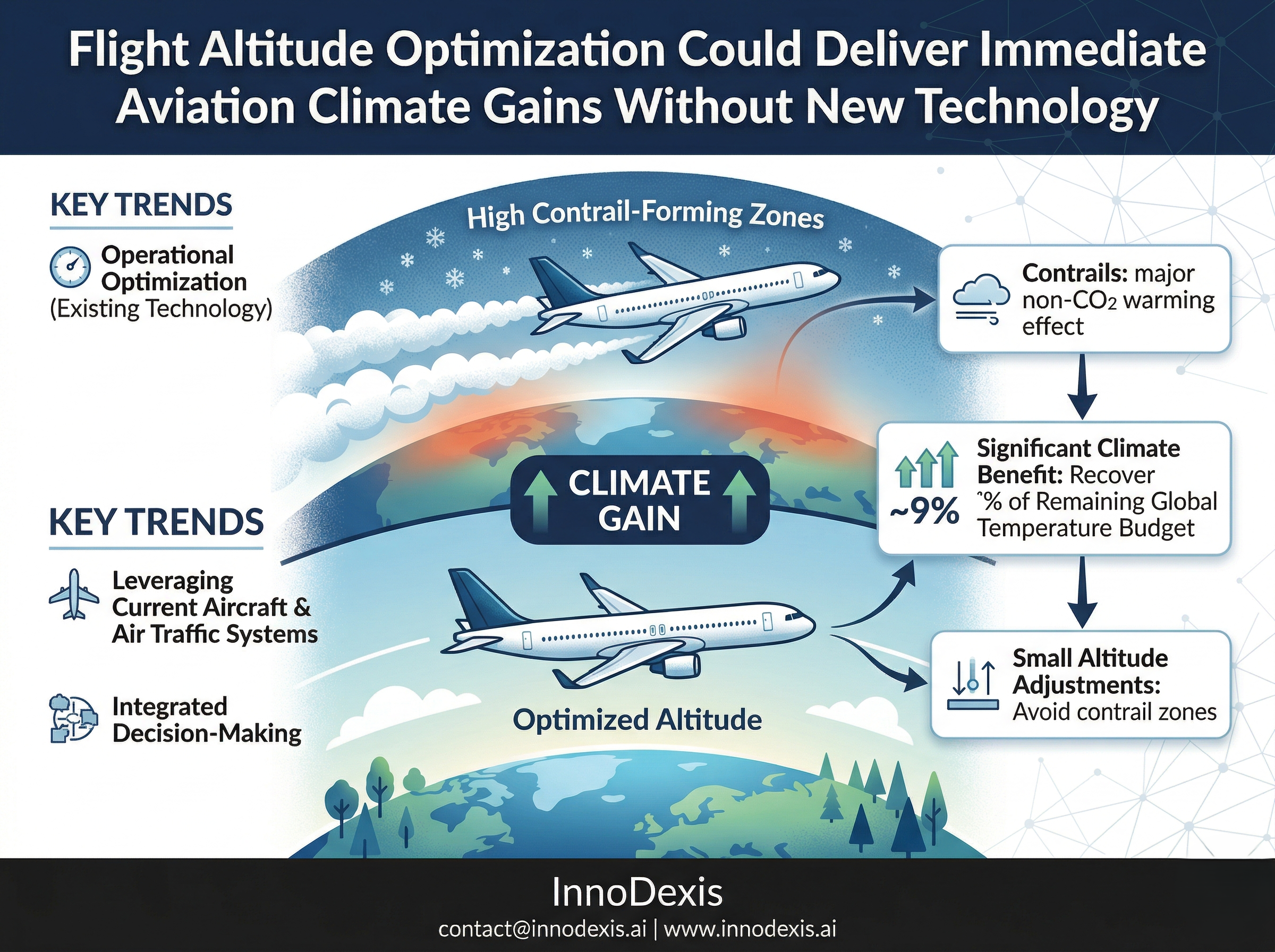
InnoDexis has published its latest Innovation Intelligence Report covering aviation decarbonization strategies, analyzing operational approaches to reducing non-CO₂ climate impacts from air travel. The report reveals that adjusting flight altitudes by a few thousand feet to avoid contrail-forming zones could significantly lower aviation’s warming effect. The findings indicate that contrails may contribute 36% more warming than aviation CO₂ by 2050, and that targeted operational changes—implemented using existing infrastructure—could recover approximately 9% of the remaining global temperature budget.
Key Findings
Research from the University of Cambridge identifies contrails as a major contributor to aviation-related warming. These high-altitude cloud formations, produced by aircraft exhaust, have a measurable impact on the Earth’s radiation balance and are projected to contribute 36% more warming than aviation CO₂ by 2050.
The study demonstrates that small adjustments in flight altitude can help aircraft avoid atmospheric regions where contrails are likely to form. By rerouting flights by a few thousand feet, airlines can reduce the formation of these warming-inducing cloud structures without requiring changes to aircraft design or propulsion systems.
The potential climate benefit is significant. Avoiding contrail-forming zones could recover approximately 9% of the remaining global temperature budget, indicating that operational changes alone may contribute meaningfully to climate mitigation efforts within the aviation sector.
Timing of implementation also plays a critical role. The analysis shows that initiating these operational adjustments in 2035 rather than 2045 could deliver 78% greater climate impact, highlighting the importance of early adoption in maximizing long-term benefits.
Even partial adoption yields measurable outcomes. The study indicates that implementing altitude optimization across just 25% of flights can still produce meaningful reductions in aviation’s overall climate impact, suggesting scalability even under incremental deployment scenarios.
Strategic Insight and Trend Analysis
The findings highlight a shift in how aviation decarbonization strategies may be approached, particularly in the near term. While much of the industry’s focus has been directed toward long-term technological solutions such as sustainable aviation fuels and next-generation propulsion systems, the Cambridge study demonstrates that operational optimization can deliver immediate climate benefits.
Contrails represent a non-CO₂ climate forcing mechanism that has historically received less attention compared to direct emissions. By identifying contrail avoidance as an actionable lever, the research expands the scope of decarbonization strategies beyond fuel and hardware innovation to include real-time operational decision-making.
The approach is notable because it leverages existing aviation infrastructure, including current aircraft and air traffic management systems. This reduces implementation barriers and suggests that meaningful emissions reductions may be achievable without waiting for new technologies to reach commercial scale.
However, the study also identifies a trade-off in the form of slightly higher fuel consumption due to altitude adjustments. This introduces a balancing dynamic between CO₂ emissions and non-CO₂ climate effects, requiring integrated optimization models to determine net climate benefit.
The broader trend reflected in the findings is the increasing importance of systems-level optimization in climate mitigation. Rather than relying solely on technological breakthroughs, sectors such as aviation may increasingly adopt operational strategies that optimize existing systems for improved environmental outcomes.
Global and Industry Implications
For corporates and R&D teams within the aviation industry, the findings suggest that operational strategies such as altitude optimization could be integrated alongside longer-term technology roadmaps. Airlines and air traffic management systems may explore incorporating contrail avoidance into flight planning and routing algorithms.
For investors and capital allocators, the research highlights an area of climate mitigation that does not depend on capital-intensive infrastructure or new technology development. Operational optimization strategies may represent lower-cost pathways to achieving measurable climate impact within shorter time frames.
For policymakers and national aviation authorities, the study underscores the potential role of regulatory frameworks in enabling or incentivizing contrail avoidance strategies. As non-CO₂ impacts gain recognition, policy mechanisms may evolve to incorporate operational measures into broader decarbonization targets.
InnoDexis Statement
“The findings indicate that operational optimization within existing aviation systems can deliver measurable climate benefits, positioning contrail avoidance as a near-term lever alongside longer-term technological transitions,” noted InnoDexis in its latest intelligence report.
Conclusion
The identification of flight altitude optimization as a method to reduce aviation’s climate impact highlights the role of operational strategies in decarbonization. By addressing contrail formation through targeted routing adjustments, the aviation sector may achieve near-term reductions in warming effects without relying on new technologies. As the industry continues to develop sustainable fuels and advanced propulsion systems, integrating operational measures could enhance overall climate performance. The complete Aviation Decarbonization Intelligence Report is available to InnoDexis subscribers and enterprise clients.
About InnoDexis
InnoDexis is a global Innovation Intelligence platform that tracks, analyzes, and interprets breakthrough innovations, prototypes, and emerging technologies across industries and countries. Its intelligence helps corporates, investors, and policymakers understand the true structure and direction of global innovation. Learn more at innodexis.ai.