Flexible Spinal Implant Decodes Motor, Sensory, and Organ Signals Simultaneously by Bypassing Injury Sites Entirely
Researchers from Houston Methodist and Cambridge have developed a single wraparound spinal implant that simultaneously interprets motor, sensory, and autonomic organ signals in preclinical models a multi-domain capability with no precedent in current neuroprosthetics.
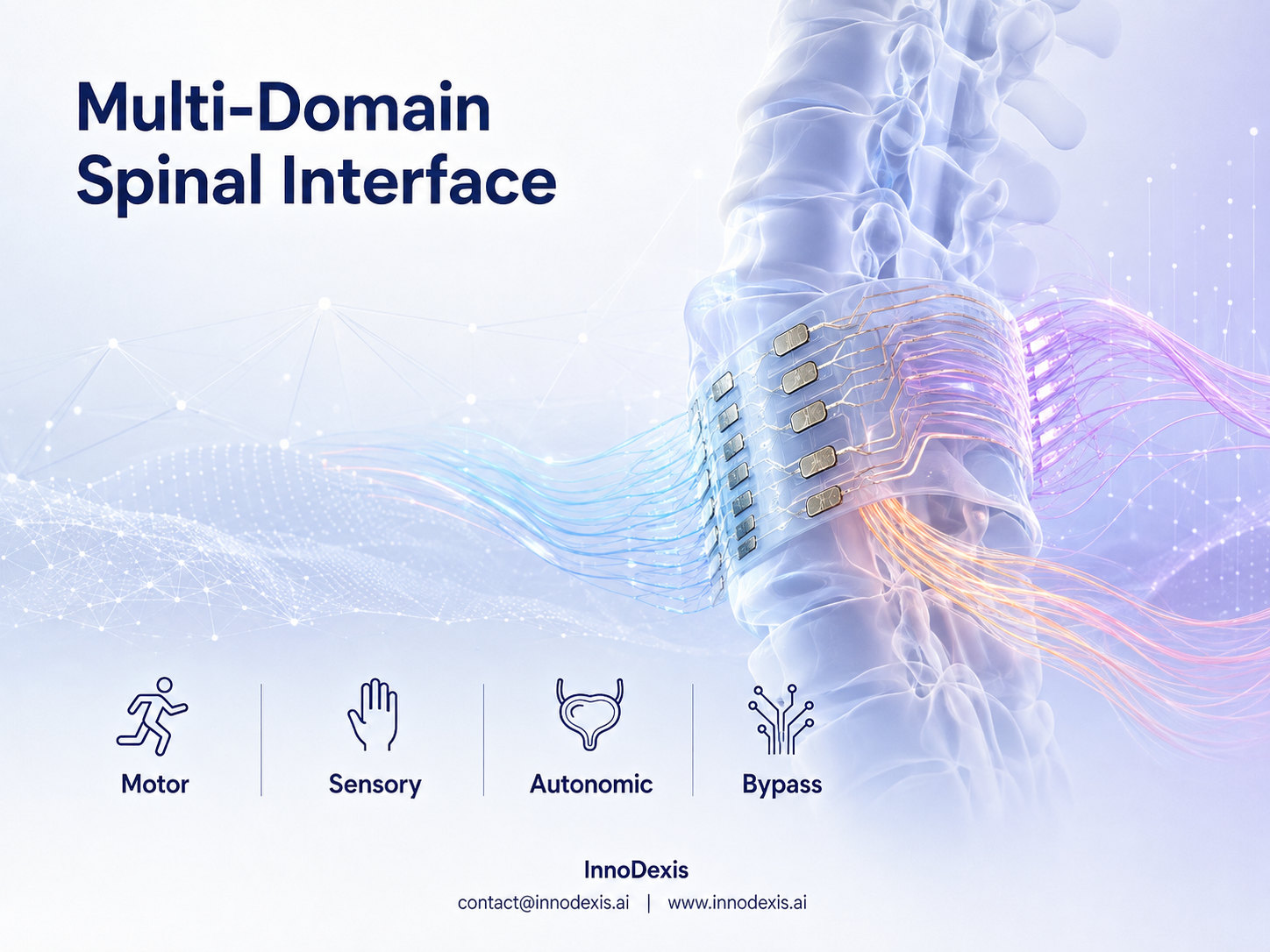
InnoDexis has published its latest Innovation Intelligence Report covering neuroprosthetics and spinal cord injury technology, analyzing a high-significance preclinical innovation developed across the United States and the United Kingdom. The report reveals that researchers from Houston Methodist and the University of Cambridge have developed a flexible spinal implant that bypasses injury sites entirely to decode three distinct signal categories — motor, sensory, and autonomic organ — from a single wraparound device. This approach represents a structural departure from existing neuroprosthetic paradigms, which have targeted damaged tissue or isolated functional restoration rather than simultaneous multi-domain signal rerouting.
Key Findings
A single flexible wraparound implant successfully decoded motor, sensory, and autonomic organ signals simultaneously in preclinical models. This multi-domain detection capability from one device has no precedent in current neuroprosthetic approaches, where existing systems address motor or sensory restoration independently rather than in combination, and where autonomic organ signal interpretation has been almost entirely absent as a therapeutic target.
The implant design bypasses the injury site entirely rather than attempting local spinal cord repair. This architectural decision represents a fundamental reframing of the implant's functional role — from a repair or augmentation tool operating at the damage site to a signal rerouting architecture that operates around the injury. The distinction carries significant implications for clinical applicability, as bypass-based approaches are not constrained by the extent or location of tissue damage in the same way that locally targeted therapies are.
The device demonstrated the ability to distinguish signals originating from internal organs — a capability that has been absent from neuroprosthetic approaches to date. Autonomic dysfunction, including impaired regulation of bladder, bowel, and cardiovascular function, represents a significant source of morbidity for individuals living with spinal cord injuries, yet has historically received limited attention as a neuroprosthetic target. The implant's organ signal detection capability directly addresses this gap.
Current spinal cord injury therapies restore isolated functions — movement or sensation — rarely addressing both simultaneously. The multi-domain recovery profile demonstrated by this implant, covering motor, sensory, and organ function from a single device, shifts the design ceiling for neuroprosthetic systems from single-function restoration toward system-level signal management. This shift is meaningful both clinically and from a device architecture perspective.
An estimated 2.5 million people worldwide live with spinal cord injuries. The scale of this population, combined with the current absence of multi-domain neuroprosthetic solutions addressing motor, sensory, and autonomic function simultaneously, defines the addressable need that this platform targets. Preclinical confirmation of accurate multi-signal detection is the foundational step toward evaluating whether this bypass architecture can translate into clinical utility at that scale.
Strategic Insight and Trend Analysis
The defining strategic signal in this dataset is a paradigm shift in neuroprosthetic design logic — from local augmentation to system-level signal rerouting. This distinction matters because it changes not only the engineering approach but the clinical question being asked. Rather than asking how much function can be restored at or near a damaged site, the bypass architecture asks whether complete signal rerouting around the injury is a more tractable path to restoring complex, multi-system function.
This reframing has compounding implications. Neuroprosthetic development has historically been constrained by the heterogeneity of spinal cord injuries — variations in injury level, completeness, and residual function have made it difficult to develop devices with broad clinical applicability. A bypass architecture that operates independently of the injury site's condition is less sensitive to that heterogeneity, potentially broadening the eligible patient population for a single device platform.
The addition of autonomic organ signal detection is the most strategically novel element of the platform. Motor and sensory restoration have been the primary targets of neuroprosthetic investment for decades. The organ signal capability introduces a third therapeutic dimension that existing commercial and clinical programmes have not systematically addressed. If this capability translates from preclinical models to human use, it would expand the functional scope of neuroprosthetic intervention in a direction that current regulatory frameworks and clinical trial designs were not built to evaluate — raising important questions about how assessment criteria for next-generation neural interfaces should evolve.
The flexible wraparound form factor is also strategically significant. Flexibility and conformal contact with neural tissue are increasingly recognised as prerequisites for stable, chronic signal acquisition in implantable neural devices. The wraparound design suggests an engineering approach oriented toward long-term deployment rather than acute signal capture.
Global and Industry Implications
For corporates and R&D teams in medical devices and neurotechnology, the platform introduces a design benchmark for multi-domain spinal neuroprosthetics that did not previously exist. Organisations developing neural interfaces for spinal cord injury will need to evaluate whether single-function device architectures remain competitive against multi-signal bypass platforms as preclinical evidence matures. The organ signal detection capability in particular defines a new functional category that current commercial offerings do not address.
For investors and capital allocators, the innovation is at preclinical stage, placing it early in the translational timeline. However, the combination of a large addressable population — estimated at 2.5 million globally — and a functionally differentiated platform targeting an unmet multi-domain need represents a compelling long-term investment thesis in the neurotech sector. The two-institution research base across Houston Methodist and Cambridge also indicates a transatlantic collaboration structure with access to both US and UK clinical and regulatory pathways.
For policymakers and national innovation bodies, the platform raises timely questions about regulatory readiness for neural interfaces that operate across motor, sensory, and autonomic domains simultaneously. Existing frameworks were largely designed around single-function neurostimulation devices. Regulatory bodies in the United States and United Kingdom will need to consider whether current evaluation criteria are sufficient for assessing multi-domain bypass architectures.
InnoDexis Statement
"The bypass architecture demonstrated in this implant reframes the neuroprosthetic design question — shifting from how much function can be restored at the injury site to whether complete signal rerouting represents a more tractable path to multi-system functional recovery," noted InnoDexis in its latest intelligence report.
Conclusion
As the neuroprosthetics field advances beyond single-function restoration, the multi-domain signal detection demonstrated by this flexible spinal implant defines a new design frontier for spinal cord injury intervention. The combination of motor, sensory, and autonomic organ signal capability from a single bypass device introduces both clinical and regulatory questions that the field will need to address as preclinical evidence matures toward human trials. InnoDexis will continue to monitor developments in neural interface design, bioelectronic medicine, and the translational pathway for multi-domain neuroprosthetic platforms. The complete Neuroprosthetics Innovation Intelligence Report is available to InnoDexis subscribers and enterprise clients.
About InnoDexis
InnoDexis is a global Innovation Intelligence platform that tracks, analyzes, and interprets breakthrough innovations, prototypes, and emerging technologies across industries and countries. Its intelligence helps corporates, investors, and policymakers understand the true structure and direction of global innovation. Learn more at innodexis.ai.