Finnish Researchers Sustain Ethylene Production from CO₂ for Four Months Using Living Nanocellulose Biohybrid Films
A biohybrid system developed at the University of Turku and VTT Finland entrapped genetically engineered cyanobacteria in biodegradable nanocellulose films, achieving continuous ethylene production from CO₂ and light at approximately twice the yield of comparable suspension cultures.
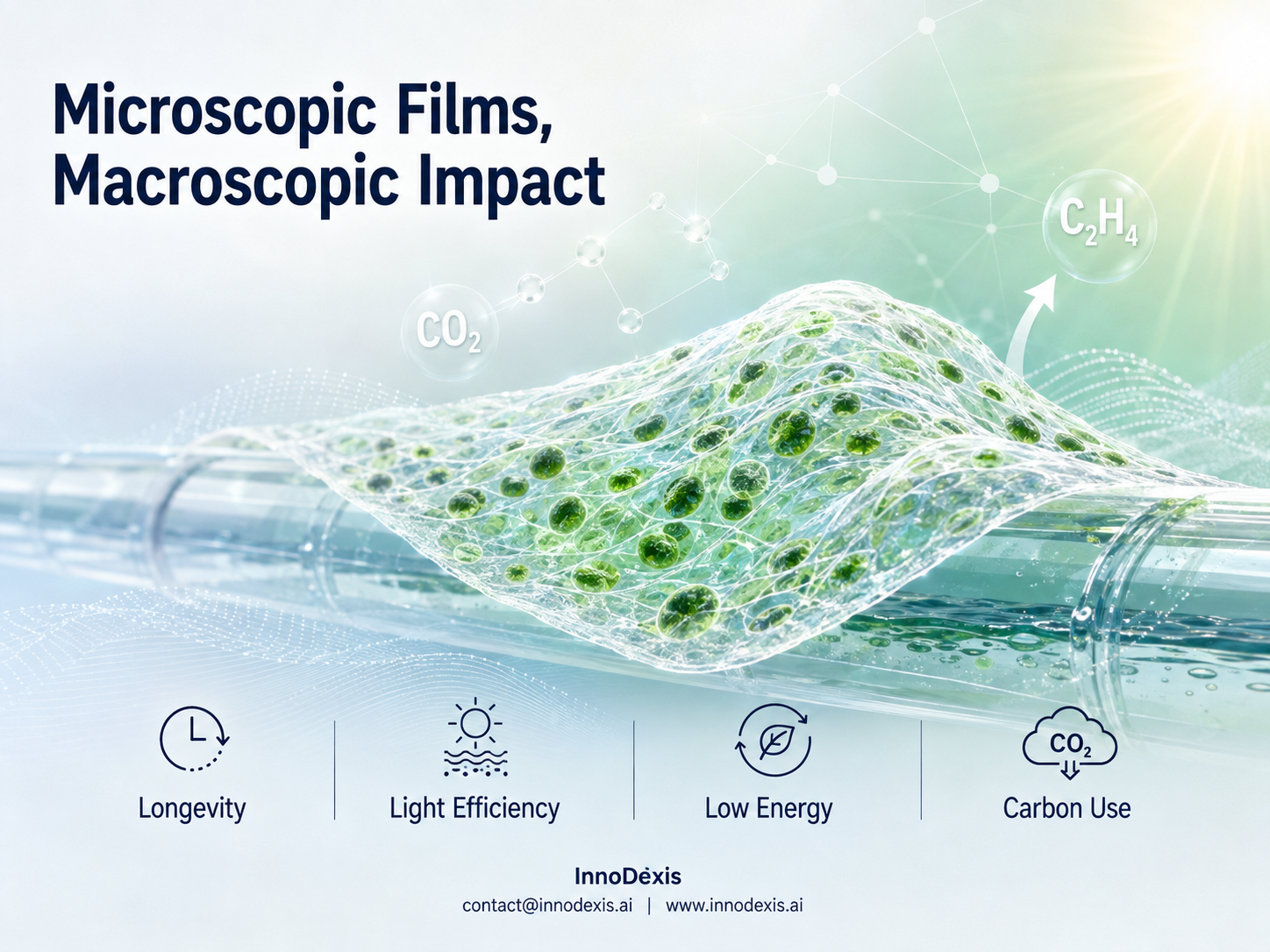
InnoDexis has published its latest Innovation Intelligence Report covering photosynthetic biomanufacturing and carbon conversion technology, analyzing a high-significance innovation from Finland in its latest report. The report reveals that researchers from the University of Turku and VTT Finland have developed living biohybrid catalysts by entrapping genetically engineered cyanobacteria within biodegradable nanocellulose films, sustaining continuous ethylene production from CO₂ and light for more than four months in a continuous-flow biofilm reactor — a duration and yield performance that advances the credibility of photosynthetic biomanufacturing as an industrial-scale platform.
Key Findings
The living nanocellulose films sustained ethylene production from CO₂ and light continuously for more than four months. This duration is the primary performance signal in the dataset: biocatalyst longevity — not peak output — is the metric that determines whether photosynthetic biomanufacturing systems can support industrial scaling, and four months of continuous operation at lab scale represents a threshold achievement for this class of technology.
The biohybrid films generated approximately twice the ethylene output of comparable suspension cultures. Conventional liquid suspension photobioreactors face structural productivity constraints — cells self-shade one another, overproduce biomass, and lose output within weeks. The nanocellulose matrix resolves each of these constraints simultaneously by improving light penetration, suppressing cell division, and directing available carbon toward target product synthesis rather than biomass accumulation.
The nanocellulose matrix restricts cell division as a functional mechanism, redirecting cellular carbon flux toward ethylene synthesis. This is not a passive containment role — the scaffold actively shapes the metabolic behaviour of the entrapped cyanobacteria by limiting the growth pathway that conventionally competes with product formation. The result is a structured biocatalyst in which the material and biological components are functionally integrated rather than merely co-located.
The biodegradable nanocellulose scaffold eliminates the heavy mixing requirements of liquid suspension systems and reduces water demand. These operational advantages compound the productivity gains: the system requires less energy input to maintain than conventional photobioreactors, and the absence of intensive mixing reduces mechanical stress on the biological components — contributing to the stability of output over the four-month operational window.
The continuous-flow biofilm reactor configuration shifts the operational model from batch liquid cultures to a continuous, low-energy biocatalyst system. This architectural shift has direct implications for process engineering at scale: continuous systems are generally more amenable to industrial integration than batch processes, and the low-energy profile of the nanocellulose film configuration reduces the operational cost structure relative to energy-intensive suspension alternatives.
Strategic Insight and Trend Analysis
The dominant trend this dataset signals is a structural transition in photosynthetic biomanufacturing — from liquid suspension systems constrained by self-shading, biomass overproduction, and short operational lifespans, toward structured biohybrid platforms that resolve these constraints through material design rather than process intensification.
The nanocellulose film approach is strategically significant because it addresses the three core failure modes of suspension-based photobioreactors simultaneously and without additional energy input. Previous attempts to improve photosynthetic biomanufacturing productivity have typically targeted individual constraints — improving light delivery systems, engineering strains for reduced biomass production, or optimising nutrient flows — without resolving the underlying architectural incompatibility between liquid suspension dynamics and stable, long-duration biocatalysis.
The four-month continuous operation figure is the dataset's most strategically important number, but its significance is contextual. Sustained output at this duration shifts the platform from proof-of-concept toward pilot-scale credibility — a meaningful transition in the development trajectory of any biomanufacturing technology. The approximately 2x yield advantage over suspension cultures compounds this: the platform does not trade longevity for productivity, it achieves both simultaneously.
Ethylene is the world's most produced organic chemical, used across plastics, packaging, agriculture, and specialty chemicals manufacturing. A photosynthetic production route using CO₂ and light as inputs — with no fossil feedstock requirement — represents a direct decarbonisation pathway for a chemical that currently depends almost entirely on petrochemical cracking. The industrial relevance of the target molecule strengthens the strategic case for continued development of this platform.
The remaining engineering questions are significant: scaling nanocellulose film reactors from lab to pilot scale, maintaining film structural integrity and biological activity across extended operations, and achieving cost-competitive ethylene yields relative to incumbent production methods. These are known and tractable challenges rather than fundamental feasibility questions.
Global and Industry Implications
For corporates and R&D teams in chemicals, biotechnology, and materials manufacturing, the nanocellulose biohybrid platform represents a credible early-stage alternative production route for ethylene and potentially other gaseous industrial chemicals. Organisations with decarbonisation commitments in chemical feedstock procurement have a specific interest in monitoring the pilot-scale development trajectory of this platform.
For investors and capital allocators, the four-month continuous operation result moves this technology meaningfully closer to the pilot-scale validation threshold that typically precedes Series A investment in biomanufacturing platforms. The biodegradable scaffold and low-energy operational profile reduce two significant cost and complexity risks relative to conventional photobioreactor investments, improving the risk-adjusted attractiveness of the platform at early stage.
For policymakers and national innovation bodies, the Finland-based collaboration between a university and a national research institute demonstrates the productivity of integrated basic and applied research partnerships in green chemistry. The platform's direct relevance to CO₂ utilisation and renewable chemical production aligns with industrial decarbonisation policy priorities across the European Union and beyond.
InnoDexis Statement
"The nanocellulose biohybrid film platform resolves the core architectural constraints of photosynthetic biomanufacturing — biocatalyst longevity, light utilisation, and energy demand — through material design rather than process intensification, representing a structurally distinct approach to renewable chemical production," noted InnoDexis in its latest intelligence report.
Conclusion
As industrial decarbonisation pressure intensifies across the chemicals sector, the development of biocatalyst platforms capable of sustained, low-energy conversion of CO₂ into target molecules will become increasingly strategically relevant. The nanocellulose biohybrid film system developed at the University of Turku and VTT Finland establishes a performance baseline — four months of continuous ethylene production at twice the yield of suspension alternatives — that warrants close monitoring as the platform progresses toward pilot-scale engineering validation. InnoDexis will continue to track developments in photosynthetic biomanufacturing, biohybrid catalyst design, and renewable chemical production platforms. The complete Solar Biomanufacturing Innovation Intelligence Report is available to InnoDexis subscribers and enterprise clients.
About InnoDexis
InnoDexis is a global Innovation Intelligence platform that tracks, analyzes, and interprets breakthrough innovations, prototypes, and emerging technologies across industries and countries. Its intelligence helps corporates, investors, and policymakers understand the true structure and direction of global innovation. Learn more at innodexis.ai.