Experiential Storytelling Emerges in Dementia Research as Neuroscience and Cinema Converge
An interdisciplinary initiative demonstrates how immersive film can translate cognitive decline into lived experience, expanding the boundaries of science communication.
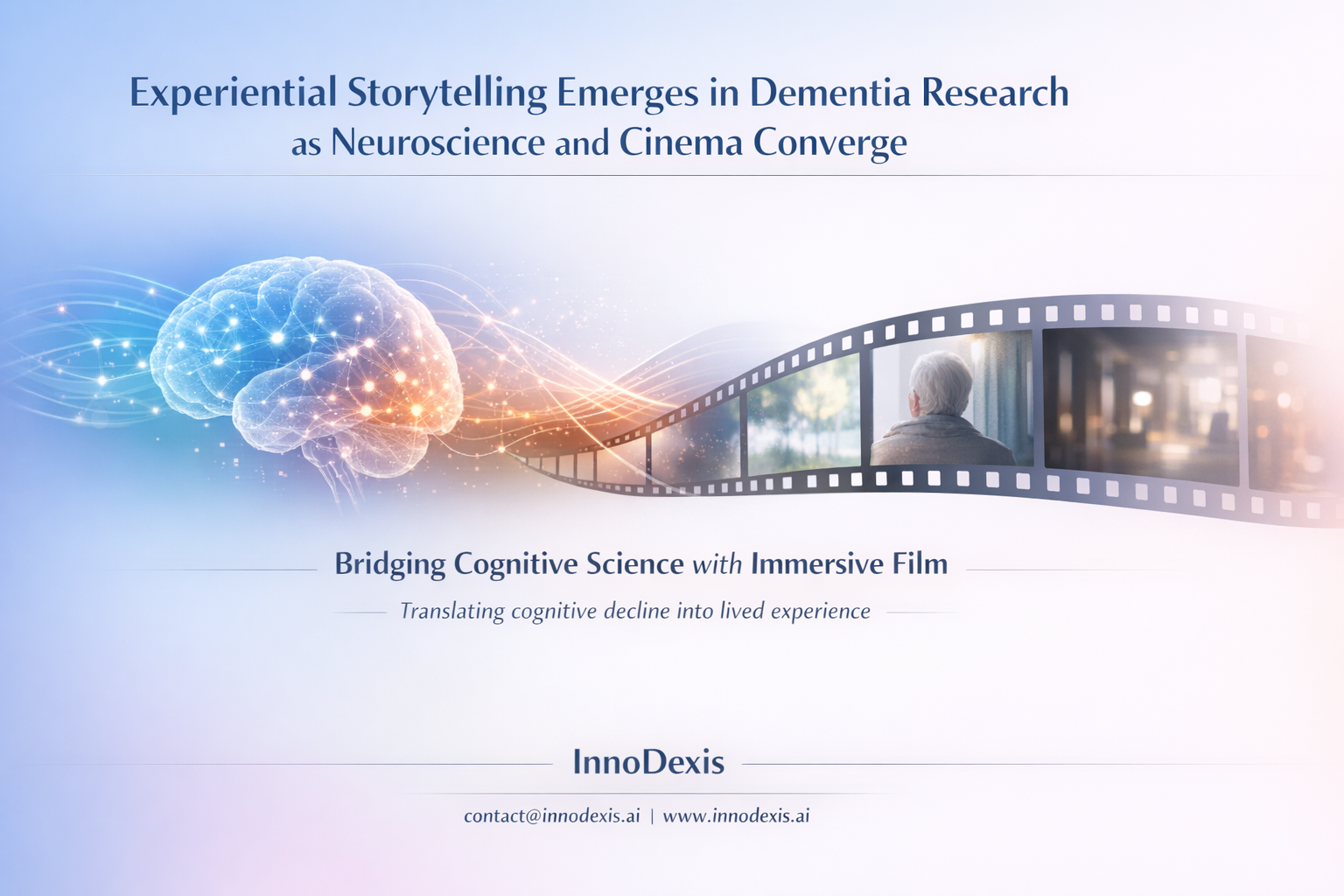
InnoDexis has published its latest Innovation Intelligence Report covering neuroscience and dementia communication, analyzing emerging interdisciplinary innovations across academic and creative domains. The report reveals that new approaches are shifting from clinical explanation toward experiential representation, with collaborations between neuroscience and filmmaking enabling audiences to engage with dementia not only intellectually, but perceptually. This transition reflects a broader movement to bridge scientific research with human-centered understanding in healthcare communication.
Key Findings
An interdisciplinary collaboration at the University of Sussex brings together neuroscientist Anil Seth and filmmaker Suki Chan to develop an immersive film titled Conscious. This initiative represents a convergence of scientific research and cinematic practice aimed at reinterpreting how dementia is communicated to broader audiences.
The film integrates consciousness science with personal testimonies from individuals experiencing dementia. By combining empirical understanding with lived narratives, the project moves beyond abstract clinical description toward a more grounded representation of cognitive decline.
Experimental cinematic techniques and sound design are used to simulate what is described as a “fragmented reality.” These methods attempt to replicate perceptual disruptions associated with dementia, enabling audiences to experience altered cognition rather than only observe it.
The approach departs from traditional documentary formats by adopting immersive storytelling. Instead of linear explanation, the film constructs an experiential environment, positioning viewers within the perceptual framework of dementia-related conditions.
The initiative bridges neuroscience, art, and healthcare education. By integrating these domains, it creates a multidisciplinary model for communicating complex neurological conditions in a manner that is accessible yet grounded in scientific insight.
Strategic Insight and Trend Analysis
The emergence of experiential storytelling in dementia research reflects a broader shift in how complex scientific phenomena are communicated. Traditional models of science communication have relied on explanation, data presentation, and observational narratives. The current approach introduces simulation and immersion as complementary tools for understanding.
By focusing on what dementia feels like rather than solely what it is, this model addresses a gap between clinical knowledge and human perception. Cognitive conditions such as dementia involve subjective experiences that are difficult to convey through conventional formats. The use of immersive film suggests that experiential methods may provide a more effective bridge between scientific accuracy and public comprehension.
The collaboration between neuroscience and filmmaking indicates a growing trend toward interdisciplinary communication frameworks. Rather than operating in parallel, scientific and creative disciplines are increasingly integrated to enhance interpretability and engagement. This convergence allows scientific insights to be translated into formats that resonate beyond academic and clinical environments.
The shift from clinical observation to experiential understanding also signals a potential redefinition of educational tools in healthcare. As technologies and creative methods evolve, immersive formats may become part of how complex conditions are taught, understood, and contextualized across professional and public audiences.
Global and Industry Implications
For corporates and R&D teams, particularly in healthcare and digital health, the findings highlight opportunities to integrate experiential design into patient engagement and medical training tools. Simulation-based communication may enhance understanding of user experiences, informing product development and service design.
For investors and capital allocators, the convergence of neuroscience, media, and healthcare education signals emerging opportunities at the intersection of content, technology, and health innovation. Platforms that translate complex conditions into immersive experiences may represent a new category within health-focused innovation ecosystems.
For policymakers and national innovation bodies, the approach underscores the importance of supporting interdisciplinary initiatives that improve public understanding of neurological conditions. Enhanced awareness and empathy may contribute to more informed healthcare policies and resource allocation strategies.
InnoDexis Statement
“The integration of immersive storytelling with neuroscience reflects a structural evolution in science communication, where experiential understanding complements clinical knowledge to improve engagement, interpretation, and application across healthcare systems,” noted InnoDexis in its latest intelligence report.
Conclusion
The convergence of neuroscience and cinematic storytelling in dementia research illustrates a shift toward more human-centered communication models. By enabling audiences to engage with cognitive decline at a perceptual level, experiential approaches may influence how conditions are understood, taught, and addressed. As interdisciplinary collaboration continues to expand, the role of immersive formats in healthcare communication is likely to grow. The complete Dementia Communication Innovation Intelligence Report is available to InnoDexis subscribers and enterprise clients.
About InnoDexis
InnoDexis is a global Innovation Intelligence platform that tracks, analyzes, and interprets breakthrough innovations, prototypes, and emerging technologies across industries and countries. Its intelligence helps corporates, investors, and policymakers understand the true structure and direction of global innovation. Learn more at innodexis.ai.