Energy Efficiency Emerges as Core Constraint in Intelligence Systems as Human Brain Operates at ~20 Watts
A cross-disciplinary effort highlights the absence of a formal model linking energy cost to survival benefit, signaling a shift toward energy-efficient intelligence design.
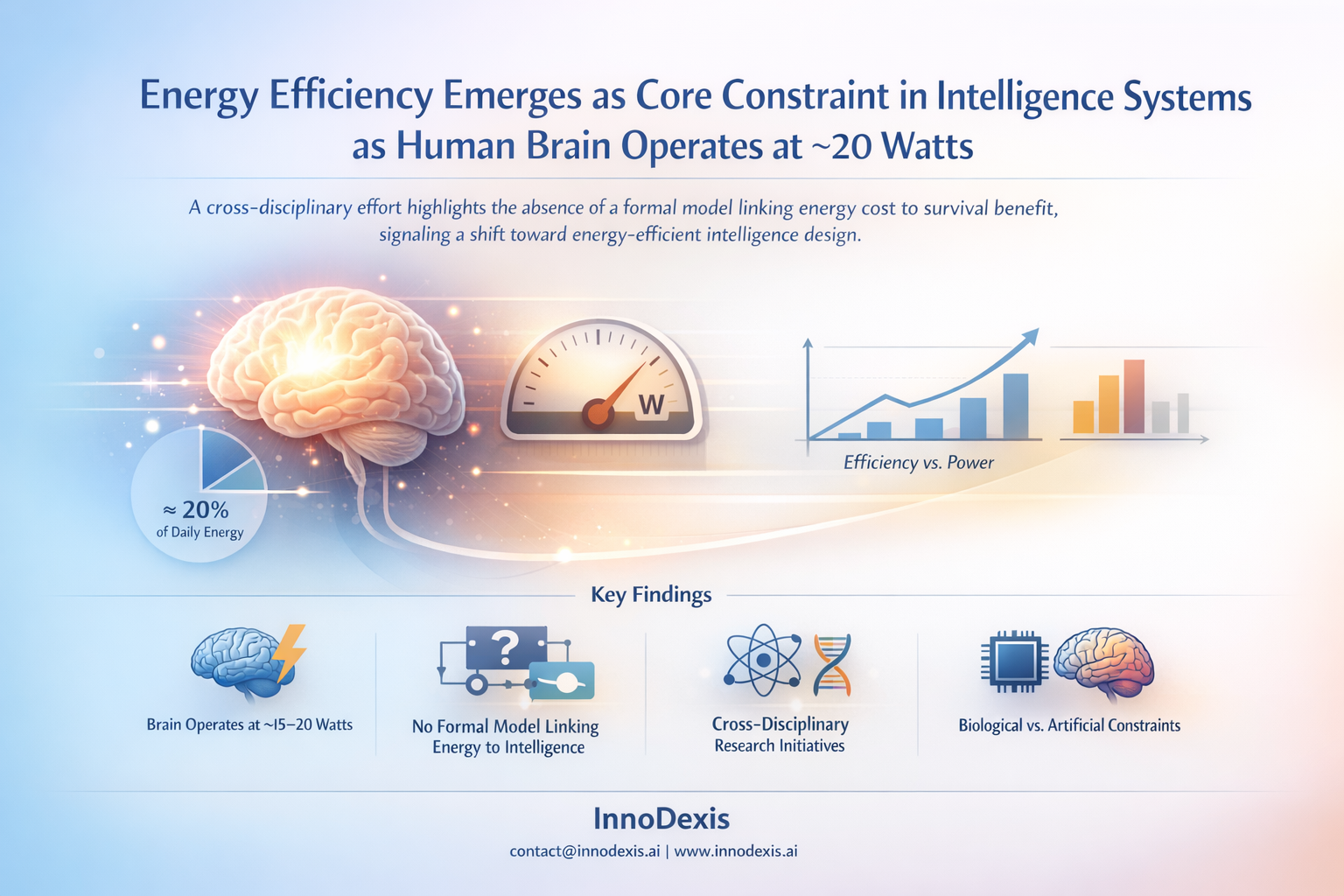
InnoDexis has published its latest Innovation Intelligence Report covering intelligence systems and energy optimization, analyzing emerging research signals from cross-disciplinary efforts spanning neuroscience, physics, and evolutionary biology. The report reveals that the human brain operates on approximately 15–20 watts while consuming around 20% of the body’s daily energy despite representing only about 2% of body weight. Despite this efficiency, there remains no rigorous mathematical framework linking the energy cost of intelligence to its survival or functional benefit.
Key Findings
The human brain consumes approximately 20% of daily energy while accounting for only about 2% of total body weight, highlighting a disproportionate allocation of metabolic resources toward cognitive function. This distribution indicates that biological intelligence operates under significant energy constraints.
Despite this high relative energy demand, the brain functions on approximately 15–20 watts, demonstrating a level of efficiency that enables complex adaptability within a tightly bounded energy budget. This suggests that biological systems have evolved to maximize functional output per unit of energy consumed.
There is currently no rigorous or widely accepted model that quantitatively links the energy cost of intelligence to its survival or adaptive benefit. This gap represents a foundational limitation in understanding intelligence from a systems-level and optimization perspective.
A cross-disciplinary research effort integrating neuroscience, physics, and evolutionary biology is working to establish a mathematical framework that connects energy expenditure with intelligence outcomes. This approach reflects a shift from domain-specific analysis toward unified theoretical modeling.
The contrast between biological and artificial systems is increasingly evident. While artificial intelligence systems have largely been optimized for performance and scale, biological intelligence has evolved under strict energy constraints, prioritizing efficiency over raw computational power.
Strategic Insight and Trend Analysis
The findings indicate an emerging shift in how intelligence systems are conceptualized and evaluated. Biological intelligence demonstrates that high adaptability can be achieved within narrowly constrained energy budgets, suggesting that efficiency is a defining characteristic rather than a secondary optimization.
The absence of a formal model linking energy expenditure to functional benefit highlights a structural gap in both scientific understanding and technological design. Without such a framework, optimization efforts in artificial intelligence remain primarily focused on performance metrics rather than system-level efficiency.
The ongoing cross-disciplinary effort signals a transition toward quantifying intelligence not only in terms of output or capability but also in terms of energy economics. By integrating principles from physics and evolutionary biology, this approach seeks to redefine intelligence as a function of both capability and cost.
This shift aligns with a broader trend from maximizing raw intelligence to optimizing energy-efficient intelligence. As systems scale and deployment environments become more resource-constrained, energy efficiency is likely to become a primary design constraint rather than an auxiliary consideration.
The comparison between biological and artificial systems suggests that future advances in intelligence may depend on aligning computational architectures with energy-aware principles. The data indicates that biological systems provide a reference model for achieving high performance within strict energy limits.
Global and Industry Implications
For corporates and R&D teams, the findings suggest that future intelligent system design may require integrating energy constraints at the architectural level. Efficiency-driven models could become critical in environments where computational resources and power availability are limited.
For investors and capital allocators, the shift toward energy-efficient intelligence introduces a new evaluation dimension beyond performance metrics. Opportunities may emerge in technologies that optimize computation per unit of energy rather than scaling raw processing power.
For policymakers and national innovation bodies, the emphasis on energy-efficient intelligence aligns with broader priorities around sustainability and resource optimization. Supporting research that integrates energy modeling with intelligence systems may become a strategic focus area.
InnoDexis Statement
“The emerging focus on energy-constrained intelligence highlights a structural shift from performance-centric design toward efficiency-driven systems, where the value of intelligence is increasingly defined by its energy cost relative to functional output,” noted InnoDexis in its latest intelligence report.
Conclusion
The current research trajectory indicates that understanding intelligence through the lens of energy consumption may redefine both scientific inquiry and technological development. As biological systems demonstrate the feasibility of high adaptability within limited energy budgets, artificial intelligence design may increasingly incorporate similar constraints. The absence of a formal model linking energy cost to benefit remains a critical gap, but ongoing cross-disciplinary efforts suggest progress toward addressing it. The complete Intelligence and Energy Optimization Report is available to InnoDexis subscribers and enterprise clients.
About InnoDexis
InnoDexis is a global Innovation Intelligence platform that tracks, analyzes, and interprets breakthrough innovations, prototypes, and emerging technologies across industries and countries. Its intelligence helps corporates, investors, and policymakers understand the true structure and direction of global innovation. Learn more at innodexis.ai.