Digital Biomarkers Market Targets USD 17.73 Billion by 2031 as Sensor Fusion and Edge AI Cross from Prototype to Commercial Deployment Across 241 Ambient Intelligence Innovations
A dual-stream analysis of 241 validated innovations across 27 countries finds that ambient intelligence is simultaneously maturing at the deployment frontier and proliferating at the laboratory bench, with sensor fusion emerging as the connective technology binding every domain from clinical wearables to defence surveillance.
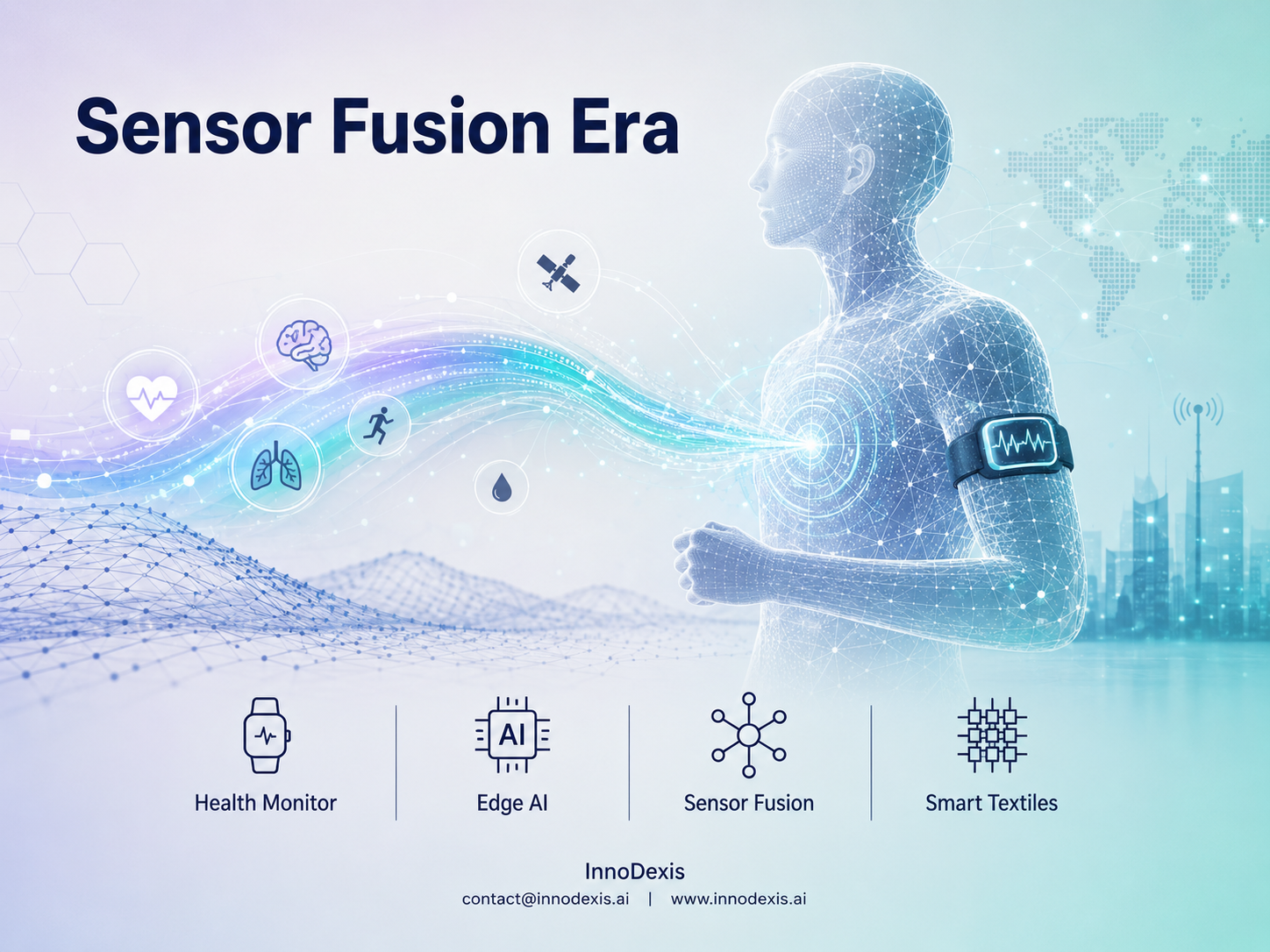
InnoDexis has published its latest Innovation Intelligence Report covering ambient intelligence and wearable sensing, analyzing 241 validated innovations — 219 from the Research Institute stream and 22 from the Corporate stream — across 27 countries and 138 research institutions during May 2026. The report reveals that the digital biomarkers market is projected to reach USD 17.73 billion by 2031 at a 19.1% compound annual growth rate, that 59% of corporate records are at TRL 8 to 9 representing production-grade deployment, and that sensor fusion appears across all 22 corporate records as the foundational integration technology of the entire ecosystem.
Key Findings
The United States and Germany together account for 55% of Institute-stream innovations, with the United States leading at 74 records and Germany following at 48 records. INESC TEC in Portugal leads all 138 institutions with 11 records, reflecting the Iberian cluster's concentration in IoT, 6G, and environmental sensing through EU-funded programmes. MIT anchors the North American cluster at 10 records, with particular depth in wearable neurotech and AI-augmented sensing. The combined Southern European cluster — Portugal and Spain — contributes 27 records, driven almost entirely by EU programme funding across Interreg VI, SNS JU, and European Investment Bank initiatives.
Edge AI has crossed from research prototype to commercial deployment. CEVA secured a major design win with a leading US semiconductor company for its Bluetooth High Data Throughput platform combining digital baseband, software stack, and integrated RF technology — validating full-stack wireless IP at TRL 9 with royalties ramping at multiple customers. Soundcore's THUS AI chip, co-developed for the Liberty 5 Pro and Max, processes audio data 384,000 times per second across a 10-sensor matrix for adaptive noise cancellation — the first mass-market consumer device to deploy a fully bespoke AI audio chip. FotoNation's TriSilica perceptual SoC, enabling audio, mmWave, spectral, infrared, and RGB multimodal inference in a single ultra-low-power package, enters its first manufacturing shuttle at Samsung's 8nm foundry in Q4 2026.
Health monitoring constitutes the single largest application cluster in the dataset with 71 records spanning cardiac, neurological, metabolic, epilepsy, and rehabilitation applications. The digital biomarkers market is currently valued at USD 7.41 billion in 2026. The PearNet Smart Epilepsy Monitoring System — a network of discreet body-worn sensors receiving EUR 2.7 million in EU funding — targets the estimated 50 million people globally affected by epilepsy. The Cumulus NeuLogiq platform, a 16-channel dry EEG system validated in a Phase 1b clinical trial for Major Depressive Disorder, enables at-home trial administration — a structural advantage over competitor CNS trial platforms requiring clinic attendance. Beacon Biosignals is building a population-scale brain foundation model by aggregating clinical EEG data from sleeping patients across neurological conditions.
Smart textiles and electronic skin are transitioning from laboratory to clinical readiness. The TAESS textile ECG sleeve integrates alignment-free electrophysiological sensing and impedance cardiography in a self-powered stretchable fabric, positioned for clinical validation at TRL 5 to 6. The WearALab microneedle patch, funded and developed at Hochschule Koblenz, targets continuous biomarker monitoring for diabetic foot syndrome — a condition generating 850,000 new cases annually in Germany alone. InnoDexis identifies an 18 to 30 month commercialisation window for clinical-grade smart textile biosensors to reach TRL 8, representing a category with limited regulatory precedent and significant first-mover potential.
Environmental and wireless sensing constitutes the second-largest application cluster with 35 or more institute records spanning precision agriculture, wildlife conservation, aquaculture, and critical infrastructure. Wirepas in Finland secured EUR 24 million in European Investment Bank backing for resilient mesh IoT infrastructure. A USD 750,000 NSF CAREER Award is funding foundational research into batteryless 5G tags for ubiquitous pervasive sensing. Telefónica, with six records and Gartner leadership in global managed IoT connectivity, secured four SNS JU projects for Europe's 6G ambient sensing infrastructure — positioning 6G not as a communication upgrade but as an ambient intelligence backbone.
Context-aware AI is advancing as the fastest-moving enterprise application vector. Tribal raised a USD 10 million seed round led by Team8 for a metadata-native enterprise AI platform that clears workflow backlogs 10 times faster with 80% lower maintenance costs. BriteCore deployed eight embedded AI copilots inside a property and casualty insurance core platform using a governed model context protocol service layer, reducing manual submission intake by 80 to 90%. Encamp's Scout platform extracts regulatory obligations and provides defensible compliance citations — shifting environmental health and safety teams from reactive spreadsheet management to proactive automated compliance operations. All three are classified as InnoDexis Score 8, the highest band in the corporate stream.
Strategic Insight and Trend Analysis
The central structural finding of the Ambient Intelligence 2026 dataset is that sensor fusion has become the unavoidable architectural constraint of the entire ecosystem — and that control of the sensor fusion semiconductor layer is therefore the most strategically consequential competitive position in the field.
Sensor fusion appears across all 22 corporate records without exception, spanning defence (THEON and Twin Prime multimodal electro-optical reasoning, Tiami PolyEdge passive 5G radar integrated into Northrop Grumman command and control systems), industrial IoT (Primax and MediaTek AI sensor fusion for food service and factory robotics), wearable health (INESC TEC physiological data synchronisation), and edge AI hardware (FotoNation TriSilica multimodal SoC). The concentration of sensor fusion IP in a small number of semiconductor platforms — CEVA, FotoNation, and the Qualcomm ecosystem — creates both a structural chokepoint and a strategic dependency risk for any ambient system requiring on-device inference at scale.
The bimodal TRL distribution in the dataset — heavy early-stage research at TRL 1 to 4 and concentrated commercial deployment at TRL 8 to 9, with a relative scarcity of TRL 5 to 7 records — confirms the persistence of a translation valley in ambient intelligence. Only 8 corporate records sit in the TRL 4 to 7 prototype zone, despite a deep research base generating technologies including the TAESS textile sleeve, WearALab microneedle patch, and Cumulus NeuLogiq platform, all of which carry identifiable clinical pathways within 12 to 36 months.
The INESC TEC systematic review finding — that 58% of multi-sensor physiological studies fail to adequately synchronise data across modalities — identifies a foundational engineering gap that cuts across every health monitoring application in the portfolio, and that represents both a research priority and an infrastructure commercialisation opportunity for middleware developers operating across wearable biosensor platforms.
Global and Industry Implications
For corporates and R&D teams, the dataset identifies three specific entry points requiring immediate strategic engagement. First, the 18 to 30 month clinical-grade smart textile commercialisation window — anchored by TAESS and WearALab at TRL 5 to 6 — requires research partnership initiation now to establish first-mover positioning before regulatory precedent is set by competitors. Second, the enterprise embedded AI category defined by Tribal, BriteCore, and Encamp is structurally distinct from horizontal AI platforms, competing on operational context depth rather than model capability — organisations with access to system metadata in regulated industries should treat this as a direct category-formation signal. Third, the sensor fusion semiconductor chokepoint identified across all 22 corporate records means that any ambient intelligence product roadmap carries a dependency on CEVA, FotoNation, or Qualcomm ecosystem licensing that should be assessed as a supply chain risk.
For investors and capital allocators, the four corporate records rated High Investment Attractiveness by InnoDexis — Tribal at USD 10 million seed, CEVA Bluetooth HDT with royalties ramping, THEON and Twin Prime at USD 3 million strategic JV, and the Cognitive Assessment and Alzheimer's market at USD 1.60 billion by 2032 — span commercial deployment, strategic inception, and defined demand growth across three structurally distinct capital entry profiles. The TRL 4 to 7 prototype cohort of eight corporate records represents the highest forward-return window, with Vadzo embedded vision cameras at TRL 7, Safe Pro drone-based landmine detection at TRL 6, and the FotoNation TriSilica semiconductor at TRL 4 with a confirmed Q4 2026 manufacturing milestone providing near-term de-risking events.
For policymakers and national innovation bodies, the Southern European cluster — 27 records across Portugal and Spain, funded almost entirely through EU programmes — demonstrates that targeted programme investment can generate internationally significant ambient intelligence research capacity within a five-year horizon. The EU's SNS JU, Interreg VI, and EIB funding mechanisms collectively account for the majority of European environmental IoT and 6G ambient sensing research in this dataset. The dual-use ESG paradox identified across the portfolio — where the same sensor fusion and context-aware AI capabilities enabling personalised healthcare also power counter-UAS surveillance and autonomous military systems — represents a governance gap that requires explicit regulatory attention as ambient intelligence deployments scale.
InnoDexis Statement
"Ambient Intelligence in 2026 is not a single technology but a convergence phenomenon — where edge AI, sensor fusion, wearable biosensors, and context-aware reasoning are collapsing into integrated systems that sense, interpret, and act invisibly, making the control of the sensor fusion layer the most consequential strategic position in the ecosystem," noted InnoDexis in its latest intelligence report.
Conclusion
The Ambient Intelligence and Wearable Sensing Innovation Landscape 2026 report establishes that the field is in simultaneous early-stage proliferation and late-stage commercial deployment, with sensor fusion as the indispensable integrating layer across health monitoring, enterprise AI, defence sensing, environmental IoT, and consumer electronics. Across 241 validated innovations from 27 countries, the evidence confirms a 19.1% CAGR digital biomarkers market, a 12 to 36 month commercialisation pipeline in clinical-grade smart textiles, and an enterprise embedded AI category in active formation. As edge AI semiconductors proliferate, 6G ambient infrastructure emerges, and clinical validation pathways consolidate for wearable biosensor platforms, organisations with systematic early intelligence into where ambient intelligence is crossing the deployment threshold will hold the most durable competitive and investment advantage. The complete Ambient Intelligence and Wearable Sensing Innovation Landscape 2026 Report is available to InnoDexis subscribers and enterprise clients.
About InnoDexis
InnoDexis is a global Innovation Intelligence platform that tracks, analyzes, and interprets breakthrough innovations, prototypes, and emerging technologies across industries and countries. Its intelligence helps corporates, investors, and policymakers understand the true structure and direction of global innovation. Learn more at innodexis.ai.