Chromosome 1q Gains Identified as Early Genetic Driver in Pancreatic Cancer Progression
New data indicate chromosome 1q amplification appears before classic driver mutations in pancreatic ductal adenocarcinoma, reshaping understanding of early tumor evolution.
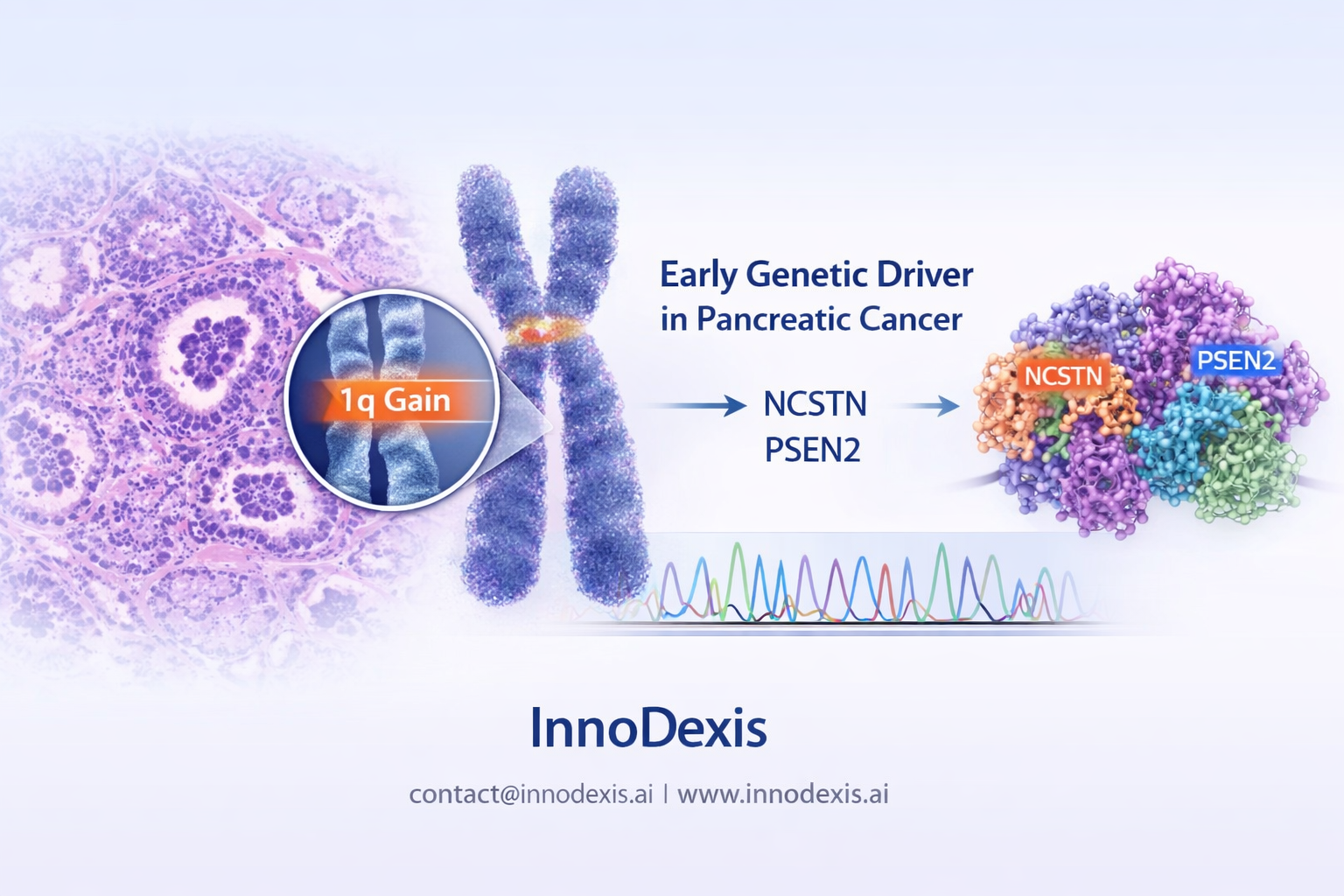
InnoDexis has published its latest Innovation Intelligence Report covering genomic drivers in pancreatic cancer, analyzing over 800 invasive cancers and precancerous lesions identified in the United States. The report reveals that extra copies of chromosome 1q represent a frequent and early genetic event in pancreatic ductal adenocarcinoma (PDAC), appearing in nearly 40% of cases. The findings indicate that chromosome 1q gains often precede classic driver gene mutations and are significantly enriched in high-grade precancerous lesions.
KEY FINDINGS
Chromosome 1q amplification was detected in nearly 40% of pancreatic ductal adenocarcinoma cases. This high prevalence positions 1q gain among the most recurrent chromosomal alterations observed in PDAC and underscores its potential structural role in disease development rather than a secondary byproduct of genomic instability.
The dataset included more than 800 invasive cancers and precancerous lesions, providing broad analytical depth across multiple stages of tumor progression. The scale of the dataset strengthens confidence in the timing and frequency of chromosome 1q events relative to other molecular alterations.
Chromosome 1q gains were found to be rare in low-grade lesions but common in high-grade precancerous lesions. This distribution suggests that 1q amplification is associated with disease escalation and may represent a molecular inflection point between indolent lesions and more aggressive neoplastic transformation.
The data further indicate that chromosome 1q amplification often precedes classic driver gene mutations. This temporal ordering challenges traditional models that center driver mutations as the initiating genomic events in PDAC and instead positions chromosomal gain as a potential early structural trigger.
Two key genes located within the amplified region — NCSTN and PSEN2 — were identified as significant. Both genes are associated with γ-secretase activity, suggesting that duplication of this enzymatic pathway may contribute to early tumor development and progression.
STRATEGIC INSIGHT AND TREND ANALYSIS
Collectively, the findings point toward a structural genomic model of early pancreatic tumor evolution. Rather than emerging solely from point mutations in canonical oncogenes, PDAC may initiate or accelerate through broad chromosomal copy number changes that alter gene dosage across critical pathways.
The enrichment of chromosome 1q gains in high-grade precancerous lesions suggests that genomic amplification may serve as a transitional event marking progression from localized dysplasia to invasive cancer. This aligns with a broader oncology trend in which copy number alterations are increasingly recognized as early determinants of tumor trajectory.
The identification of NCSTN and PSEN2 within the amplified region adds functional clarity. As components linked to γ-secretase activity, their duplication introduces a defined biological mechanism through which chromosomal gain could influence oncogenic signaling. This moves the finding beyond descriptive cytogenetics and toward pathway-level interpretation.
From an intelligence perspective, the data suggest that early detection frameworks focused exclusively on driver gene mutations may overlook structurally driven tumorigenic processes. Integrating chromosomal copy number profiling into diagnostic strategies may provide earlier or more accurate identification of high-risk lesions.
GLOBAL AND INDUSTRY IMPLICATIONS
For corporates and R&D teams, these findings highlight chromosome 1q amplification as a potential early biomarker for risk stratification in pancreatic cancer. Diagnostic platforms incorporating copy number analysis may enhance detection of high-grade precancerous lesions before invasive progression. Additionally, therapeutic development targeting duplicated γ-secretase-related genes presents a defined molecular avenue for intervention.
For investors and capital allocators, the data indicate potential expansion in genomic diagnostics and targeted oncology therapeutics addressing structural chromosomal alterations. Companies developing copy number–based screening technologies or pathway-specific inhibitors may see increased relevance in pancreatic oncology portfolios.
For policymakers and national innovation bodies, the findings reinforce the importance of supporting genomic infrastructure capable of high-resolution chromosomal analysis. Investment in early-stage cancer detection frameworks that move beyond mutation panels toward structural genomic profiling may improve long-term healthcare outcomes.
INNODEXIS STATEMENT
“Chromosomal amplification events such as chromosome 1q gain appear to function as early structural catalysts in pancreatic tumor evolution, potentially preceding canonical driver mutations,” noted InnoDexis in its latest intelligence report.
CONCLUSION
The identification of chromosome 1q gains as an early and frequent event in pancreatic ductal adenocarcinoma reframes prevailing models of disease initiation. By clarifying the timing and biological relevance of structural genomic alterations, the findings open pathways for earlier detection and more targeted therapeutic strategies. Continued monitoring of chromosomal amplification patterns across cancer types will be critical in refining early intervention frameworks. The complete Chromosome 1q Gains in Pancreatic Cancer Innovation Intelligence Report is available to InnoDexis subscribers and enterprise clients.
ABOUT INNODEXIS
InnoDexis is a global Innovation Intelligence platform that tracks, analyzes, and interprets breakthrough innovations, prototypes, and emerging technologies across industries and countries. Its intelligence helps corporates, investors, and policymakers understand the true structure and direction of global innovation. Learn more at innodexis.ai.