China's Agricultural Research System Produces 82 Curated Innovations Led by Crop Genomics as a Field-Validation Gap and a Horticulture Skew Diverge From Stated Food-Security Policy
A sixteen-week analysis of Chinese institutional research output finds that crop genomics and breeding account for 45% of all tracked records, that only one record describes a field trial, and that horticultural crops substantially outweigh staple grains in disclosed output.
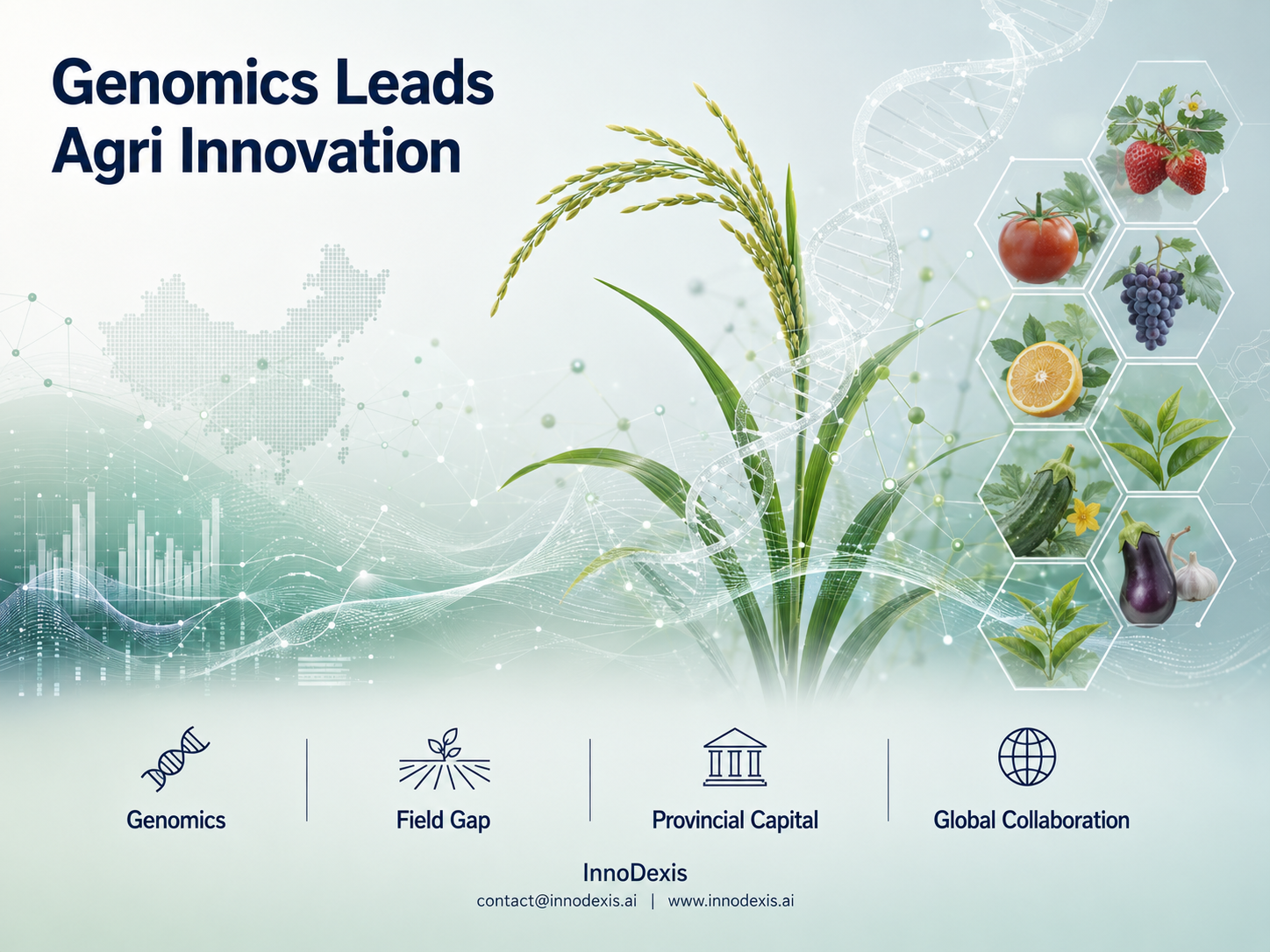
InnoDexis has published its latest Topic Intelligence Report — TR-16 — covering China's agri-food and crop innovation landscape, analyzing 82 curated Research-stream records drawn from 26 tracked Chinese institutional sources and 172 performing entities during the period from 1 April to 21 July 2026. The report reveals that agri-food and crop science is the single largest innovation theme in China's disclosed research pipeline for the period — ahead of artificial intelligence, photonics, materials, and space — with crop genomics and breeding accounting for 45% of all records, provincial capital emerging as a first-order funding actor, and a consistently named lab-to-field validation gap representing the sector's defining commercial constraint.
Key Findings
Crop genomics and breeding is the dominant sub-sector with 37 of 82 records — 45% of the cohort — a concentration seen in no other theme in the China dataset. The work follows a consistent template: assemble a high-quality reference genome, identify the causal gene or structural variant behind a commercially relevant trait, and convert it into a screenable breeding marker. Several records complete all three steps within a single disclosure. The most commercially proximate example is a quadruple 725-base-pair repeat in the SmMYB113 promoter identified as the mechanism for light-independent purple-black eggplant colour and converted directly into KASP screening markers described in the source record as immediately relevant to breeding programmes.
Quantified trait gains across the genomics sub-sector confirm the depth of the underlying science. A wild-ancestor gene — THP3-T, isolated from teosinte and reintroduced into an elite maize hybrid — lifted seed protein from 8.5% to 12–13% and whole-plant protein from 7% to above 9% with no yield penalty, the clearest quantified trait gain in the cohort. Rice bacterial blight lesion length was reduced by more than 65% against wild type through secreted MOC1 expression. Common bean flowering time was advanced by 29 days through natural mutations in the PvE1 floral repressor, opening latitude-range extension. Oregano essential-oil content reached 5.12% in a HEO1 mutant against 2.72% in wild type, with jasmonic acid treatment adding a further 27.95%.
The field-validation gap is the sector's defining commercial constraint and the single most consistently named limitation across the cohort. Only one of 82 records describes a field trial. Six of fourteen disclosed weaknesses cite laboratory conditions as unrepresentative of field complexity — specifically flagging standardised artificial soils, single-year experimental periods, and the absence of cost-effectiveness assessments at agricultural scale. Eleven of 64 research-gap statements call for mechanistic follow-up, and field validation is explicitly absent on two gap records while implied across the majority of the cohort. Any commercial reader should treat trait claims in this cohort as directionally credible and temporally distant.
The funding architecture is bimodal rather than centralised. The National Natural Science Foundation appears in 35 grant citations across the 66 records carrying grant attribution — 81% of the cohort. Provincial and municipal programmes account for 18 further citations, with Guangdong alone appearing 15 times. The China Agriculture Research System — the earmarked commodity-fund mechanism — appears seven times. The report identifies Guangdong's prominence as consistent with a province optimising for high-value horticultural and aquaculture production rather than staple output, and flags three records in the cohort where provincial funding, a provincial academy performer, and a marker-ready trait appear simultaneously — the conditions the report identifies as necessary for regional agri-tech company formation.
Horticultural and specialty crops substantially outweigh staple grains in disclosed output, representing a marked divergence from the food-security framing of Chinese agricultural policy. Strawberry, tomato, tea, grape, citrus, pear, banana, mango, papaya, cucumber, pepper, eggplant, garlic, and oregano collectively account for more records than rice, wheat, and maize combined. Rice remains the single most-referenced individual species at 11 records, appearing across sub-sectors as a platform organism for method demonstration rather than solely as a yield target. The report identifies two possible explanations — genuine deployment of marginal research capacity toward high-value crops, or systematic under-coverage of staple-crop research routed through provincial academies not yet tracked as sources.
United States–China agricultural genomics collaboration is running at the level of routine co-authorship in mid-2026 despite a broadly restrictive bilateral technology relationship. Of 15 international-collaboration records in the cohort, six name US institutions as partners — more than any other country — concentrated in strawberry, papaya, and cucumber genomics, typically involving Nanjing Agricultural University on the Chinese side. The report flags this as a live gap between observed research practice and policy posture in domains with direct food-security implications, and identifies it as exposure requiring institution-level mapping for research-security functions.
Strategic Insight and Trend Analysis
The most consequential structural finding of TR-16 is the co-existence of world-class mechanistic biology and a near-total absence of field-scale validation within the same 82-record cohort. This is not a limitation of the individual studies — it is a structural feature of how China's agricultural research system currently operates at the TRL 1–4 stage the InnoDexis Research stream covers. Translation is handled elsewhere and largely undisclosed to the tracked institutional sources, meaning the commercial distance from any given genomics record to a deployable product is systematically further than the quality of the underlying science would suggest.
The exception to this structural pattern is the marker and process technology layer. KASP markers, cold plasma processing, SERS detection substrates, and storage-protocol optimisation each carry no engineered-organism approval requirement and could advance on ordinary commercial timelines. These records are commercially proximate not because they are scientifically superior but because they sit outside the regulatory pathway that governs engineered plant lines — a distinction the cohort itself does not always make explicit but that has material consequences for any commercialisation timeline assessment.
The artificial intelligence gap is an unusually clean forward signal. Machine learning appears in one methodology statement across 82 agricultural records, while AI appears in 19% of all valid China Research-stream records. The convergence of AI and agronomy is stated in Chinese policy and absent in tracked research disclosure — a gap that either reflects genuine underdevelopment of the AI-agriculture interface within Chinese institutional research, or systematic under-coverage of the organisations where that convergence is occurring. Either reading identifies a whitespace that has not yet reached the InnoDexis tracking layer and is worth interrogating through source-coverage extension before treating it as a research signal.
Global and Industry Implications
For corporates and R&D teams, the cohort's practical sequencing is clear from the data. Marker and process technologies — the eggplant KASP markers, the cold plasma system, the SERS substrate, the mango 12°C storage protocol — carry no engineered-organism regulatory burden and represent the nearest-term engagement layer. Post-harvest technologies in particular offer existing industrial channels and no GMO pathway, making the cold plasma cherry-tomato coating and the banana ripening NAC transcription factor work the most directly actionable records for food processing and cold-chain operators. Engineered plant lines — including the strawberry and tomato protection work — sit behind GMO regulatory pathways that the source records themselves identify as contested, and should be tracked as watchlist items rather than pipeline candidates.
For investors and capital allocators, the provincial funding signal is the most operationally specific commercial intelligence in the dataset. Three records simultaneously carry Guangdong provincial funding, a provincial academy performer, and a marker-ready trait — the combination the report identifies as the formation signal for regional agri-tech company formation. Guangdong Academy of Agricultural Sciences and Jiangsu-affiliated institutions are identified as the most likely near-term sources of company formation activity within the tracked cohort. The absence of cost-of-goods, unit economics, or manufacturing-scale data across all 82 records confirms that the diligence layer for any specific investment thesis must be constructed externally rather than sourced from the disclosed research record.
For policymakers and national innovation bodies, two gaps in the cohort carry direct policy implications. The divergence between disclosed horticultural research output and the staple food-security framing of Chinese agricultural policy represents either a genuine strategic reallocation of marginal research capacity toward high-value crops or a source-coverage artefact that systematically under-represents provincial academy staple-crop work — a distinction with material consequences for any trade or food-security assessment built on tracked research output. The active US–China co-authorship in food-relevant genomics, running at six of fifteen collaboration records in mid-2026, identifies a domain where research practice and technology-restriction policy are demonstrably divergent and where institution-level exposure mapping has not yet caught up with observed activity.
InnoDexis Statement
"China's agricultural research system is producing mechanism-rich, genomics-driven crop science at high volume, funded increasingly by provincial capital, aimed disproportionately at horticultural rather than staple crops, and separated from commercial impact by a field-validation gap that the researchers themselves name more consistently than any other limitation in the cohort," noted InnoDexis in its latest intelligence report.
Conclusion
TR-16 establishes that China's agri-food and crop innovation pipeline is the most densely documented and consistently funded body of work in the InnoDexis China Research-stream dataset for the period, with crop genomics producing quantified trait gains across maize protein, rice blight resistance, bean flowering time, and oregano essential-oil content that confirm the mechanistic quality of the underlying science. Across 82 curated records from 172 performing entities, the evidence consistently points to a research system operating at high mechanistic quality with field-scale validation pending — where marker and process technologies represent the nearest commercial layer, provincial capital identifies where company formation is most likely to follow, and the AI-agriculture convergence visible in policy remains largely absent from tracked research disclosure. As source coverage extends to provincial academies of agricultural science, cross-stream pairing maps named traits from laboratory to corporate deployment, and a quarterly refresh makes the second edition trend-comparable, TR-16 will serve as the baseline against which China's agri-food research-to-commercial conversion rate can be tracked with increasing precision. The complete China Agri-Food and Crop Innovation Topic Report TR-16 is available to InnoDexis subscribers and enterprise clients.
About InnoDexis
InnoDexis is a global Innovation Intelligence platform that tracks, analyzes, and interprets breakthrough innovations, prototypes, and emerging technologies across industries and countries. Its intelligence helps corporates, investors, and policymakers understand the true structure and direction of global innovation. Learn more at innodexis.ai.