China Advances Micro-Robotics Innovation as Untethered Piezoelectric Systems Expand Precision Automation Capabilities
New research from Harbin Institute of Technology demonstrates how highly durable centimeter-scale robots may accelerate the shift toward collaborative micro-robotic systems for industrial environments.
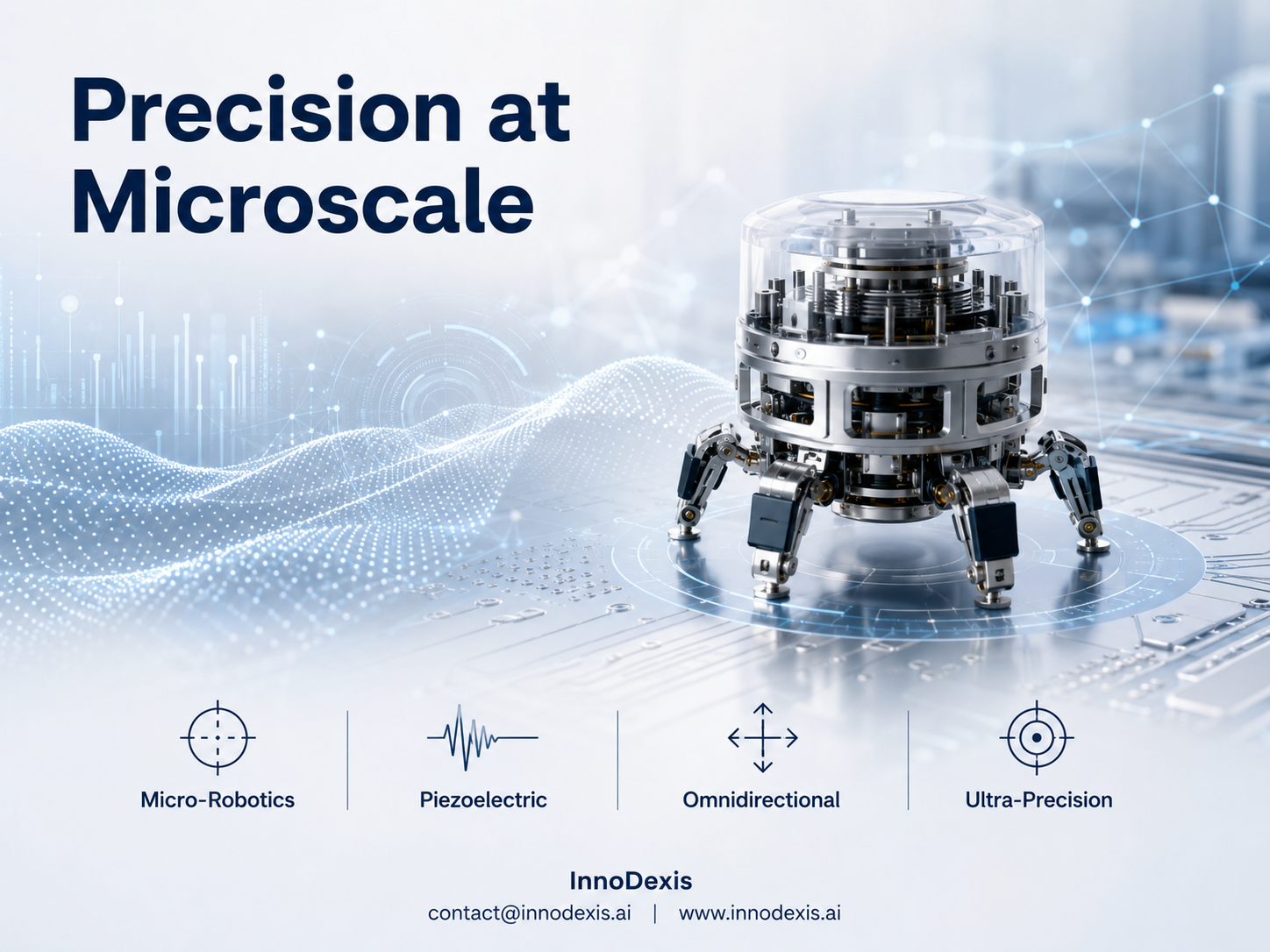
InnoDexis has published its latest Innovation Intelligence Report covering micro-robotics and industrial automation systems, analyzing emerging developments in precision robotics, piezoelectric actuation, and confined-environment automation. The report reveals that researchers at Harbin Institute of Technology have developed an untethered centimeter-scale piezoelectric robot capable of both macro-scale locomotion and ultra-precise micro-motion without external tethering or continuous attitude adjustment. The findings indicate that future robotics innovation may increasingly depend not only on larger autonomous systems, but also on networks of highly specialized micro-robots capable of operating collectively inside constrained industrial environments.
Key Findings
The report identifies the development of a centimeter-scale untethered piezoelectric robot as an important advancement in micro-robotic mobility and precision engineering. Measuring Φ3.10 × 2.75 cm³ and weighing only 12.2 grams, the robot demonstrates that miniaturized robotic systems can achieve both compact structural design and high operational capability. The system’s untethered architecture also enables movement without dependence on fixed external support systems, which remains a major limitation for many micro-scale robotic platforms.
A second major finding concerns the robot’s ability to achieve omnidirectional movement inside confined environments. Researchers demonstrated that the robot could navigate complex spaces without requiring continuous attitude correction or external stabilization. This capability is particularly significant for industrial environments where conventional robotic systems face limitations due to restricted access, narrow geometries, or hazardous operating conditions.
The report also highlights the robot’s precision capabilities, with motion accuracy reaching 0.56 micrometers. Such fine-scale movement control suggests potential applicability in environments requiring high positional precision, including semiconductor inspection, advanced manufacturing processes, and micro-scale infrastructure maintenance operations. Precision at this level may become increasingly important as industrial systems continue moving toward smaller and more densely integrated architectures.
Another notable finding involves the robot’s load-bearing and durability performance. The system carried 13.63 times its own weight and withstood pressure equivalent to 559 times its body weight. These characteristics demonstrate that micro-scale robotic systems can combine compact form factors with substantial mechanical resilience, expanding their potential utility across demanding industrial environments.
The report further indicates that the research reflects a broader shift in robotics development. Rather than focusing exclusively on larger humanoid or general-purpose machines, the field is increasingly exploring distributed networks of smaller specialized robots capable of operating collaboratively. This transition may reshape how future automation systems are designed, deployed, and coordinated across industrial settings.
Strategic Insight and Trend Analysis
The broader significance of these findings lies in the evolving architecture of industrial robotics systems. The report suggests that robotics innovation is increasingly diverging into two parallel trajectories: large autonomous general-purpose machines and highly specialized micro-robotic systems optimized for confined, hazardous, or precision-intensive environments. The Harbin Institute of Technology research reflects the growing strategic importance of the latter category.
Historically, industrial robotics focused primarily on fixed-position automation or large-scale mobile systems operating in structured environments. However, modern industrial infrastructure is becoming more spatially complex, densely integrated, and operationally distributed. Semiconductor manufacturing systems, advanced energy infrastructure, and high-precision industrial equipment increasingly require inspection, maintenance, and monitoring capabilities at scales inaccessible to conventional robotic platforms.
The ability to combine untethered locomotion, omnidirectional mobility, and ultra-precise movement within a miniature system represents an important development in this transition. The findings suggest that future robotic effectiveness may depend less on the size of individual machines and more on the coordination and orchestration of distributed robotic networks operating collectively across industrial systems.
The report also highlights the growing importance of coordination software and multi-agent operational intelligence. As micro-robotic systems become more capable individually, long-term competitive advantage may increasingly shift toward platforms capable of managing large numbers of specialized robotic units simultaneously. This introduces parallels with distributed computing architectures, where system performance emerges not only from hardware capability but from coordination efficiency across networks.
Collectively, the findings point toward a robotics landscape in which industrial automation expands beyond centralized machines toward adaptive fleets of small autonomous systems capable of operating dynamically within real-world industrial infrastructure.
Global and Industry Implications
For corporates and R&D teams, the findings reinforce the growing relevance of micro-robotics for industrial inspection, semiconductor operations, and confined-environment automation. Organizations developing advanced manufacturing systems may increasingly evaluate how distributed robotic architectures can complement or replace larger conventional automation platforms in precision-intensive environments.
For investors and capital allocators, the report signals expanding strategic opportunities across micro-robotics, piezoelectric systems, industrial AI coordination software, and autonomous robotics infrastructure. As automation systems become more decentralized, enabling technologies that support multi-agent coordination and precision mobility may attract increasing industrial and commercial interest.
For policymakers and national innovation bodies, the findings underscore the importance of sustained investment in robotics research, advanced manufacturing technologies, and next-generation industrial automation capabilities. Countries seeking long-term competitiveness in semiconductor manufacturing, industrial resilience, and intelligent automation may increasingly prioritize micro-robotics as a strategic technology domain.
InnoDexis Statement
“The convergence of precision mobility, untethered operation, and distributed robotic coordination may redefine how industrial automation systems are structured and deployed across complex operating environments,” noted InnoDexis in its latest intelligence report.
Conclusion
The Harbin Institute of Technology findings suggest that the future of robotics may extend beyond larger autonomous systems toward highly coordinated networks of specialized micro-robots capable of operating inside constrained industrial environments. As precision, durability, and collaborative autonomy continue advancing simultaneously, micro-robotic systems may become increasingly important across manufacturing, infrastructure, and semiconductor operations. The ability to coordinate large numbers of compact robotic units with high positional accuracy could shape the next phase of industrial automation development. InnoDexis will continue tracking developments in robotics, intelligent automation, and distributed machine systems shaping the future of industrial infrastructure. The complete Micro-Robotics and Distributed Automation Intelligence Report is available to InnoDexis subscribers and enterprise clients.
About InnoDexis
InnoDexis is a global Innovation Intelligence platform that tracks, analyzes, and interprets breakthrough innovations, prototypes, and emerging technologies across industries and countries. Its intelligence helps corporates, investors, and policymakers understand the true structure and direction of global innovation. Learn more at innodexis.ai.