Cathode Materials Research Emerges as Key Lever in Lithium-Ion Battery Cost Reduction
A new research framework combining chemical science and machine learning highlights a potential pathway to accelerate discovery of improved lithium-ion battery cathode materials.
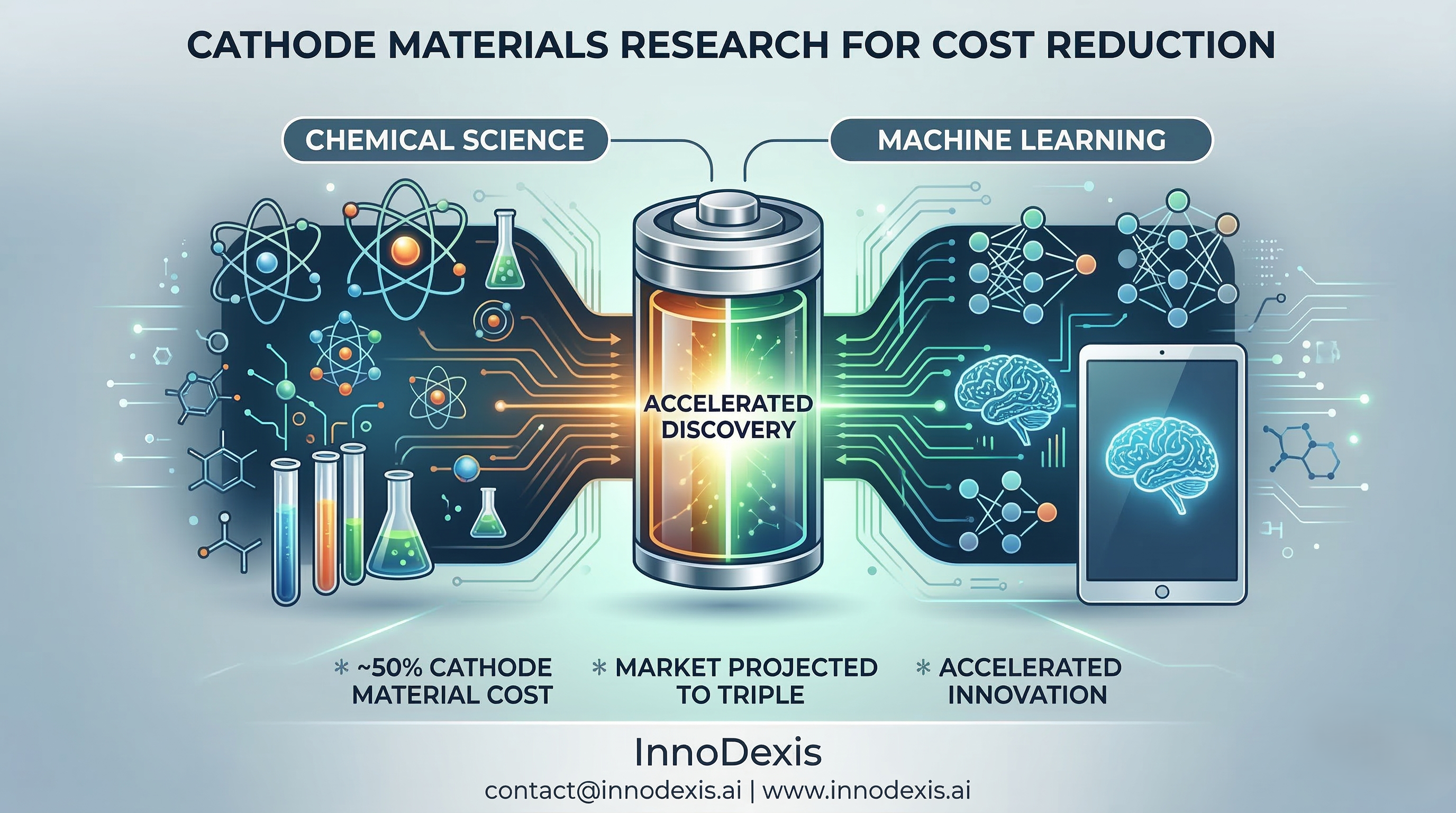
InnoDexis has published its latest Innovation Intelligence Report covering lithium-ion battery materials innovation, analyzing emerging research approaches aimed at accelerating cathode discovery and performance optimization. The report reveals that researchers at The University of Texas at Austin have developed a framework identifying three core chemical factors that determine oxide cathode performance. Given that cathodes account for roughly half of battery material costs, and materials represent about 75% of the total cost of lithium-ion batteries, the research highlights how advances in cathode chemistry could play a significant role in improving battery economics as global demand continues to expand.
Key Findings
Lithium-ion batteries remain the dominant energy storage technology powering applications ranging from electric vehicles to consumer electronics. Despite their widespread adoption, the cost structure of these batteries continues to be heavily influenced by materials, which account for approximately 75% of total battery cost.
Within the battery architecture, cathodes represent the most expensive material component. Research indicates that cathode materials alone account for roughly half of overall battery material costs, making them a central factor in determining battery affordability and scalability.
Researchers at The University of Texas at Austin have introduced a new framework designed to accelerate the discovery of improved oxide cathode materials. The approach identifies three key chemical parameters that influence cathode performance: electronic configuration, chemical bonding, and chemical reactivity.
The framework combines chemical science with machine learning to improve the efficiency of materials discovery. Rather than relying exclusively on artificial intelligence models, the methodology emphasizes human-guided machine learning, where scientific expertise and physics-based insights help generate high-quality experimental datasets for AI systems.
The economic context for such research is significant. The global lithium-ion battery market was valued at approximately $60 billion in 2024 and is projected to triple over the next decade. As demand expands across electric mobility and grid energy storage applications, advances in cathode materials could play an important role in improving battery performance and cost efficiency.
Strategic Insight and Trend Analysis
The development of new frameworks for cathode materials discovery reflects a broader shift in how battery innovation is being approached. Historically, improvements in lithium-ion battery technology have often relied on incremental optimization of known materials. However, the scale of demand associated with electric vehicles and renewable energy storage is increasing the need for accelerated materials discovery.
The research framework proposed by The University of Texas at Austin demonstrates an emerging hybrid model that integrates machine learning with domain-specific scientific knowledge. While artificial intelligence has become widely discussed as a tool for materials discovery, the framework emphasizes that algorithmic approaches alone may not produce optimal results without well-structured experimental datasets and underlying physical understanding.
By identifying electronic configuration, chemical bonding, and chemical reactivity as core determinants of oxide cathode performance, the framework provides a structured method for evaluating candidate materials. This approach may help researchers prioritize experimental exploration more efficiently while improving the predictive capabilities of machine learning models.
The combination of scientific intuition with computational modeling represents a growing trend in advanced materials research. Rather than replacing traditional laboratory science, machine learning systems are increasingly being used to complement and guide experimental processes. In the context of battery technology, this hybrid approach may accelerate the identification of materials capable of delivering improved safety, higher efficiency, and reduced reliance on critical minerals such as cobalt.
Global and Industry Implications
For corporates and R&D teams, advances in cathode materials research could influence both battery performance and long-term cost structures. As cathodes account for a large share of battery material expenses, improvements in cathode chemistry may support more efficient electric vehicle production and large-scale energy storage deployment.
For investors and capital allocators, the projected growth of the lithium-ion battery market—from $60 billion in 2024 with expectations to triple over the next decade—indicates expanding demand for technologies that can enhance battery performance or reduce material costs. Materials discovery frameworks that accelerate innovation may therefore represent an important area within energy storage investment.
For policymakers and national innovation bodies, improvements in cathode chemistry may also affect strategic supply chain considerations. Reducing dependence on critical minerals such as cobalt could influence long-term resource strategies and support more resilient battery manufacturing ecosystems.
InnoDexis Statement
“The research demonstrates how combining machine learning with domain-specific scientific expertise can create more effective pathways for advanced materials discovery in energy storage systems,” noted InnoDexis in its latest intelligence report.
Conclusion
The emergence of structured frameworks for cathode materials discovery reflects the growing importance of materials science in the evolution of lithium-ion batteries. As global demand for electric mobility and grid-scale storage continues to rise, advances in cathode chemistry may play a central role in determining battery performance, cost efficiency, and resource dependence. Hybrid approaches that integrate machine learning with experimental expertise may increasingly define the next phase of battery innovation.
The complete Lithium-Ion Battery Materials Innovation Intelligence Report is available to InnoDexis subscribers and enterprise clients.
About InnoDexis
InnoDexis is a global Innovation Intelligence platform that tracks, analyzes, and interprets breakthrough innovations, prototypes, and emerging technologies across industries and countries. Its intelligence helps corporates, investors, and policymakers understand the true structure and direction of global innovation. Learn more at innodexis.ai.