Blue Carbon Could Offset Up to 3% of Global Emissions as Majority of Countries Exclude It from Climate Reporting
A global analysis highlights that while blue carbon ecosystems offer measurable mitigation potential, limited policy integration and coordination frameworks are constraining large-scale deployment.
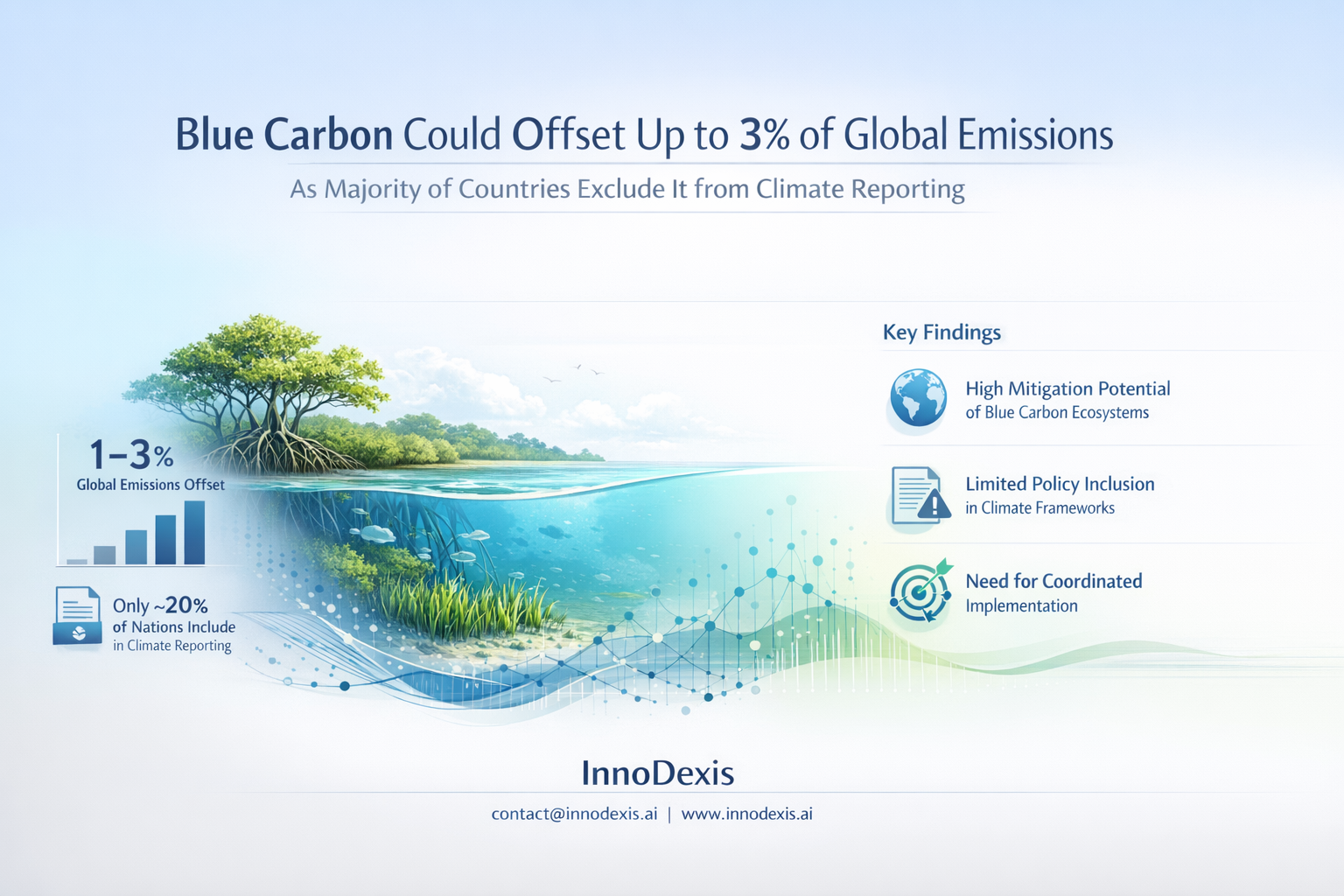
InnoDexis has published its latest Innovation Intelligence Report covering blue carbon and nature-based climate solutions, analyzing global research signals and policy alignment across multiple countries. The report reveals that blue carbon ecosystems could offset between 1–3% of global emissions, yet only around 20% of eligible countries currently include them in national climate reporting. Based on 116 expert inputs and identified research priorities, the findings point to a structural gap between scientific understanding and coordinated implementation at scale.
Key Findings
Blue carbon ecosystems, including coastal and marine environments, demonstrate the potential to offset an additional 1–3% of global emissions. This quantified mitigation capacity positions blue carbon as a complementary component within broader climate strategies, particularly in conjunction with emissions reduction efforts.
Despite this potential, only approximately 20% of eligible countries currently include blue carbon ecosystems in national climate reporting frameworks. This limited inclusion indicates a significant policy gap, where recognized environmental assets are not fully accounted for in formal climate commitments.
A structured global research effort identified 10 priority areas based on inputs from 116 experts. These priorities reflect a coordinated attempt to define the scientific, technical, and policy requirements necessary to advance blue carbon from research to implementation.
Persistent gaps remain across scientific validation, policy integration, and on-ground implementation. While foundational knowledge of ecosystem carbon capture exists, standardization, measurement methodologies, and integration into regulatory systems continue to lag.
The findings indicate that the primary constraint is no longer the identification of blue carbon potential, but the absence of aligned frameworks required to operationalize these ecosystems at scale. This reflects a shift from discovery-driven challenges to coordination-driven barriers.
Strategic Insight and Trend Analysis
The data indicates a transition in climate strategy from isolated carbon reduction approaches toward integrated, nature-based systems. Blue carbon ecosystems represent a category of climate solutions where scientific understanding has advanced to a stage that supports measurable contribution estimates, yet systemic integration remains incomplete.
The identification of 10 global research priorities suggests that the scientific community has moved toward structured problem definition. However, the continued exclusion of blue carbon from national reporting in approximately 80% of eligible countries highlights a disconnect between research outputs and policy adoption. This gap suggests that institutional alignment mechanisms have not evolved at the same pace as scientific insight.
The emergence of coordination as the primary constraint reflects a broader trend within climate innovation. Solutions with established technical validity are increasingly limited by cross-sector integration challenges, including governance structures, measurement standards, and economic alignment. Blue carbon exemplifies this pattern, where ecosystem-based mitigation requires simultaneous engagement across environmental science, policy frameworks, and local economic systems.
The shift from carbon reduction alone to incorporating nature-based infrastructure signals a redefinition of climate mitigation strategies. Rather than functioning as supplementary initiatives, ecosystems such as mangroves, seagrasses, and salt marshes are positioned as components of core climate infrastructure. This transition introduces new requirements for scalability, monitoring, and long-term integration into national and global systems.
Global and Industry Implications
For corporates and R&D teams, the findings indicate an emerging need to integrate nature-based solutions into sustainability and carbon management strategies. The absence of standardized frameworks presents both a challenge and an opportunity to participate in shaping implementation models and measurement systems.
For investors and capital allocators, the limited policy integration of blue carbon suggests that large-scale investment pathways remain underdeveloped. However, the quantified mitigation potential and defined research priorities indicate a future pipeline of investable opportunities as regulatory clarity improves.
For policymakers and national innovation bodies, the data highlights the importance of incorporating blue carbon into formal climate reporting and infrastructure planning. Expanding inclusion beyond the current ~20% of eligible countries will be critical to unlocking coordinated global impact.
InnoDexis Statement
“The findings indicate that blue carbon has progressed beyond a scientific discovery phase, with the primary barrier now centered on coordination across policy, measurement, and implementation systems required for large-scale integration,” noted InnoDexis in its latest intelligence report.
Conclusion
The global analysis of blue carbon ecosystems highlights a climate solution with defined potential but limited systemic integration. As nature-based approaches become increasingly central to climate strategies, the ability to operationalize these ecosystems at scale will depend on alignment across scientific, regulatory, and economic frameworks. The transition from pilot initiatives to infrastructure-level deployment remains a key development to monitor. The complete Blue Carbon Innovation Intelligence Report is available to InnoDexis subscribers and enterprise clients.
About InnoDexis
InnoDexis is a global Innovation Intelligence platform that tracks, analyzes, and interprets breakthrough innovations, prototypes, and emerging technologies across industries and countries. Its intelligence helps corporates, investors, and policymakers understand the true structure and direction of global innovation. Learn more at innodexis.ai.